
Reclaiming the Right to be Forgotten: A P2P Agent Approach to Digital Oblivion
A peer-to-peer agent community for digital oblivion in online social networks
The paper introduces a Peer-to-Peer (P2P) agent community design to provide "digital oblivion" (the right to be forgotten) on Online Social Networks (OSNs). By using a decentralized architecture of software agents, it allows users to filter out unwanted content—such as compromising photos or cyberbullying material—without requiring cooperation from OSN providers like Facebook.
TL;DR
The internet never forgets, but a new P2P agent community might help us ignore what shouldn't be there. This paper proposes a decentralized system where user-installed agents collaborate to "delete" (filter) offensive or unwanted content from online social networks (OSNs). By using a combination of perceptual hashing, watermarking, and trust management, the system empowers communities to enforce digital oblivion even when the OSN provider (like Facebook) fails to act.
Context: The Permanent Record Problem
Online Social Networks (OSNs) have transformed personal tragedies into permanent digital scars. The paper cites the heartbreaking case of Amanda Todd, a victim of cyberbullying who felt she could "never get that photo back." Current remedies are insufficient:
- Platform Dependency: You must wait for OSN administrators to approve removal.
- The Copy Problem: Once a photo is re-uploaded by others, the original uploader loses control.
- Legal Lag: Laws like the GDPR's "Right to be Forgotten" are difficult to enforce technically across global borders.
This research pivots from legal battles to technical autonomy, proposing a "virtual environment" where users take control of what they and their community see.
Methodology: Authenticating User-to-Content (U2C) Relations
The core innovation lies in how the system determines who has the right to "forget" a piece of content. The authors identify two critical relations:
1. Ownership (U2C R1): "I uploaded this."
To prove an image belongs to a user even after it's been copied and re-uploaded, the system uses:
- Perceptual Hashing: Unlike cryptographic hashes, these remain stable even if an image is slightly resized or compressed.
- Blind Watermarking: A digital signature is embedded into the pixels.
- Verification: When an agent sees an image, it extracts the signature and matches it against the perceptual hash. If they match, the "forget" request is authenticated.
2. Personal Presence (U2C R2): "I am in this photo."
This is harder to prove mathematically. The system uses social signals (tags) and trust management:
- If a user is tagged in an image, the agent uses that tag as evidence of the user's involvement.
- Because tags can be malicious, the community uses TrustComb functions to weigh the reputation of the requester against the reputation of the uploader.
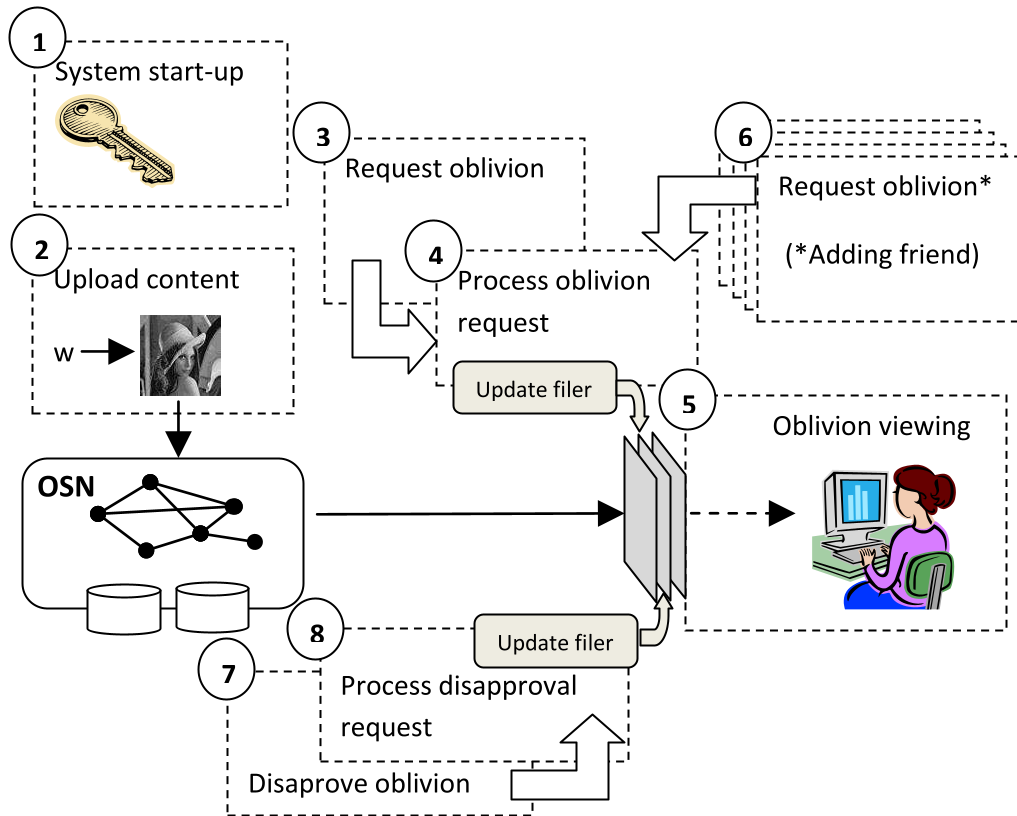 Figure 1: High-level overview of the P2P Agent Community and its interaction with the OSN.
Protocol Deep Dive
The system operates via a suite of 8 algorithms. The most critical for daily use is Algorithm 5 (Oblivion Viewing). Every time a user scrolls through their feed, the agent intercepts the content:
- It checks the content's serial number (from watermark) or perceptual hash.
- It compares these against a local Oblivion List (LO).
- If a match is found, the agent instructs the browser/app to hide the content.
Experimental Analysis & Feasibility
One might worry that a P2P agent would slow down the social media experience. However, the authors' performance analysis suggests the system is highly efficient:
| Operation | Frequency | Network Impact | Storage |
|---|---|---|---|
| Content Upload | Common | None (Local calculation) | Low |
| Filtering (Viewing) | Frequent | None (Instant local check) | Very Low |
| Adding Friends | Seldom | Syncs oblivion lists | Moderate |
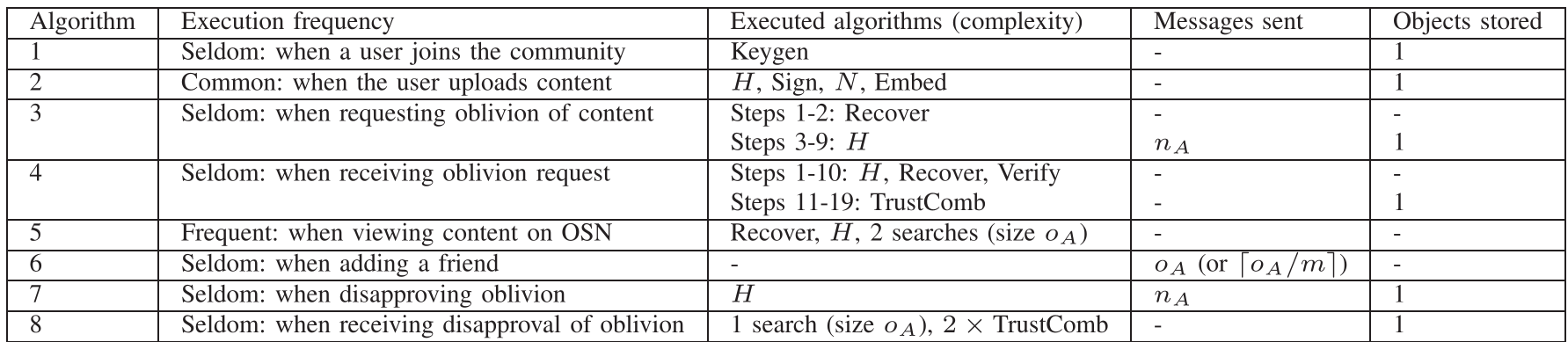 Table 1: Analysis of resource consumption and complexity for the protocol suite.
Critical Insight: The Ethics of Filtering
The paper acknowledges a "Conflict of Rights." If Person A wants a photo forgotten but Person B (also in the photo) wants it public, who wins? The authors adopt a Privacy-First policy: the request for oblivion always takes precedence. While controversial, this aligns with the urgent need to protect victims of harassment where the "harm of visibility" far outweighs the "utility of publication."
Conclusion & Limitations
This P2P approach offers a powerful, autonomous path toward digital oblivion. Its main limitation is the "Community Barrier": users not using the agent will still see the content. However, for a high school or a specific support group, this creates a "safe zone" where the harmful content simply ceases to exist.
Future work aims to integrate facial recognition and NLP semantics to automatically detect personal information without relying on OSN tags, further increasing the system's robustness against malicious platforms.