
PeopleCloud: Bridging the Gap Between the Wisdom of Crowds and Enterprise Processes
PeopleCloud Service for Enterprise Crowdsourcing
The paper introduces PeopleCloud, an on-demand service framework designed for enterprise crowdsourcing. It transitions crowdsourcing from isolated "open calls" to a structured service integrated with business processes, focusing on expert discovery, virtual team building, and seamless task management.
TL;DR
PeopleCloud is a specialized on-demand service system that transforms crowdsourcing from a chaotic "open call" into a disciplined enterprise tool. By integrating with existing business infrastructures, it enables the creation of scalable virtual teams to solve complex IT tasks while ensuring that the resulting knowledge is fed directly back into corporate databases.
Background Positioning: This work represents a crucial evolution in the crowdsourcing landscape—moving away from the "Human Intelligence Tasks" (HITs) of Mechanical Turk toward high-value, knowledge-intensive collaborative production within global organizations.
The "Disconnected Knowledge" Problem
Historically, enterprise knowledge has been scattered. When an expert leaves, their specific domain knowledge often vanishes. While Web 2.0 allowed companies to reach out to external crowds, these efforts remained decoupled from internal workflows.
The authors identify three fatal flaws in prior crowdsourcing attempts:
- Knowledge Loss: Solutions provided by the crowd are rarely re-integrated into the company's ticketing or knowledge management systems.
- Task Atomicity: Most platforms only handle trivial, isolated tasks, failing at complex "task bundles" that require sequential dependencies.
- Lack of Coordination: Existing models don't support the formation of virtual teams or provide mediation (facilitation) when disputes arise.
Methodology: The PeopleCloud Framework
The core of PeopleCloud is its ability to be "application-agnostic" yet deeply integrated. It achieves this through a structured interaction model.
1. The Interaction Model
Unlike simple bidding sites, PeopleCloud involves complex roles including Business Owners (for validation), Facilitators (for conflict mediation), and Collaborators (who form teams and divide work).
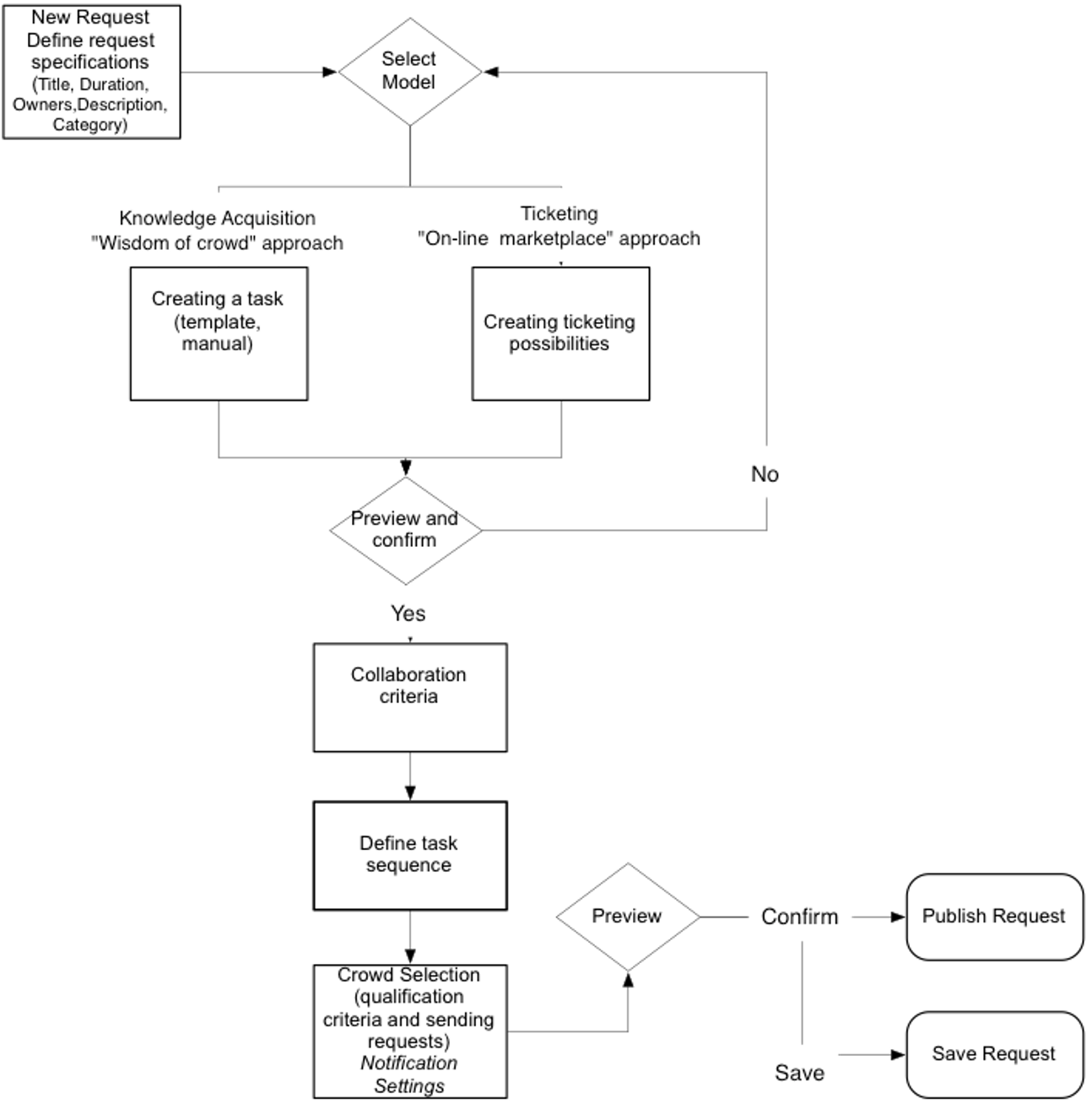
2. Dynamic Task Creation & Integration
Instead of manually typing out tasks, PeopleCloud can pull data directly from enterprise systems. For example, in an IT Support scenario, "tickets" from a helpdesk system are automatically converted into crowdsourcing tasks based on predefined filters (urgency, category, or cost).
3. Virtual Team Building & Proactive Discovery
One of the system's most powerful features is referral-based discovery. Using social network data and corporate hierarchies, PeopleCloud proactively suggests the right experts for a task, rather than waiting for them to find the task.
Experimental Use Cases: IT Service Delivery
The authors validated PeopleCloud through two distinct lenses:
- IT Inventory Management: This focused on "Knowledge Acquisition." Tiny snippets of data about servers and applications were crowdsourced from distributed owners across the globe to build a centralized repository.
- On-line Support Marketplace: This demonstrated the "Marketplace" model. Support tickets were pushed to a curated expert community where experts could collaborate or compete to solve technical issues.
Performance Comparison
When compared to industry standards like Mechanical Turk (MTurk) or Innocentive, PeopleCloud is the only system providing a complete suite of enterprise features:
 (Note: As seen in the table, PeopleCloud excels in Sequence Tasks, Collaboration, and Enterprise Integration where others fail.)
Critical Insight & Conclusion
The true value of PeopleCloud isn't just "accessing a crowd"—it's the management of human capital as a cloud service. By defining "People as a Service," organizations can treat human expertise with the same scalability and API-driven logic as they treat storage or compute power.
Takeaway for the Future: As we move into an era of remote, distributed work, the PeopleCloud model provides the blueprint for how companies will manage their "Liquid Workforce"—balancing the internal corporate hierarchy with the agility of the global on-line marketplace.
Limitations: The paper notes that legal challenges (taxation, compliance) and the complexity of incentive modeling remain significant hurdles for cross-border enterprise crowdsourcing.