
PeopleNet: Why "Swapping" Trumps "Spreading" in Virtual Social Networks
Peoplenet: engineering a wireless virtual social network
PeopleNet is a wireless virtual social network architecture that mimics human social information-seeking. It combines cellular infrastructure for long-range query routing to geographic "bazaars" with peer-to-peer (Bluetooth) propagation, achieving high-efficiency matching for location-specific information.
TL;DR
PeopleNet is an early 2000s architectural masterpiece that anticipated the need for hyper-local social search. By combining cellular routing with Bluetooth peer-to-peer exchange, it builds a distributed database where people are the data. Its most profound insight: in a world of limited device memory, spreading information like a virus (epidemic) is actually less effective than a calculated one-for-one swap.
The Core Intuition: People as the Database
Despite having Google in our pockets, we often find the best information—like the best pizza in a specific neighborhood or someone selling a last-minute concert ticket—by asking people. PeopleNet digitizes this "social navigation."
The architecture relies on two tiers:
- Fixed Infrastructure (Cellular): Routes your query (e.g., "Buying Red Sox tickets") to a specific geographic Bazaar (a sports-themed cluster of cells).
- Mobile Ad-hoc Network (Bluetooth): Once in the bazaar, the query hops between devices as people move, seeking a match.
The Methodology: Swap vs. Spread
The authors tackle a critical question in mobile computing: How should nodes share data when they meet?
1. Random Spread (Epidemic Model)
Nodes copy their data to others. While this sounds efficient, in a finite buffer system, a new copy forces the deletion of an old query. This creates high variance in query copies and often kills "rare" queries before they find a match.
2. Random Swap (The PeopleNet Choice)
Nodes exchange queries one-for-one. No new copies are made, but the query's spatial footprint changes. This ensures a constant lifetime for every query, maximizing the long-tail chance of a match.
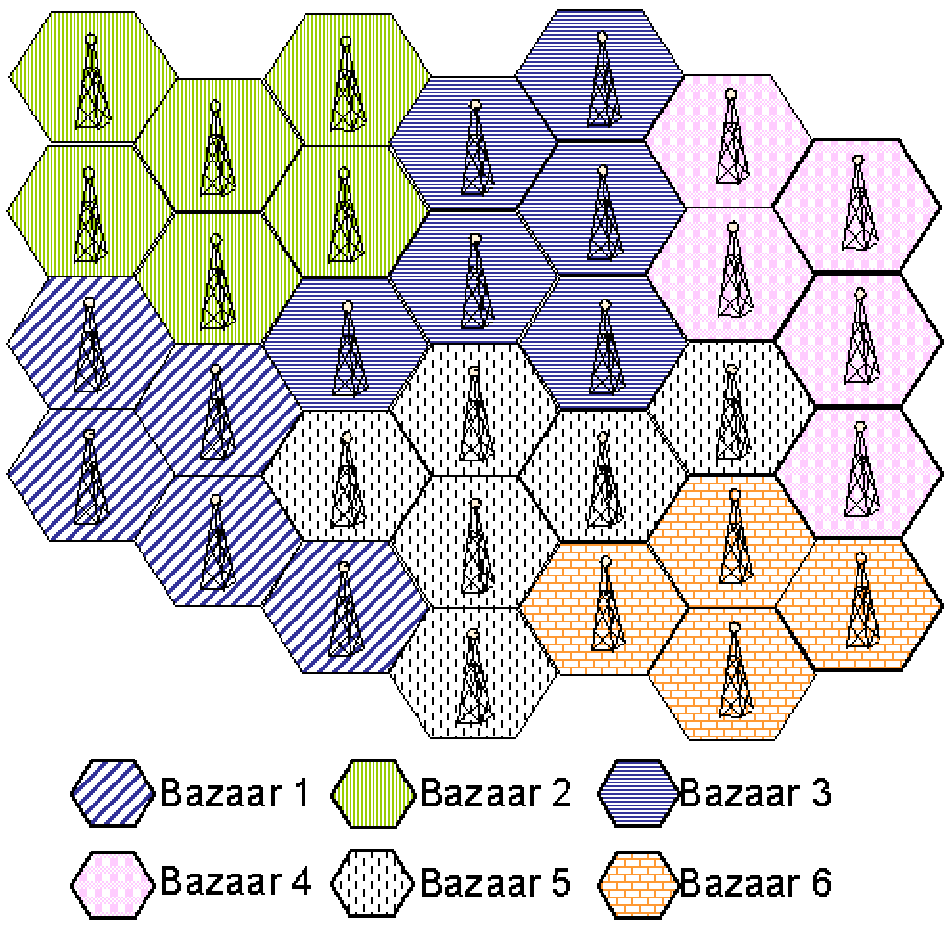 In PeopleNet, hexagonal cells are clustered into specialized Bazaars to localize search density.
The "Genie" and Smart Meta-Rank
The paper introduces a "Genie" analysis—an upper bound where nodes perfectly know each other's buffers. To bridge the gap between random swapping and the Genie, the authors propose Meta-Rank.
Before transferring large files (images/descriptions), nodes exchange tiny "meta-information" (query types). A greedy algorithm then prioritizes swapping queries that have the highest count in the other node's buffer, maximizing the total "reward" (matches) per encounter.
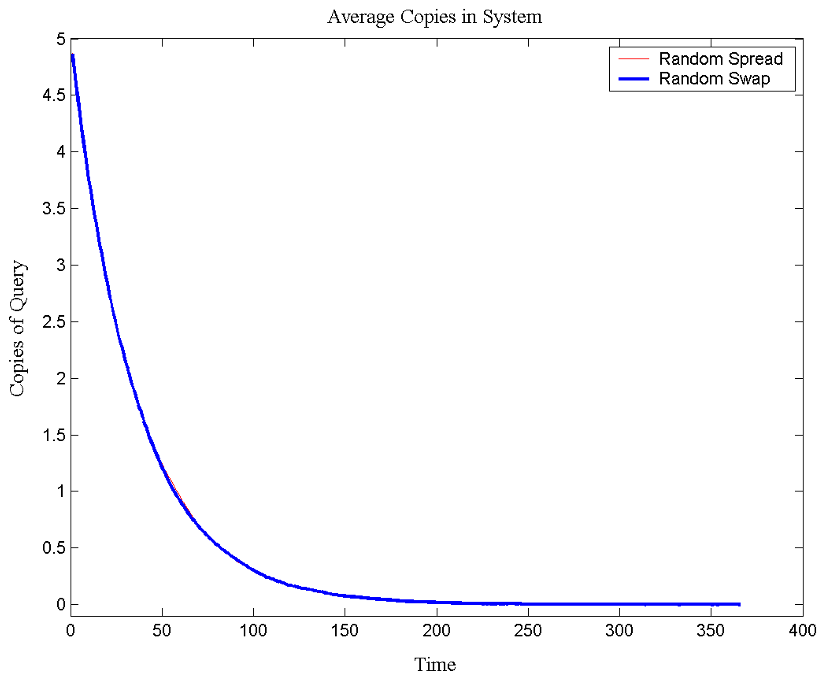 Simulation results comparing Random Swap vs. Spread. Note the significantly higher match probability for Swap as the system reaches steady state.
Performance Breakthroughs
The results validated the "Bazaar" concept. By shrinking the search space (targeting queries to specific regions), the matching probability and speed improved drastically.
| Metric | Random Swap | Smart Meta-Rank | Improvement |
|---|---|---|---|
| Match Probability | 0.73 | 0.85 | +16% |
| Time to Match | 250 units | 150 units | -40% |
| Number of Matches | 0.25 | 2.0 | 8x Increase |
Critical Insight & Future Outlook
PeopleNet proved that we don't need massive server farms to handle "perishable" local data. By leveraging human mobility, the network becomes a self-organizing entity.
Limitations: The model assumes altruistic behavior (nodes willing to swap). In a modern context, this would require blockchain-based incentives or carrier-led rewards. Furthermore, as Bluetooth evolved into Low Energy (BLE), the energy concerns cited in 2005 have lessened, making the "Meta-Rank" strategy even more viable for today's hyper-connected IoT environments.
Conclusion
PeopleNet stands as a seminal work in Delay Tolerant Networking (DTN). It reminds us that engineering for social contexts requires more than just raw bandwidth—it requires an understanding of human movement and the physical constraints of the devices we carry.