
The Pulse of Life in a Vial: Engineering the First Synthetic Peptide Oscillator
A Peptide-Based Oscillator
This paper introduces the first synthetic peptide-based oscillator by integrating coiled-coil peptide self-replication with controlled initiation and inhibition pathways. By operating in a Continuously Stirred Tank Reactor (CSTR), the system achieves sustained chemical oscillations, mimicking biological rhythmic behaviors such as circadian clocks.
TL;DR
Researchers have successfully designed the first autonomous peptide-based oscillator. By leveraging the self-replicating properties of coiled-coil proteins and balancing them with a "self-destruct" inhibition mechanism in a flow reactor, they created a system that "breathes" (oscillates in concentration) just like the molecular clocks found in living cells.
Background: Why Peptide Oscillators Move Us Closer to "Life"
Rhythmic behavior is a hallmark of life—from the beating of a heart to the 24-hour circadian rhythm. In the world of Systems Chemistry, creating a synthetic system that pulses on its own is a "holy grail." While we have seen oscillators made from DNA or simple inorganic chemicals (like the famous BZ reaction), peptides—the building blocks of enzymes—have remained stubbornly difficult to "rhythmatize."
This study bridges that gap, showing that peptides aren't just structural components; they can form dynamic networks capable of complex, time-dependent behavior.
The Problem: The "Death" of Batch Reactions
Most synthetic peptide replicators operate in "batch" (a closed vial). They start, they catalyze their own formation (positive feedback), and then they hit equilibrium. Once they reach the bottom of the energy hill, the reaction stops. To get a true heartbeat, you need:
- Energy Fueling: Continuous influx of reagents.
- Delayed Negative Feedback: A way to "turn off" the product after it reaches a peak, but with a delay so the peak can actually form.
Methodology: Designing the Peptide Heartbeat
The system relies on a coiled-coil peptide template (T). This template acts as a catalyst for its own creation from two smaller fragments (E and N).
1. The Initiation (The "Spark")
The nucleophile (N) is added as an inactive disulfide (N-N). A reducing agent (TCEP) "activates" it by breaking the disulfide bond, allowing it to start reacting.
2. High-Efficiency Replication (The "Pulse")
Once some product (T) is formed, it acts as a template, bringing E and N together in a coiled-coil structure to speed up the reaction. This is the positive feedback loop.
3. Inhibition (The "Brake")
The authors used two "brakes":
- Air Oxidation: Naturally turning the active thiols back into inactive disulfides.
- Chemical Sponges: Adding inhibitors like maleimide that permanently "eat" the active fragments.
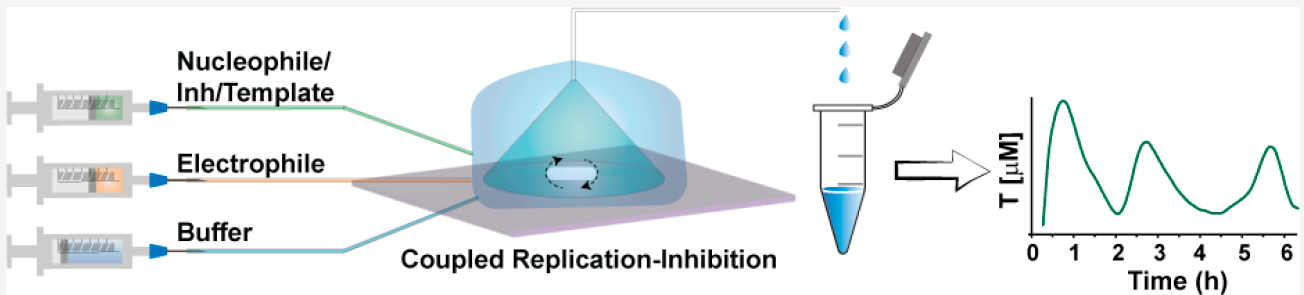 Scheme 1: The transition from simple replication (a) to a fully oscillatory network in a flow reactor (c).
Experimental Proof: Sustained Rhythms in CSTR
To prevent the system from dying out, the researchers used a Continuously Stirred Tank Reactor (CSTR). Fluids are pumped in and products are pumped out at a constant rate, keeping the system far from equilibrium.
Key Insights from the Data:
- Phase Inversion: When the concentration of the product (T) goes up, the concentration of the inactive precursor (N-N) goes down, and vice versa. This confirms the "oscillator" logic.
- Supramolecular Necessity: When the researchers added a denaturant (GnHCl) to break the peptide's 3D structure, the oscillations vanished. This proves that the physical shape (coiled-coil) of the peptide is what makes the chemistry happen fast enough to pulse.
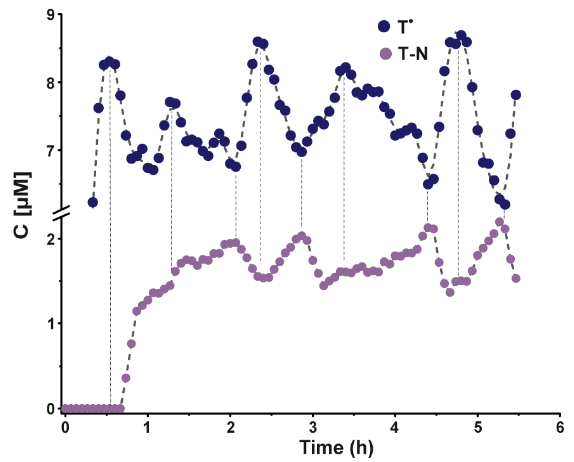 Figure 5: The "Heartbeat." Sustained oscillations of Product T seen over several hours under different flow conditions.
Critical Analysis: A Step Toward Synthetic Cells?
The achievement of the first peptide oscillator is a milestone. It proves that the "logic of life" can be programmed into peptides without the need for complex modern enzymes.
Limitations: The oscillations are currently "damped" (they lose strength over time) due to side reactions like the hydrolysis of the electrophile and the degradation of the fuel (TCEP) by oxygen. Achieving "indefinite" oscillation remains the next engineering hurdle.
Future Outlook: The authors suggest that we can now build oscillator networks where multiple "peptide pulses" compete for resources. This mimics the complexity of a real cell and offers a window into how "dumb" molecules might have evolved into "smart" biological systems.
Conclusion
By combining Native Chemical Ligation with the physics of supramolecular assembly, this research demonstrates that peptides are capable of autonomous, rhythmic behavior. It’s not just chemistry; it's a step toward building synthetic life from the bottom up.