
Beyond Utility: Decoding the Social and Experiential Value of Facebook
Understanding the perceived community value of Facebook users
2014-03-29
Summary
Problem
Method
Results
Takeaways
Abstract
This research develops a multidimensional model to investigate how social capital (structural, relational, and cognitive) influences user behavioral intentions on Facebook through perceived value. By surveying 402 university students, the study identifies that perceived value—spanning social, experiential, information, and transaction dimensions—is a key determinant of information sharing in Social Network Services (SNS).
## TL;DR
Why do we stay on social media? It isn't just about efficiency. This study reveals that **social capital**—the value we derive from our connections—is transformed into **perceived value** through the act of information sharing. While information and social status matter, the "Experiential Value" (the simple joy of a "Like" or a reply) is the true engine driving the Facebook ecosystem.
## The Motivation: Why Technology Models Fail SNS
Old-school IS (Information Systems) models are built on the "Utility" logic: *Does this tool help me work faster?* However, Facebook isn't a spreadsheet; it is a living community. The authors argue that to understand SNS, we must combine **Marketing** (Value) with **Sociology** (Social Capital). The core problem is that prior work focused too much on monetary costs, ignoring the rich emotional and social dividends users receive for their "free" labor of posting and sharing.
## Methodology: The Architecture of Digital Capital
The study breaks down the Facebook experience into a logical flow:
1. **Social Capital (The Input)**: Divided into Social Interaction Ties (Structural), Trust (Relational), and Shared Vision (Cognitive).
2. **Information Sharing (The Process)**: The active exchange of ideas and news.
3. **Perceived Value (The Output)**: Categorized into Information, Experiential, Social, and Transaction values.
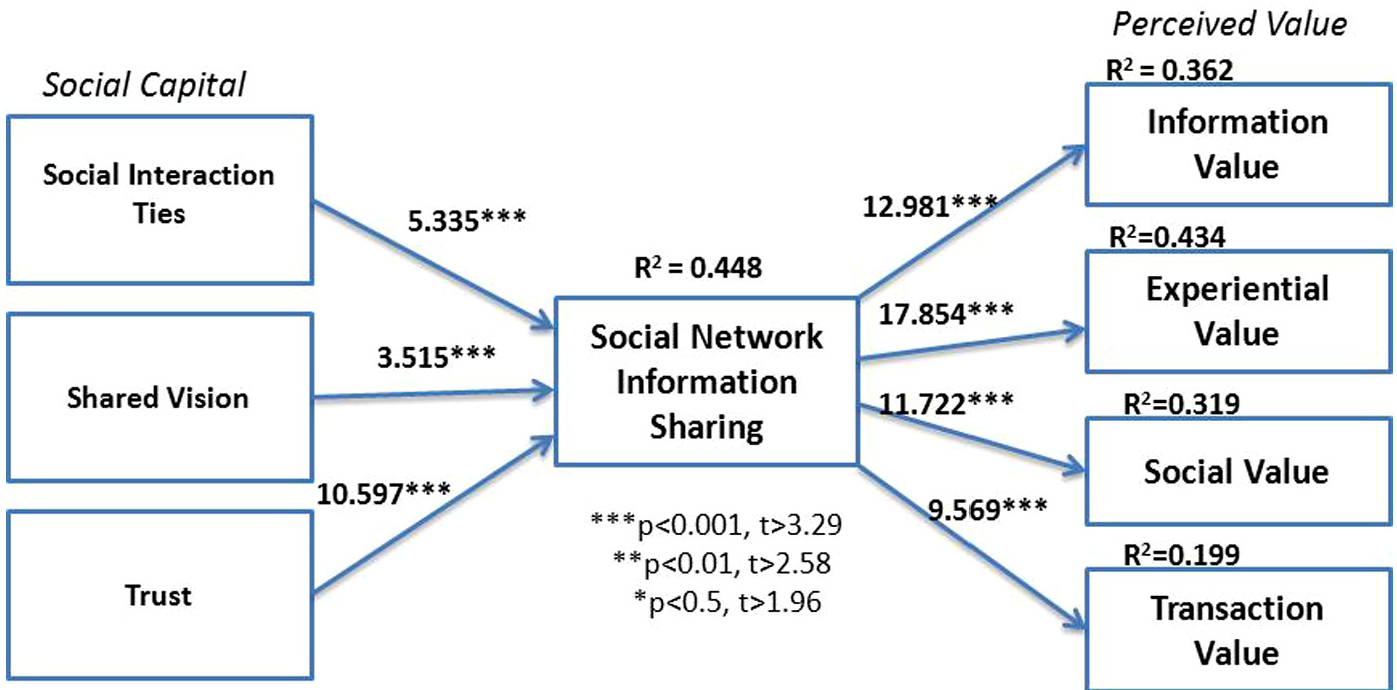
*Figure 1: The hypothesized path model linking Social Capital to Perceived Value.*
## Deep Dive: Why Trust and Experience Win
The empirical results from 402 participants reveal a fascinating hierarchy of needs within the digital space:
### 1. Trust is the Bedrock
Unlike the early anonymous internet, Facebook's real-name environment fosters a high degree of **Trust**. The study found that trust is the strongest predictor of whether a user is willing to share resources. Without the "Integrity" of the other party, the social capital remains locked and unused.
### 2. The Dominance of Emotional Fulfillment
The data shows that **Experiential Value**—the happiness and fulfillment felt when receiving feedback—is the most significant outcome. When you press the "Like" button, you aren't just acknowledging data; you are providing an "inner reward" to the sharer. This psychological loop is more powerful than the "Information Value" (learning something new).
### 3. The F-Commerce Gap
Interestingly, while **Transaction Value** (buying/selling via Facebook) was positive, it had the lowest explanatory power. This suggests that in 2014, users still viewed Facebook primarily as a social playground rather than a marketplace—a dynamic that has significantly shifted with the rise of modern Social Commerce.
## Key Experimental Results
The researchers used Factor Loading and AVE (Average Variance Extracted) to ensure their measurements were robust.
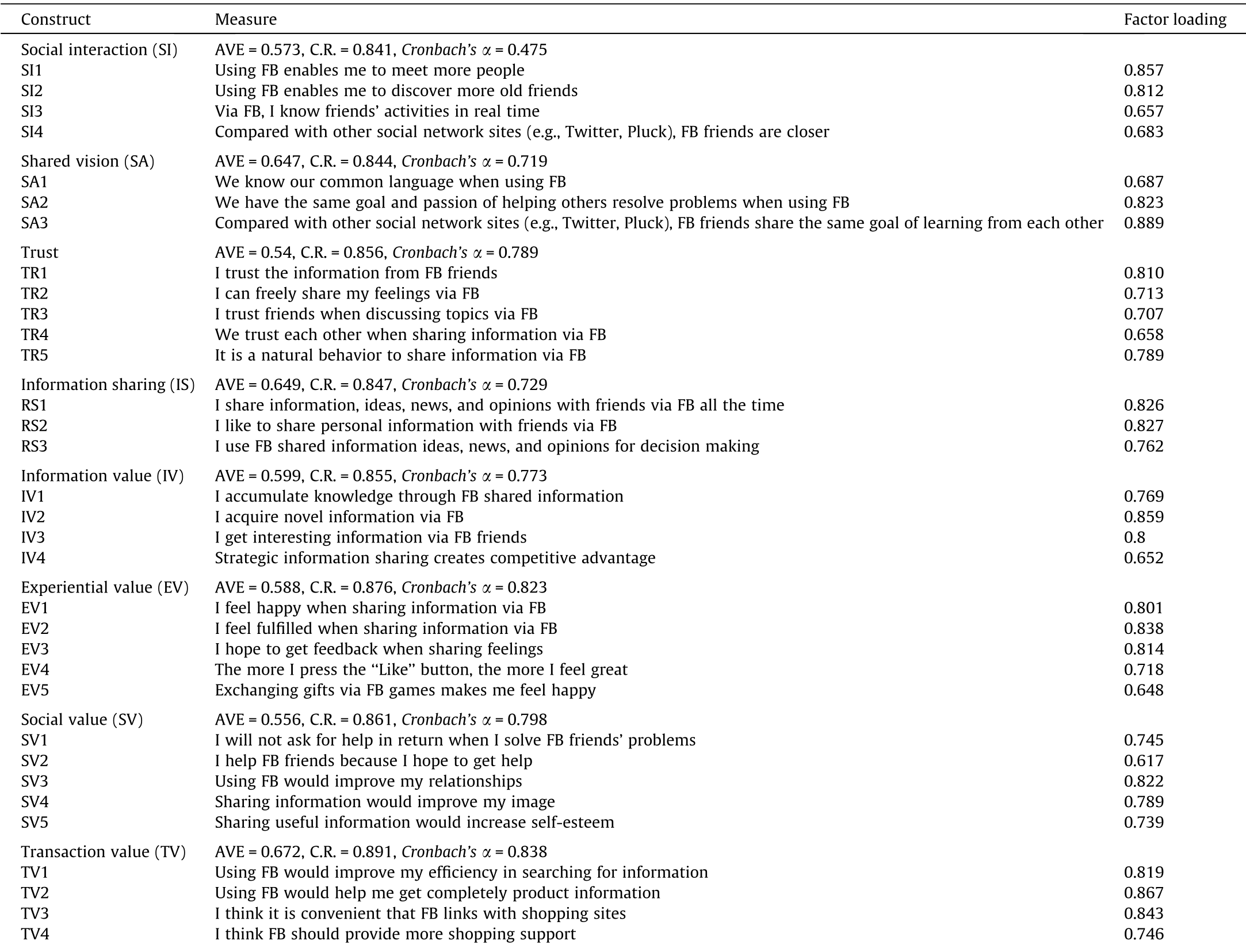
*Table 2: Construct measures showing high factor loadings for items like "acquiring novel information" (0.859) and "feeling happy when sharing" (0.801).*
## Critical Analysis & Conclusion
**The Takeaway**: If you are building a platform or a brand strategy, focus on the **Relational** and **Experiential** layers. People don't share content just to be helpful; they share it to build their self-image and feel an emotional connection.
**Limitations & Future Outlook**:
* **Age Bias**: 86.7% of the sample was aged 21-30. The "community value" for older demographics, who might use SNS for "wisdom sharing" rather than "playfulness," remains a fertile ground for future study.
* **Geographic Scope**: The study was localized to Taiwan (the world’s second-highest Facebook penetration at the time), suggesting that cultural nuances in communication (collectivism vs. individualism) might influence these results in other regions.
Ultimately, this work proves that in the digital age, **Social Capital is the currency, and Perceived Value is the profit.**