
The Internet Paradox: Why Digital Fluency Might Be Making You More Anxious About Your Career
The less you know, the better you'll sleep e Perceived job insecurity in the Internet age
This study investigates the longitudinal impact of Internet and digital tool usage on perceived job insecurity among 45,988 Israeli employees from 2003 to 2012. Utilizing Human Capital and Diffusion of Innovation theories, the researchers demonstrate that while general Internet access reduces job insecurity, specific digital behaviors like social media use and information seeking paradoxically increase it.
TL;DR
A decade-long study of nearly 46,000 employees reveals a striking contradiction: while having access to the Internet generally makes you feel more secure in your job, using it to "stay informed" or browse social media actually increases your fear of being fired. This "Information Paradox" suggests that while ICT is a vital part of modern human capital, the quality of digital content we consume often fuels economic pessimism.
The "First-Level" Shield and the "Second-Level" Trap
The research landscape of the digital divide has shifted. We are no longer just looking at who has a laptop (the first-level divide), but how they use it (the second-level divide).
The authors argue that Internet access functions as Human Capital. In the early 2000s, being "online" was a skill that protected workers. However, as the Internet reached a saturation point, its power to grant security diminished. The authors use the Diffusion of Innovation Theory to show that once everyone has a tool, it no longer serves as a competitive advantage.
Methodology: A Decade in the Israeli "Social Laboratory"
Israel provides a unique backdrop for this study due to its rapid ICT adoption and distinct socio-economic gaps between veteran Jews, Arab citizens, and new immigrants. The researchers analyzed data from 2003 to 2012, mapping the rise of the Internet against perceived job insecurity.
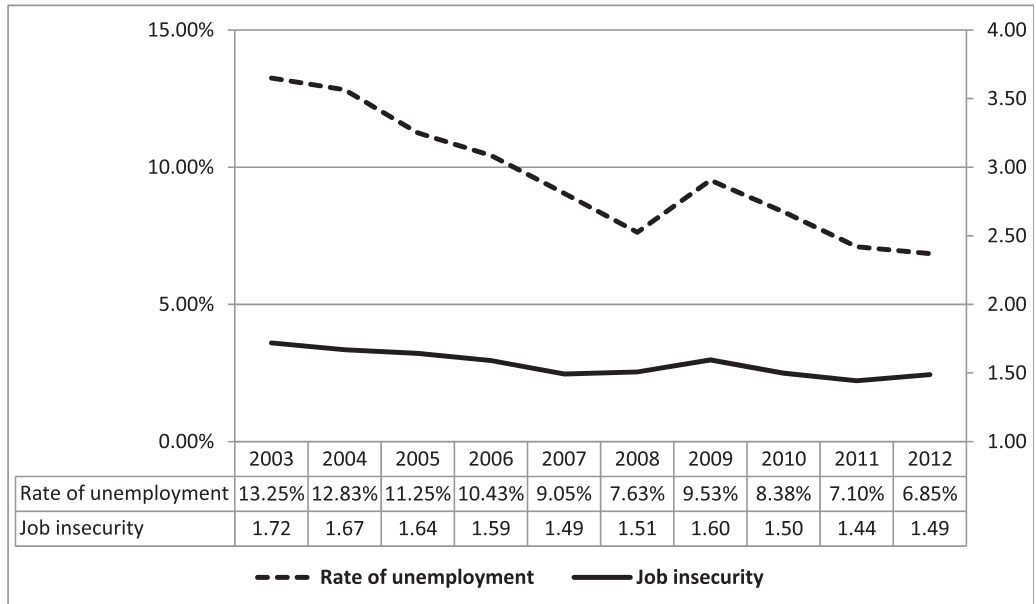 The graph demonstrates that while objective unemployment fell, the subjective "feeling" of insecurity followed a more complex trajectory, influenced by global crises like the 2008 recession.
Why the "Weakest" Gain the Most
One of the most profound insights of the paper is the application of the Maximally Maintained Inequality (MMI) hypothesis. It suggests that privileged groups (high-income, majority populations) benefit from new tech first until they hit "saturation."
Once the elite are fully connected, the relative gains for marginalized groups—in this case, Arab workers and low-income earners—become much larger. For these groups, the Internet isn't just a tool; it's a vital bridge to labor market information that was previously locked away in informal "old boys' networks."
The Dark Side: Why more information = more fear
The most counter-intuitive finding of the study is that seeking information and social media use correlate positively with job insecurity. If you are online trying to reduce your uncertainty (Uncertainty Reduction Theory), why do you end up feeling worse?
The authors point to two psychological mechanisms:
- Negative-Positive Asymmetry: Humans are hardwired to weigh "bad news" more heavily than "good news." A single LinkedIn post about layoffs carries more emotional weight than ten posts about hiring.
- Marketability of Drama: Social media algorithms prioritize high-arousal, threatening content because it generates more engagement.
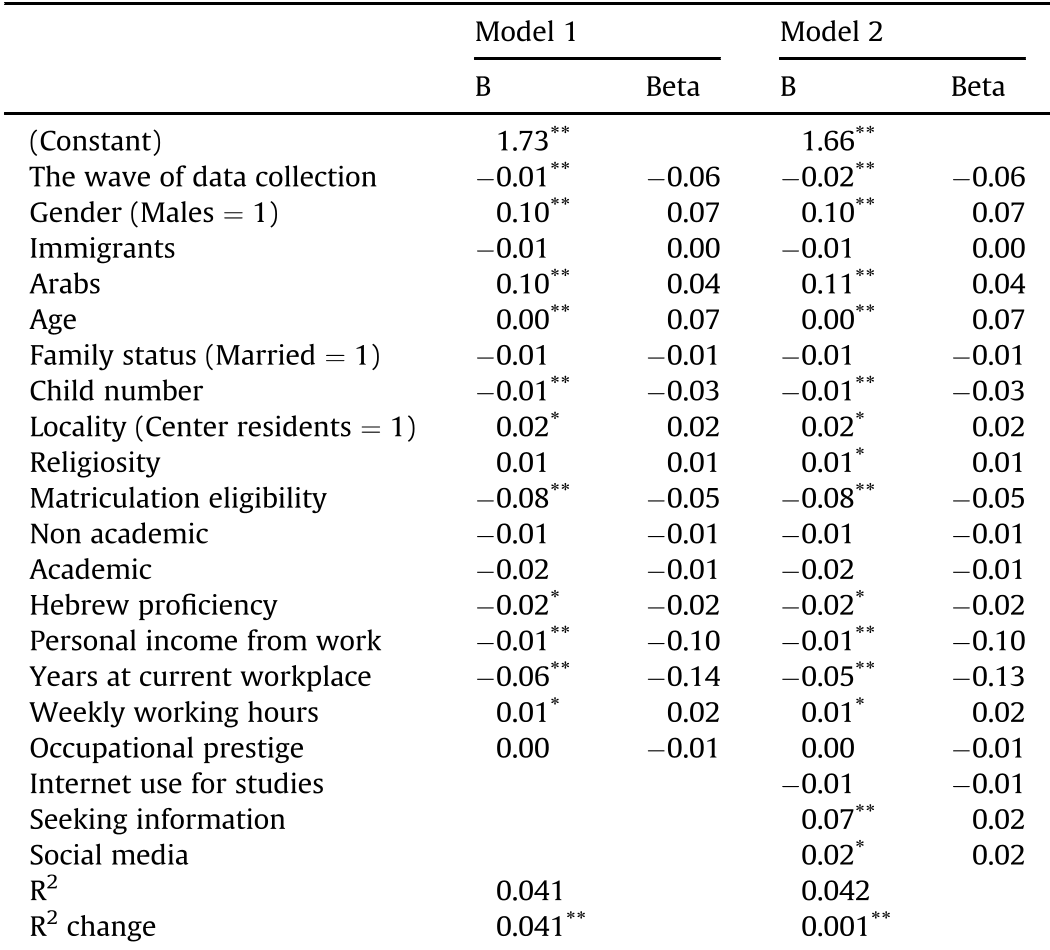 Regression results showing that while general Internet use (Model 2) predicts lower insecurity, specific acts of 'Seeking Information' and 'Social Media' usage move the needle in the opposite direction.
Deep Insight: Is It Causality or Correlation?
The authors handle a critical "chicken-and-egg" problem: Does social media make you insecure, or do insecure people flock to social media to find answers? Using Uncertainty Reduction Theory, the paper suggests it’s a vicious cycle. Those who feel a threat use "extractive strategies" (online searching) to find clarity, but the "bad news" bias of digital content only confirms their worst fears, leading to a state of chronic economic pessimism.
Conclusion & Future Outlook
The takeaway for the modern professional is clear: The less you know, the better you’ll sleep.
While technical digital literacy (knowing how to use the tools) is a prerequisite for security, "informational hygiene" is equally important. To survive the "Internet Age" without constant burnout or career anxiety, workers must recognize that the digital mirror often reflects a distorted, unnecessarily bleak version of the labor market.
Limitations: The study is cross-sectional, meaning it captures snapshots in time rather than following the same individuals over a decade. Future research should look at how the "AI Revolution" is currently mimicking these same patterns of initial fear followed by stratified adoption.