
The Privacy Illusion: Why AI Knows More About You Than You Think
Perceived Versus Actual Predictability of Personal Information in Social Networks
This paper investigates the gap between user perceptions of privacy and the actual inferability of personal information in Online Social Networks (OSNs). By analyzing a real-life dataset of 170 Facebook users, the authors evaluate machine learning techniques to predict 96 user attributes, benchmarking actual "predictability" against user-reported "sensitivity."
TL;DR
Can an algorithm guess your political views or health status just by looking at your Facebook "Likes"? This study proves that not only is the answer a resounding yes, but also that users are dangerously overconfident in their ability to keep sensitive information private. The more sensitive you think a piece of information is, the more likely you are to underestimate how easily AI can uncover it.
The Blind Spot of the Modern User
Most OSN (Online Social Network) users understand basic privacy: "If I don't post my phone number, no one has it." However, we have entered the era of inferred information.
The authors argue that current privacy models (like Westin's) are broken because they rely on access control. You can control who sees a post, but you cannot control what a machine learning model concludes from that post. This research bridges the gap between what users perceive as predictable versus what is actually extractable by today’s algorithms.
Methodology: Mining the Digital Footprint
The researchers collected a comprehensive multi-modal dataset from 170 participants, including:
- Likes: Binary vectors of 3,622 unique likes.
- Text: Bag-of-Words and Topic Modeling (LDA) from status updates.
- Images: Visual concepts extracted via Convolutional Neural Networks (CNNs).
Architecture and Learning Strategy
Unlike simple classification, this study treated user profiles as multi-label problems. By using Ensemble of Classifier Chains (ECC), the system doesn’t just look at features; it looks at correlations between attributes. For example, knowing someone's "Education Level" might improve the prediction of their "Income."
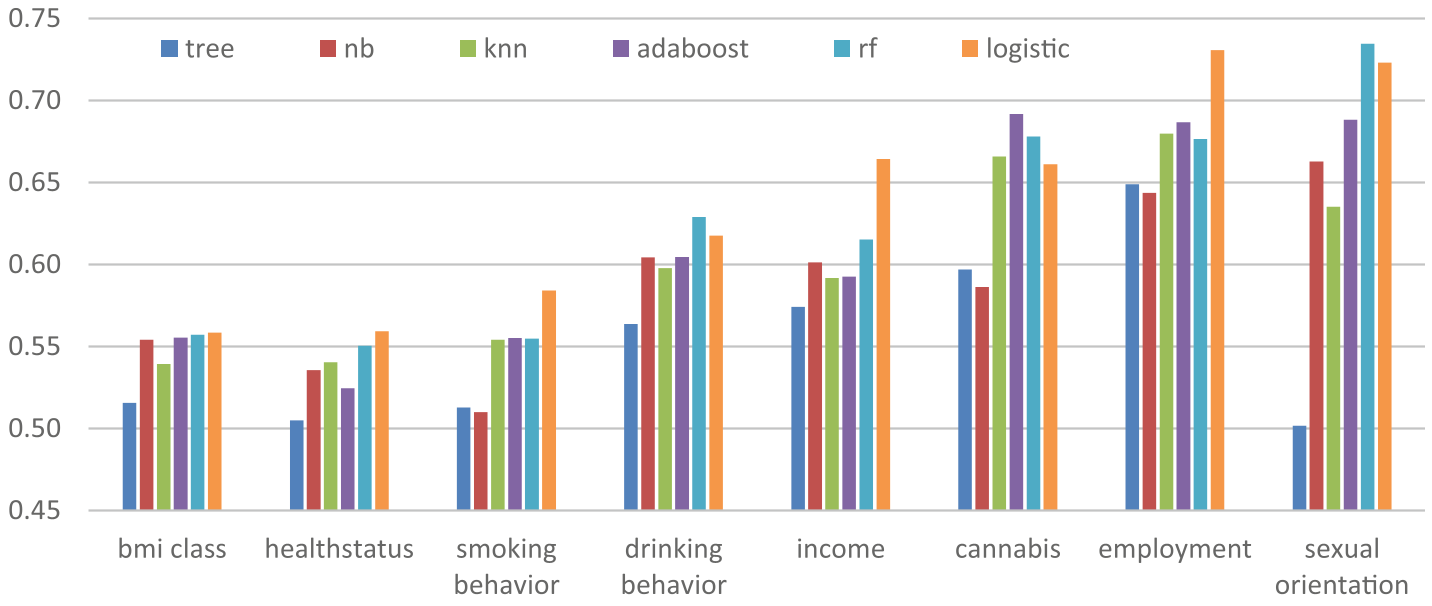 Figure 1: Comparison of different classifiers (Logistic Regression, Random Forest, etc.) across key target attributes.
Key Findings: The Sensitivity-Predictability Paradox
The experimental results led to several startling insights in the academic landscape of privacy:
- Likes are King: Facebook "Likes" remain the most potent predictor of personal traits, outperforming both textual posts and visual image content.
- The Underestimation Gap: Users are fairly accurate at judging the predictability of "Demographics" (Age, Gender). However, they are drastically wrong about "Political Beliefs" and "Health Factors."
- Inversion of Perception: There is a clear linear relationship where high sensitivity leads to lower perceived predictability. In reality, modern models bridge that gap easily.
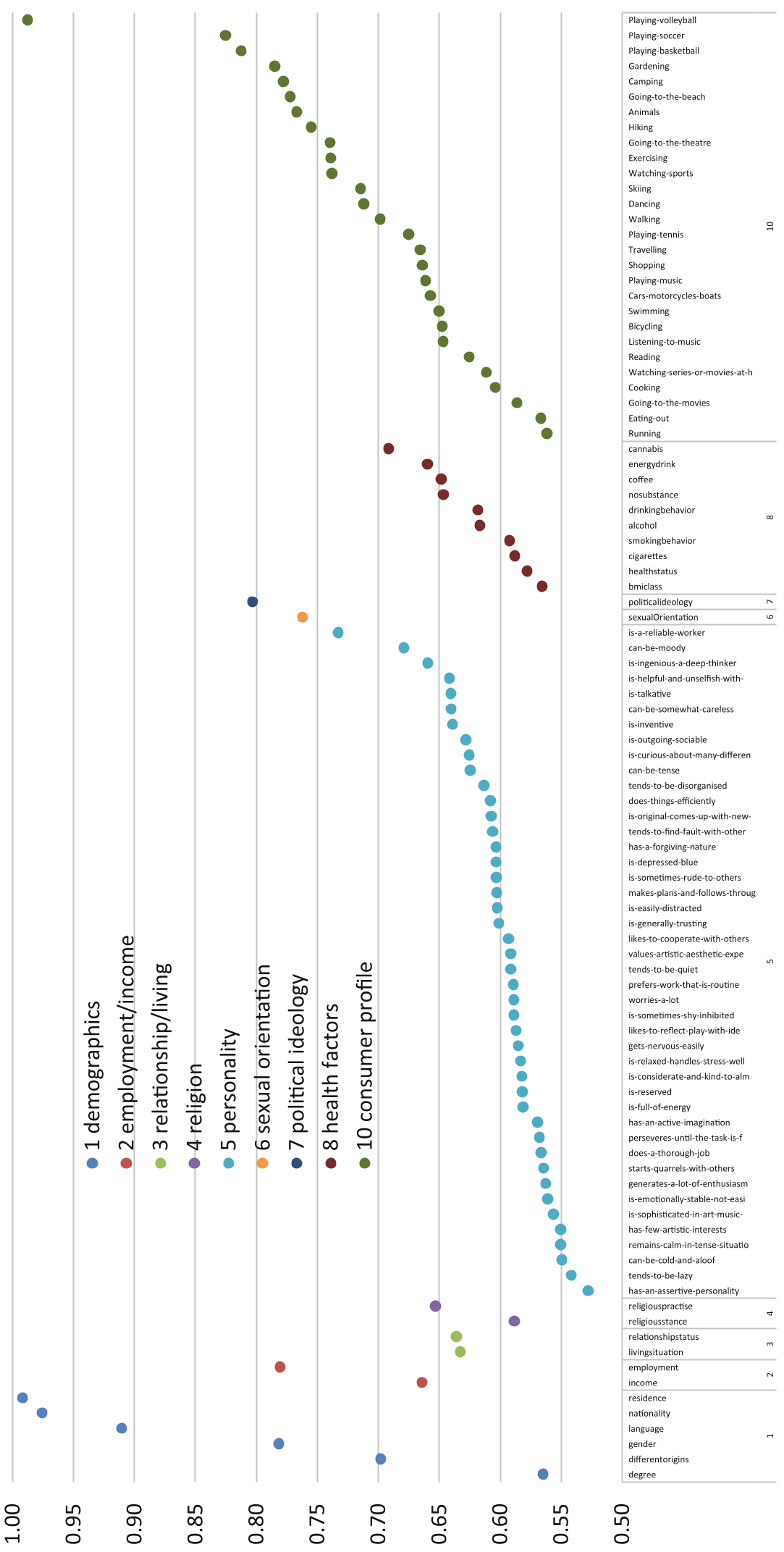 Figure 2: Best AUC achieved across various target attributes. Note the high performance in areas users often consider private.
Critical Analysis & Conclusion
The value of this paper lies in its psychological-technical crossover. It proves that "Privacy Paradox" isn't just about users being lazy with settings—it's about a fundamental lack of intuition regarding how high-dimensional data correlates.
Limitations
While the study is rigorous, the sample size (n=170) is relatively small for deep learning standards, and the data is limited to the Facebook ecosystem of that era. Furthermore, the AUC scores (avg 0.63) suggest that while AI is better than a random guess, it is not yet "omniscient."
Future Outlook
The study suggests the development of Privacy Assistance Tools. Imagine a browser extension that evaluates your "Like" button click in real-time and warns: "Warning: Clicking this increases the probability of an algorithm correctly guessing your religious affiliation by 15%." As AI moves from standard ML to LLMs, the "Actual Predictability" will only increase, making this research a vital early warning for digital sociology.
Takeaway: Your digital shadows are more revealing than the objects that cast them. Control over data access is no longer enough; we need control over data inference.