
From Perception to Action: Mapping the Frontier of Spatial AI Agents
From Perception to Action: Spatial AI Agents and World Models
This survey establishes a unified three-axis taxonomy for "Spatial AI Agents," integrating Agentic AI capabilities (Memory, Planning, Tool Use) with Spatial Intelligence tasks (Navigation, Manipulation, Geospatial Analysis) across Micro, Meso, and Macro scales. It synthesizes insights from 742 cited works to provide a foundational roadmap for autonomous systems that ground symbolic reasoning in physical geometry.
TL;DR
The next frontier of AI isn't just "smarter" chat—it's agents that can move, grasp, and reason across physical space. This seminal survey by AtlasPro AI researchers introduces a Unified Three-Axis Taxonomy that connects Agentic AI (the "brain") with Spatial Intelligence (the "body"). By analyzing 742 papers, the authors reveal that while LLMs are great at talking about the world, they lack the Spatial Grounding—the metric understanding of physics and geometry—required to actually function in it.
Core Insight: Perception does not confer agency. Describing a cup isn't the same as knowing how to reach for it without knocking it over.
The Problem: The Symbolic vs. Spatial Gap
Modern LLMs suffer from "spatial hallucinations." They can explain the concept of a "kitchen" but fail to navigate one because they lack an internal model of 3D structure. The authors distinguish between:
- Symbolic Grounding: Associating images with text (what CLIP does).
- Spatial Grounding: Understanding metric geometry, contact forces, and the physical consequences of actions.
Current systems are fragmented. Navigation experts don't talk to manipulation experts, and both ignore planetary-scale geospatial reasoning.
The Unified Taxonomy: A New Design Space
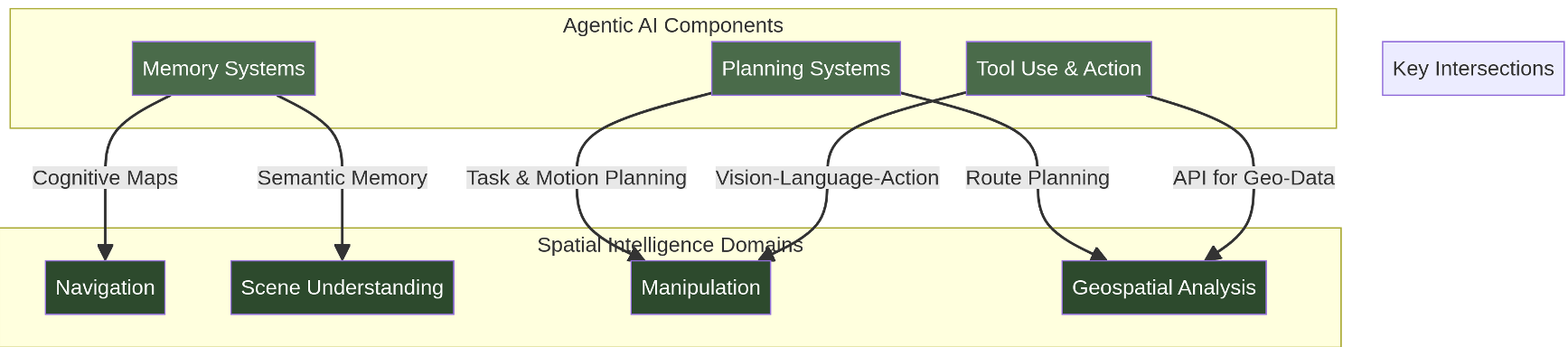
The paper organizes the field into three critical axes. Every agentic system can be placed at an intersection of these three:
- Task Axis: Navigation, Scene Understanding, Manipulation, and Geospatial Analysis.
- Capability Axis: Memory (how it remembers), Planning (how it decides), and Tool Use/Action (how it executes).
- Scale Axis: Micro (<1m), Meso (1m-100m), and Macro (>100m).
Enabling Technologies: The Pillars of Agency
The paper identifies three technologies that are bridging the gap between digital tokens and physical reality:
1. Relational Reasoning via GNNs
Transformers treat space as an unordered set of tokens. Graphs allow agents to explicitly model relationships (e.g., "the cup is on the table"). Integrating GNNs with LLMs allows the graph to act as an externalized spatial memory.
2. World Models: Predicting the Playbook
To act safely, an agent must "imagine" the future. World models like DreamerV3 or Genie learn latent dynamics—predicting how a scene will change before the robot even moves.
Intuition Equation: This represents the agent simulating the next state () based on its current state and a potential action.
3. VLA Models: The End-to-End Bridge
Vision-Language-Action (VLA) models like RT-2 or OpenVLA translate web-scale semantic knowledge into low-level motor commands, allowing a robot to follow instructions like "pick up the extinct animal" by reasoning that it needs to grab the toy dinosaur.
Critical Analysis: What's Missing?
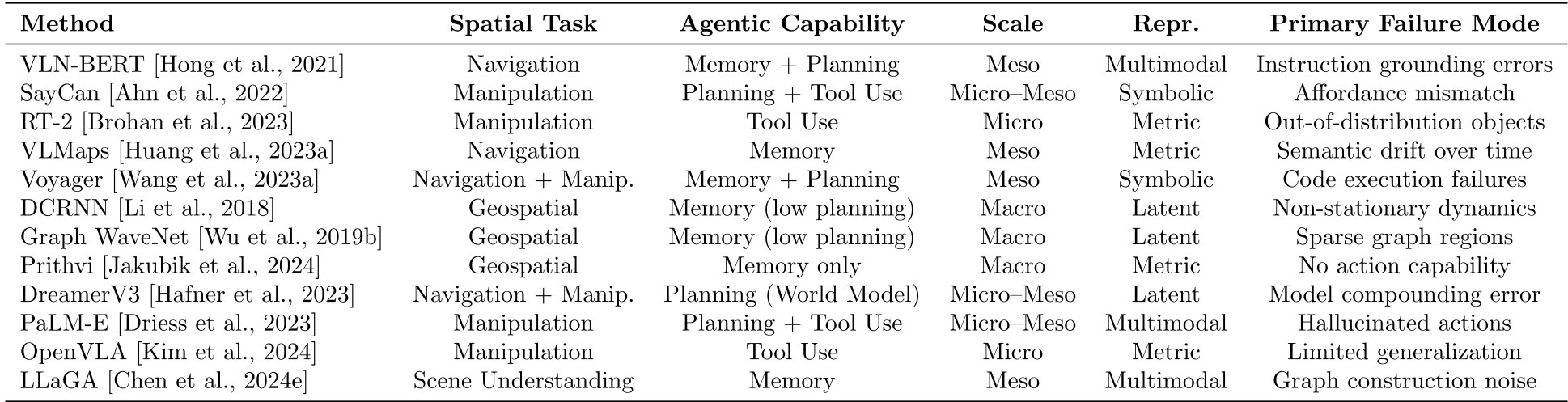
The survey is brutally honest about the field's current failures. The "Primary Failure Modes" (Table 2) show that even SOTA models like SayCan fail due to "affordance mismatch," and RT-2 struggles with out-of-distribution objects.
The Benchmarking Crisis: Most benchmarks (Habitat, R2R) operate in simulation. The authors note that RT-1’s success rate drops from 97% in sim to 68% on real robots. We lack a "SpatialAgentBench" that tests:
- Cross-Scale Reasoning: A single task that requires navigating a city (Macro) to find a house (Meso) and pick up a key (Micro).
- Long-Horizon Planning: Tasks that last hours, not seconds.
The Six Grand Challenges for 2026 and Beyond
- Unified Representation: One model that understands both "atoms" (grasping) and "infrastructure" (urban planning).
- Grounded Planning: Moving beyond CoT to plans that are actually geometrically feasible.
- Safety Guarantees: Formal verification so a robot doesn't "hallucinate" a path through a human.
- Sim-to-Real: Closing the physics gap.
- Multi-Agent Coordination: Scaling to thousands of agents with limited communication.
- Edge Deployment: Running these massive models on the robot's local hardware without "brain lag."
Final Takeaway
The era of passive AI is ending. The future belongs to "Spatially Aware" agents. This paper provides the first comprehensive map to that future, arguing that the "bitter lesson" of simply scaling more data won't work for physics—we need architectures that respect the structural discipline of the 3D world.