
Decoding Digital Masks: How Culture Shapes Social Perception Online
The Perception of Cultural Differences in Online Self-presentation
This study investigates how cultural differences influence online self-presentation and social perception on social networking platforms. By manipulating the "Blog Style" and "Physical Appearance" of virtual personae (British vs. Chinese), the researchers demonstrate that cultural cues significantly trigger stereotypes and affect interpersonal attraction.
TL;DR
In the digital world, "who you are" is often reduced to a profile picture and a few blog posts. This study reveals that these small cues are powerful triggers for cultural templates. British and Chinese users interpret the same online behaviors through fundamentally different lenses—where one sees "competence," the other might see a "lack of caring."
The Problem: Lost in Digital Translation
When we meet offline, we rely on a symphony of non-verbal cues—gestures, tone, and immediate feedback. Online, we are "cued-filtered." We rely on "small cues" (status updates, profile names, photos) to fill in the blanks of a stranger's personality.
The authors argue that this process is fraught with danger in cross-cultural encounters. If a British user (Low-Context/Independent) encounters a Chinese user (High-Context/Interdependent) on a platform designed with Western biases, the "anticipation of effect" is often inaccurate. The presenter thinks they are being "respectful," while the receiver perceives them as "indirect" or "evasive."
Methodology: The 7-Dimensional Cultural Framework
To test how these perceptions shift, the researchers constructed four virtual personae by crossing two types of Blog Styles (British vs. Chinese) with two types of Physical Appearances (Caucasian vs. Asian).
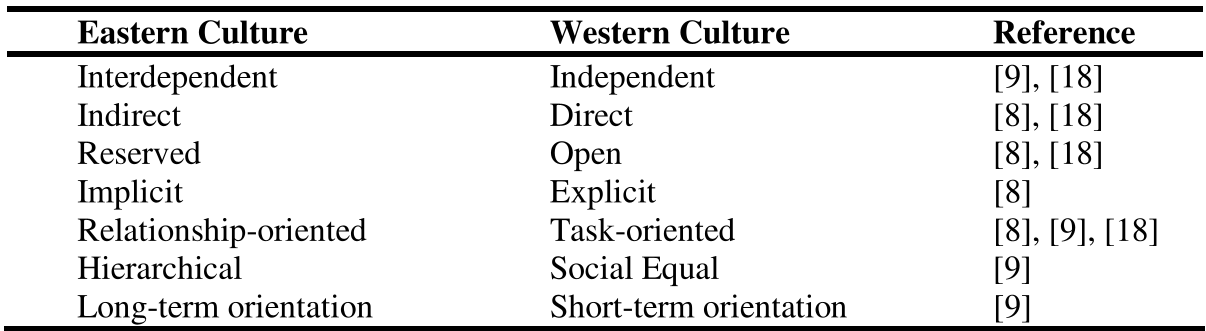
The "Cultural DNA" of these blogs was built on seven validated dimensions:
- Self-Construal: Independent vs. Interdependent
- Communication Style: Direct vs. Indirect
- Context: Low vs. High
- Power Distance: Social Equal vs. Hierarchical
Core Findings: The Perception Gap
The experiment yielded several "Aha!" moments that challenge simple assumptions about online attraction.
1. The "Competence" vs. "Caring" Trade-off
There was a stark contrast in what defined a "good" profile. For British participants, an Independent blog style (focusing on inner thoughts and directness) was the hallmark of Competence.
For Chinese participants, however, the Interdependent style (focusing on roles, relationships, and self-criticism) made a persona significantly more Socially Attractive and Caring. In fact, Chinese participants saw "Competent" (Independent) personae as less socially attractive—a direct reflection of the cultural value placed on group harmony over individual ego.
2. The Power of Incongruence
One of the most fascinating results involved "Incongruent" profiles—such as a Chinese face paired with a British blog style.
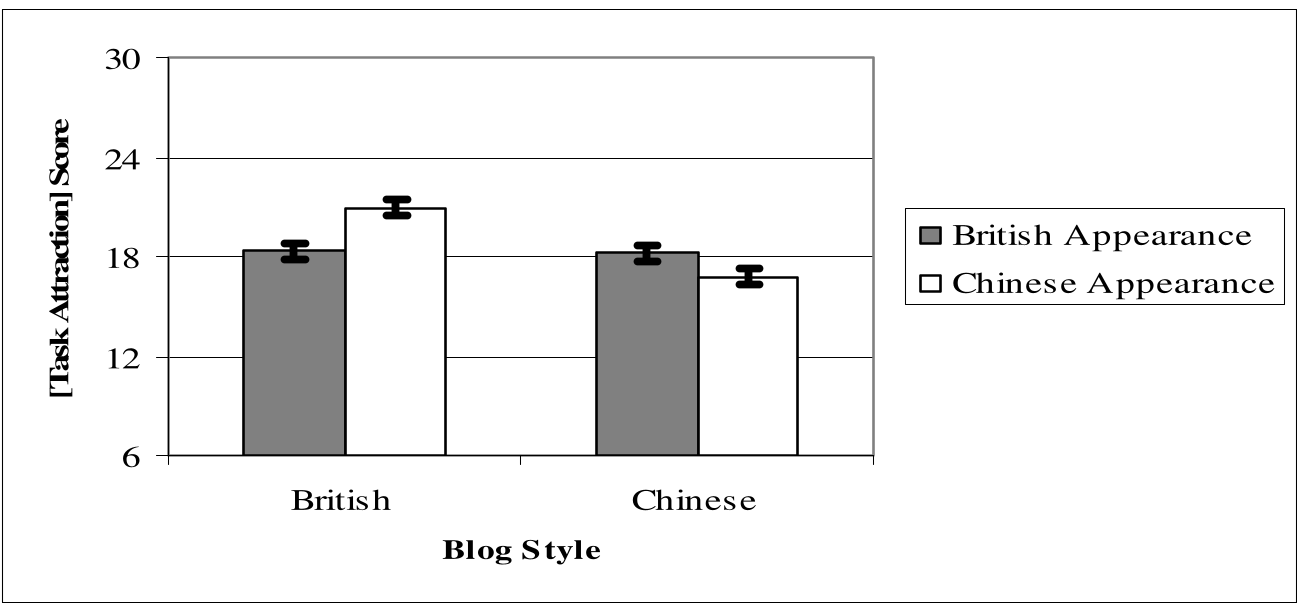
Contrary to Hypothesis 3 (which predicted people prefer consistency), the incongruent persona (Asian face + British blog) received the highest ratings for Task Attraction. The authors hypothesize that participants applied a "British-Born Chinese" (BBC) stereotype—viewing the individual as a high-achieving "best of both worlds" student.
Depth Insight: High vs. Low Context Platforms
The study highlights that British participants tended to ignore verbal cues more than Chinese participants when judging origin, whereas Chinese participants were much more sensitive to the content of the writing.
This aligns with Hall’s High/Low Context theory:
- Western (Low-Context): Communication must be explicit. If the text says "I am British," the appearance is secondary.
- Eastern (High-Context): The meaning is in the relationship between the text and the context (the face, the tone, the implicit hierarchy).
Critical Analysis & Conclusion
Takeaway
Self-presentation is not a universal language. A platform's "standard" UI (like the layout of Facebook or Windows Live Spaces) acts as a hidden curator of cultural values.
Limitations
The study used a student population in the UK. The Chinese participants, having lived in the UK, were likely "bicultural" to some extent, which might have dampened the results. A "pure" cross-cultural study between users residing in their home countries might show even more drastic divergence.
Future Outlook
As we move toward a Metaverse or AI-driven social ecosystems, "Digital Cultural Competence" will become a core feature. Imagine a platform that "nudges" you: "Your tone might be perceived as overly blunt by users from X culture." Or perhaps, a system that allows for more "Interdependent" profile layouts (emphasizing groups and mentors) rather than just the "Independent" wall of personal achievements.
Source Reference: Jiang, Y., de Bruijn, O., & De Angeli, A. (2026). The Perception of Cultural Differences in Online Self-presentation.