
Perceptual Computing: Enabling Human-Centric Queries in Massive Social Networks
Perceptual computing in social networks
The paper introduces a computationally efficient framework for Perceptual Computing in large-scale social networks by representing node attributes and relationship strengths as words modeled by Interval Type-2 (IT2) fuzzy sets. By leveraging the Linguistic Weighted Power Mean (LWPM) and pre-computation strategies, it achieves feasible on-the-fly querying in complex relational environments.
TL;DR
Quantifying social relationships with precise numbers (e.g., "Relationship Strength = 0.732") is often an arbitrary and fragile practice. This paper proposes a transition to Perceptual Computing, where networks are built using words like "Strong," "Casual," or "Very High Net Worth." By representing these words as Interval Type-2 (IT2) Fuzzy Sets and employing a clever pre-computation strategy, the authors enable sophisticated, human-like querying at scale without the typical computational overhead of fuzzy logic.
Background: The Precision Paradox
In social network analysis, we often force "crisp" values onto inherently "fuzzy" human concepts. As the paper points out, a person's age or net worth changes daily, but our human interpretation of them—"Early Middle-Aged" or "High Networth"—is remarkably stable. Previous attempts to use Fuzzy Sets (Type-1) helped, but they couldn't capture the uncertainty about the uncertainty (inter-personal differences in what "tall" means). Interval Type-2 fuzzy sets solve this but are traditionally too slow for large-scale graphs.
Methodology: High-Order Reasoning via LWPM
The core innovation lies in the use of the Linguistic Weighted Power Mean (LWPM). Unlike standard min/max operators, LWPM allows for a spectrum of logical conjunction.
1. The Power Mean Generalization
The authors redefine path strength and attribute aggregation using:
By tuning , the system can behave as a strict AND (min), a lenient OR (max), or an arithmetic average. This provides the mathematical flexibility to model complex human requirements, such as "Mandatory" vs. "Desirable" traits.
2. Overcoming the "Computational Tax"
To make this feasible for large networks, the author proposes:
- Vocabulary-Based Pre-computation: If you have a 7-word vocabulary, the combinations of node interactions are finite. The authors pre-calculate the results of these interactions and store them as lookup tables.
- Granular Decoding: To prevent fuzzy sets from becoming "blurry" or too broad after multiple hops (recursive compositions), the system maps the result back to the closest word in the original vocabulary using Jaccard similarity.
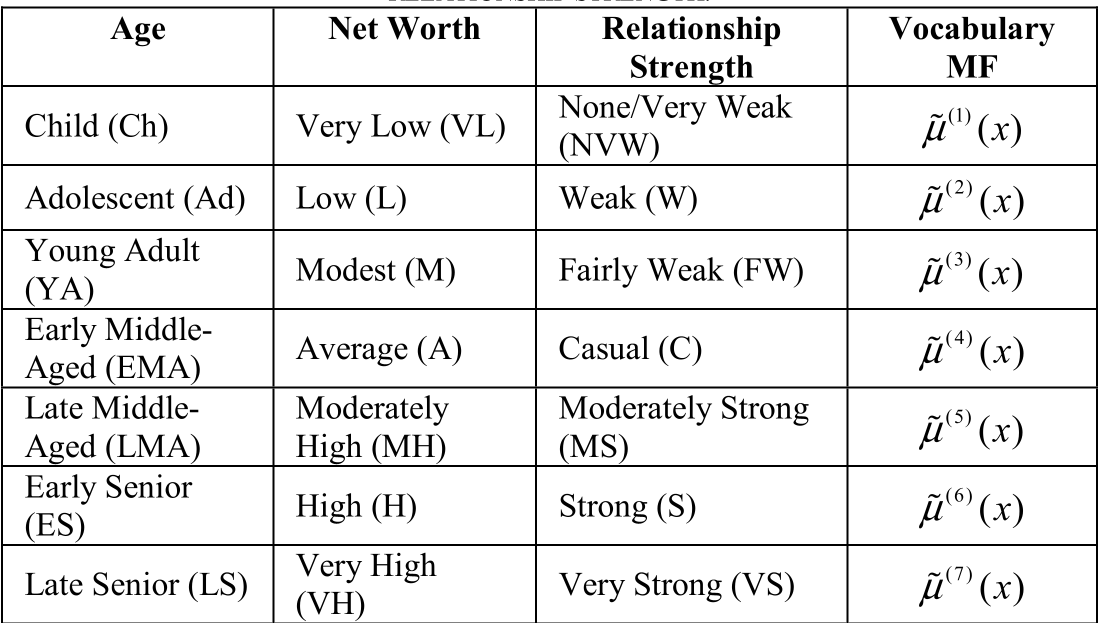 Table 1: Example Vocabularies for Age, Net Worth, and Relationship Strength.
Experiments: Finding the Perfect Investor
The paper illustrates the approach through a business scenario: An entrepreneur (Node 1) seeks "Strong connections" to "High Net Worth" (HNW) individuals.
Across a 6-node network sample, the system evaluates both direct and indirect paths.
- Finding 1: Direct connections might be weak (e.g., Node 1 to Node 4 has a satisfaction of only 0.258).
- Finding 2: By calculating -fold compositions (multi-hop paths), the system discovers that Node 1 can reach a "Very Strong" candidate (Node 6) through an intermediary (Node 3), resulting in a high criterion satisfaction of 0.85.
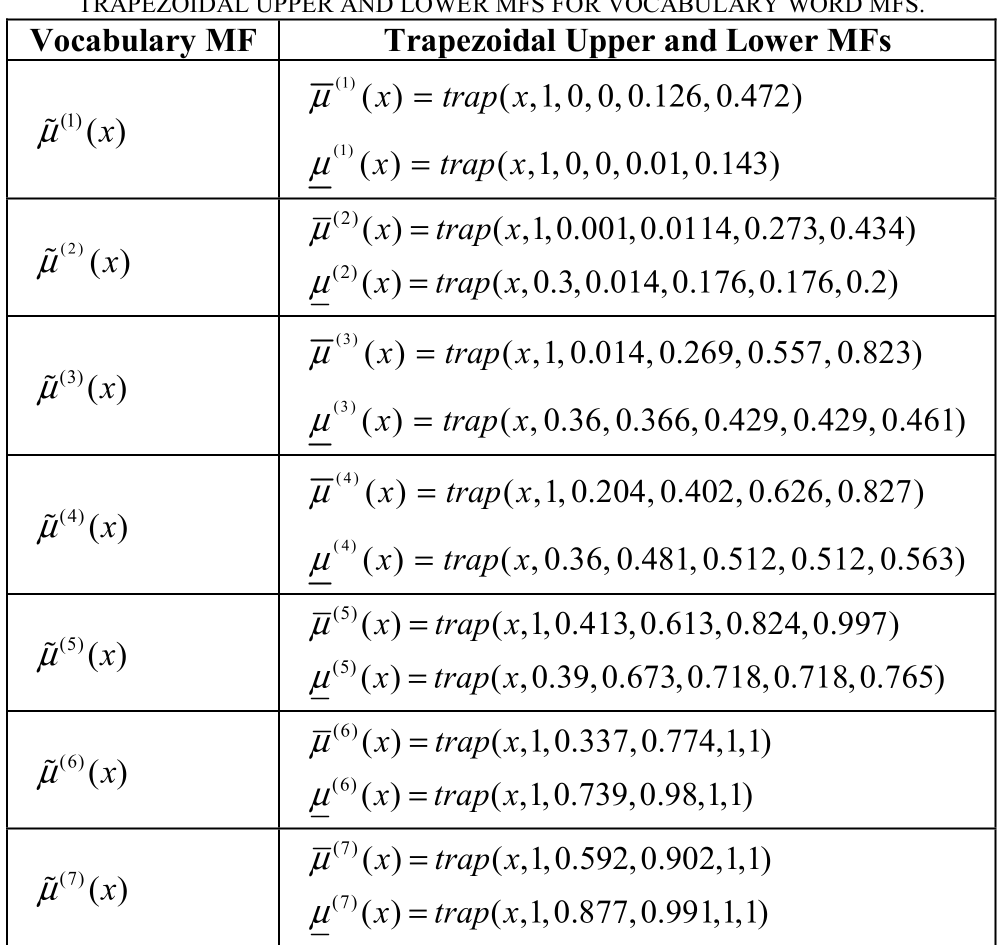 Table 2: The underlying trapezoidal IT2 Membership Functions (UMF/LMF) used for the computations.
Deep Insight: Why This Matters
The true value of this work is the decoupling of "Reasoning" from "Calculation." By restricting the "knowledge" of the network to a discrete vocabulary of words, the authors treat social network analysis as a linguistic retrieval task rather than a continuous optimization problem.
Limitations
- Vocabulary Constraint: The efficiency relies on a relatively static vocabulary. If the linguistic nuances required are highly specific, the pre-computation tables grow exponentially.
- Topology Agnostic: The paper focuses on the fuzzy logic of the attributes rather than the structural properties (like graph motifs) of the network itself.
Conclusion
Rickard and Yager have provided a bridge between the high-level qualitative reasoning of humans and the low-level quantitative speed of binary silicon. This approach is particularly promising for Fuzzy Cognitive Maps and expert systems where explanation ("Why was this node chosen?") is as important as the result itself.