
Percimo: Bridging the Geo-Social Gap in Tweet Location Estimation
Percimo: A personalized community model for location estimation in social media
Percimo is a personalized community model for fine-grained geo-tag estimation of social media messages (tweets). It integrates textual content, personalized user behavior, and social relationships by leveraging a novel "common-bond and common-identity" theory from social psychology to outperform state-of-the-art content and interest-based baselines.
Executive Summary
TL;DR: Percimo is a sophisticated framework designed to estimate the precise location (geo-tag) of individual tweets by analyzing the fusion of textual semantics, personal habits, and social community dynamics. By moving beyond simple keyword matching and incorporating sociological theories of community attachment, Percimo reduces estimation errors significantly, even for users with zero historical geo-data.
Positioning: This work represents a shift from "Content-Only" or "User-Only" modeling toward Community-Aware spatial inference. It sits at the intersection of Natural Language Processing (NLP), Social Network Analysis (SNA), and Urban Informatics.
Problem & Motivation: The Sparsity Challenge
While social media is a goldmine for real-time regional insights (e.g., tracking disease outbreaks or emergency response), only about 2% of tweets are explicitly geo-tagged by GPS.
Existing solutions are often brittle:
- Content-Based Models: Assume words like "Rockets" only appear in Houston. This fails for generic terms or "off-topic" personal interests.
- Individual History Models: Rely on a user's past geo-tags. This fails for the "Cold Start" problem where a user has no history or sparse data.
The Insight: The authors argue that your location is driven by your interests, and your interests are shaped by your Communities. Even if you haven't visited a place, people like you (your "bonds") or people near you (your "identity") likely have.
Methodology: The Percimo Framework
Percimo operates in three distinct phases, transitioning from raw social graphs to specific coordinate predictions.
1. Geo-Social Community Detection
The model identifies three types of attachments:
- Social (Common Bond): Mutual-follow relationships.
- Local (Common Identity): Physical proximity (living in the same neighborhood).
- Hybrid (Local-Social): The intersection of both.
2. Personal-Community Interest Detection
Using a modified Latent Dirichlet Allocation (LDA), the model determines whether a tweet's content is driven by a user's unique interest or their community's collective interest.
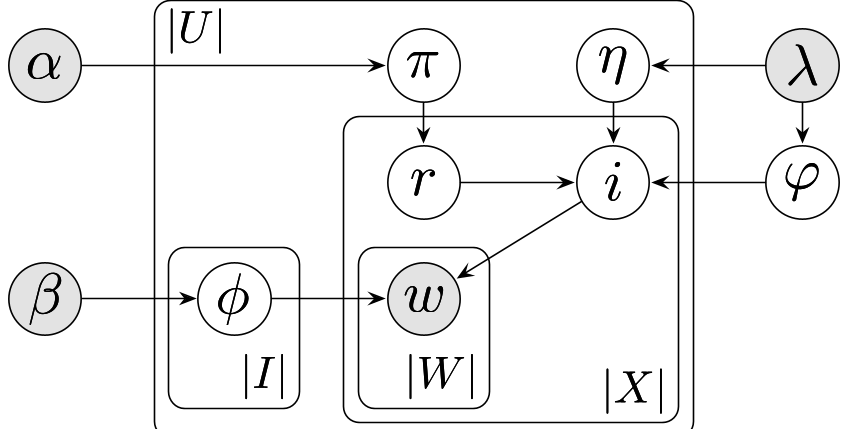
In this generative process, the variable r acts as a switch: deciding if the interest comes from the community (identity/bond) or the individual.
3. Location Estimation (The Fusion)
The final step maps the identified "Interest" (e.g., "Dining") to a candidate location.
- If Personal: It looks at the user’s own history of food-related spots.
- If Community: It looks at where community members with similar tastes go, weighted by their social similarity.
Experiments & Results
The researchers tested Percimo on over 1 million tweets from Maryland and North Carolina.
SOTA Comparison
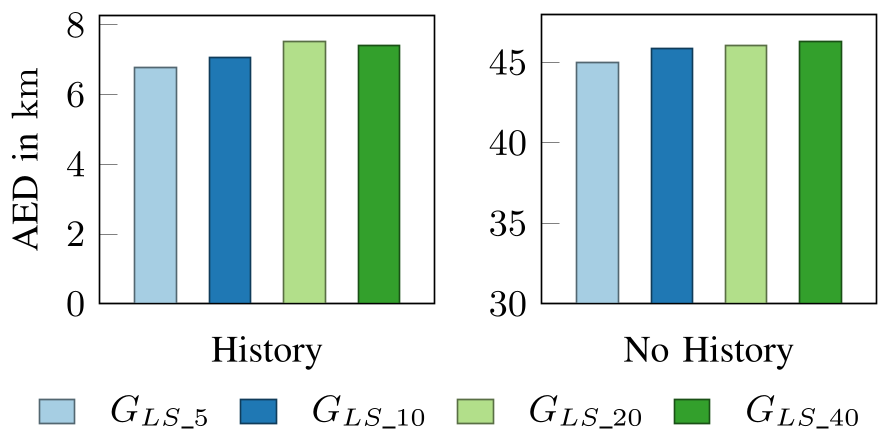
Percimo outperformed all baselines, particularly highlighting the failure of purely content-based models (CM) which suffer from a massive candidate pool (search space), leading to high error distances.
Key Findings:
- The Hybrid Advantage: The
GLS_5graph (Local + Social) yielded the lowest error, proving that knowing who your friends are and where they live is the most powerful predictor. - The Power of Centrality: Using Betweenness Centrality to weight community influence (rather than a simple 50/50 split) significantly improved accuracy.
- Cold Start Success: For users with no history, Percimo still achieved reasonable accuracy by "borrowing" the geographical identity of their social bubble.
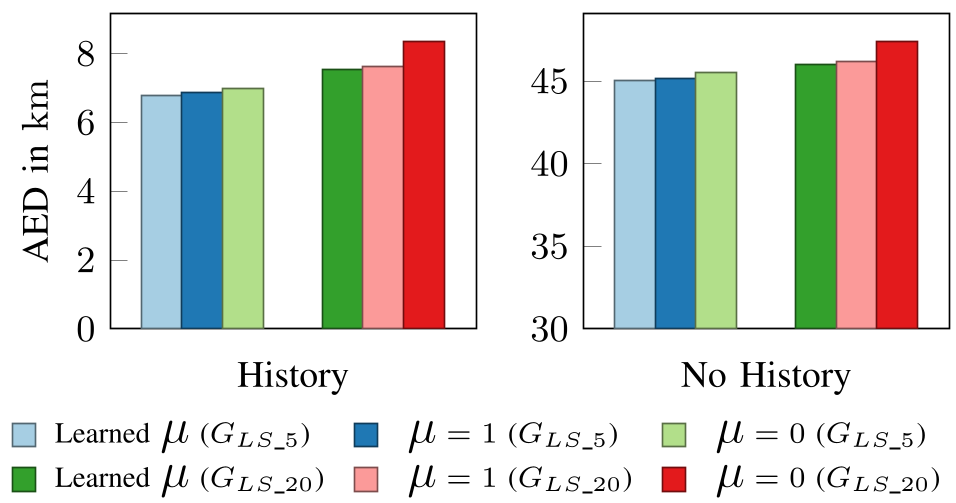 The charts above demonstrate that while personal history is the strongest single indicator (µ=1), the "Learned µ" (weighted combination) provides the best overall performance.
Critical Analysis & Conclusion
Takeaway: Percimo proves that social media location estimation is not just a text-processing task—it is a social-behavioral modeling task. By restricting the candidate location pool through geo-social communities, the "noise" is filtered out.
Limitations:
- The model assumes a user belongs to a single community; however, in reality, people occupy multiple overlapping circles (work, hobby, family).
- Dependence on Foursquare POI categories might introduce lag if local business landscapes change rapidly.
Future Outlook: Integrating this community-logic into deep learning architectures like Graph Convolutional Networks (GCNs) could further refine the spatial-textual embeddings, potentially pushing the "Average Error Distance" into the sub-kilometer range.