
Beyond SLAs: A Systems Thinking Approach to IT Outsourcing Success
Performance assessment of outsourced service engagements: Leveraging economic theories based critical success factors
This paper introduces a performance assessment framework for IT outsourcing using System Dynamics (SD) and Critical Success Factors (CSFs). Derived from 11 distinct economic theories, the model evaluates service engagements beyond simple Service Level Agreements (SLAs) to provide a predictive, holistic view of engagement health.
TL;DR
IT outsourcing performance assessment is often stuck in a "static trap," relying on monthly SLA reports that miss the big picture. This paper by researchers at Tata Consultancy Services (TCS) shifts the paradigm by using System Dynamics and Economic Theories to model the health of an engagement. It transforms qualitative "soft" factors into a predictive simulation tool that can forecast costs and performance gaps.
Background Positioning
In the landscape of IT management, this work moves from Service Level Agreements (SLAs) to Service Value Agreements (SVAs). It is a methodology-driven research piece that bridges the gap between academic economic theories (like Transaction Cost Theory) and industrial operational practice.
The "Static Trap": Why Conventional Metrics Fail
The authors identify a critical disconnect: many engagements "green" on paper (met SLAs) are actually failing in reality. Why?
- Point-in-Time Bias: Traditional metrics only tell you what happened yesterday, not what will happen tomorrow.
- Lack of Theory: Most metrics focus on attributes like "timeliness" or "accuracy" without understanding the underlying economic drivers like agency costs or resource rarity.
- The Invisible Drivers: Intangibles such as knowledge management and relationship maturity are rarely captured quantitatively, yet they are the primary causes of engagement failure.
Methodology: Mapping Economic Theory to Simulation
The core of this work is the CSF-Simulation Bridge. The authors take 11 economic theories of outsourcing and distill them into measurable Critical Success Factors (CSFs).
The Hierarchical Architecture
To make these theories actionable, they are organized into a hierarchy. For instance, "Vendor Resource Exploitation" is broken down into "Vendor Team Competency," "Knowledge Management," and "Automation Support."
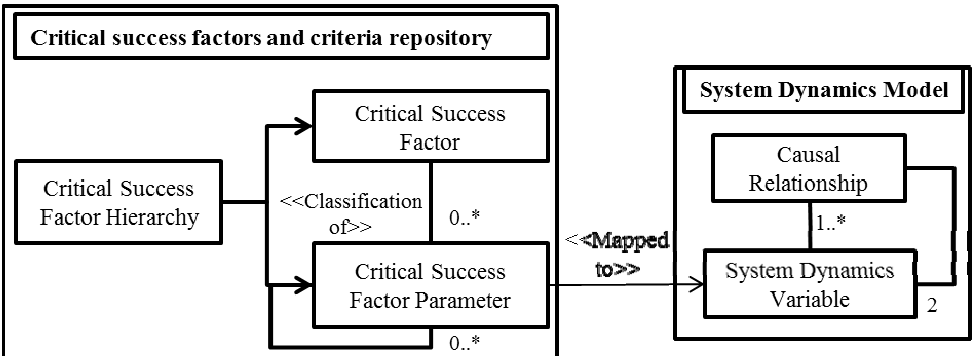 Figure 1: The structural schema showing how CSFs are mapped onto simulation model variables.
The System Dynamics (SD) Engine
Unlike a spreadsheet, the SD model uses causal feedback loops. For example, increasing "Automation" reduces "Production Costs" but requires an upfront investment that might temporarily increase "Transaction Costs." The model allows managers to visualize these trade-offs over time.
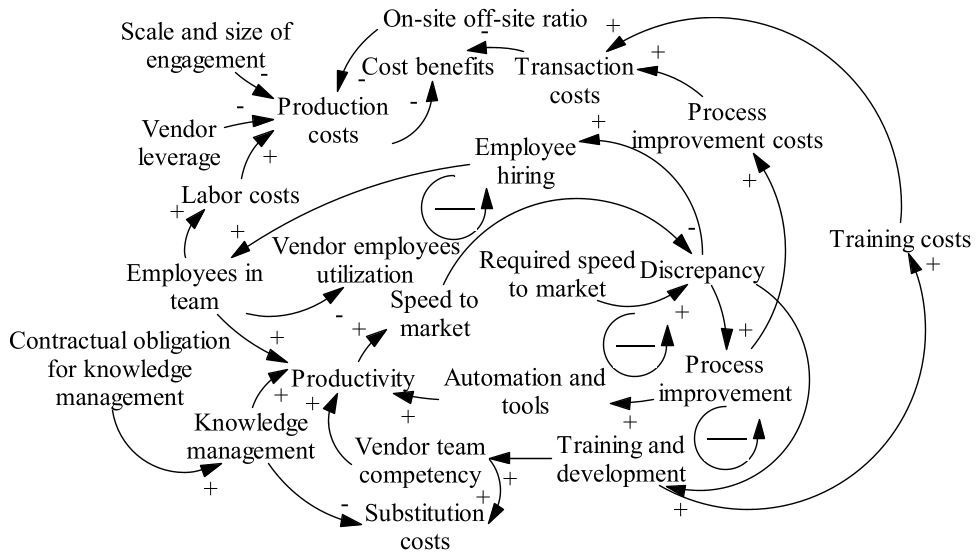 Figure 2: Causal relationship diagram for Production Cost Benefits, illustrating the interconnection of labor, scale, and vendor leverage.
Experimental Insights: Simulating the Future
The authors simulated a resource augmentation engagement over 300 days. The findings were revealing:
- The Cost of "Hidden" Knowledge: Without contractual bindings for knowledge management, substitution costs increased significantly as the "rarity" of the vendor team grew, creating a vendor lock-in risk.
- Optimization Potential: By comparing the current state to an "Ideal State" (benchmarking), the simulation revealed that the client was paying 30% more than necessary due to poor process automation and training frequencies.
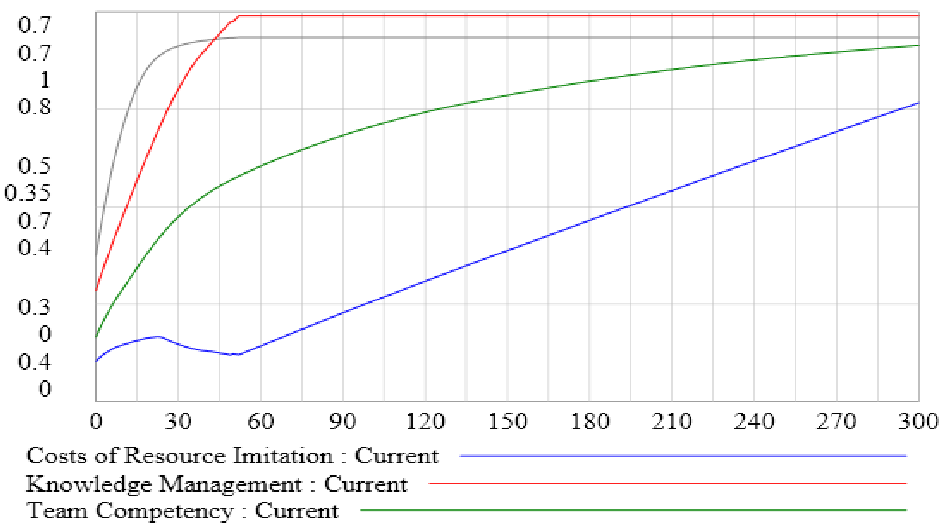 Figure 3: Time-series graphs showing the progression of automation, knowledge management, and team competency vs. actual production costs.
Critical Analysis & Takeaways
The Value Proposition
The genius of this approach lies in Predictive Performance Assessment. Instead of waiting for a quarterly review to find out the relationship is souring, managers can simulate the impact of policy decisions—such as increasing on-site presence or changing the pricing model—before they are implemented.
Limitations
- Initialization Burden: The framework requires high-quality initial data from questionnaires and reports to calibrate the "black box" simulation model.
- Subjectivity: Benchmark "ideal values" are still set by subject matter experts, which can introduce bias.
Conclusion
This TCS research provides a robust blueprint for the next generation of IT governance. By grounding performance in economic theory and using systems thinking to model complexity, it transforms performance assessment from a "policing" activity into a strategic steering tool. For future practitioners, the message is clear: don't just manage the metrics, manage the system.