
Beyond SLAs: A Systemic Approach to IT Outsourcing Success via Economic Simulation
Performance assessment of outsourced service engagements: Leveraging economic theories based critical success factors
This paper introduces a novel performance assessment framework for IT outsourcing engagements by integrating Critical Success Factors (CSFs) derived from 11 core economic theories. The methodology leverages System Dynamics (SD) modeling to simulate engagement health over time, moving beyond static metrics to a predictive, systemic evaluation.
Executive Summary
In the high-stakes world of IT outsourcing, the delta between "meeting the contract" and "generating value" is growing. This paper by Rai and Mehta from Tata Consultancy Services (TCS) argues that traditional performance assessment—focused on static Service Level Agreements (SLAs)—is fundamentally flawed because it ignores the dynamic, systemic nature of service engagements.
The authors propose a System Dynamics (SD) framework grounded in 11 economic theories. By simulating the feedback loops of an engagement, they provide a method to not only see where a project stands today but to predict its health 300 days into the future. This work transitions outsourcing management from reactive reporting to proactive, theory-driven governance.
The "Measurement Gap" in Modern Outsourcing
Why do so many outsourcing engagements feel like failures despite green dashboards? The authors identify two primary pain points:
- Static Point-in-Time Views: Traditional metrics are snapshots. They don't account for how a decision today (like cutting training costs) will degrade service quality six months later.
- Lack of Theoretical Depth: Metrics like "tickets resolved" don't reflect deeper objectives like Focus on Core Competencies or Resource Imitability.
The shift from cost-arbitrage to strategic partnership requires a framework that can quantify intangibles—innovation, communication, and trust—using the same rigor as financial reporting.
Methodology: The Synthesis of Economics and Simulation
The core innovation lies in the mapping of economic theories to Critical Success Factors (CSFs). For example:
- Agency Theory: Focuses on "Vendor Behavior Control" to minimize monitoring costs.
- Resource-Based Theory: Focuses on "Vendor Resource Exploitation" (leveraging vendor skills that the client lacks).
Architecture of the Assessment System
The authors use System Dynamics, a mathematical technique for modeling complex systems through stocks, flows, and feedback loops.
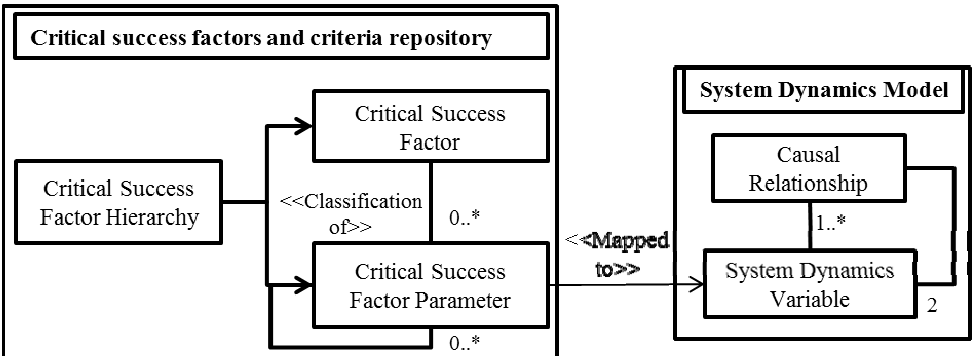 Figure 1: The structural schema showing how CSFs are parameterized and mapped to a simulation engine.
The model doesn't just look at output; it examines the causal relationships. As shown below, "Production Cost Benefits" is not a static number but a dynamic function of labor costs, onsite/offsite ratios, and vendor leverage.
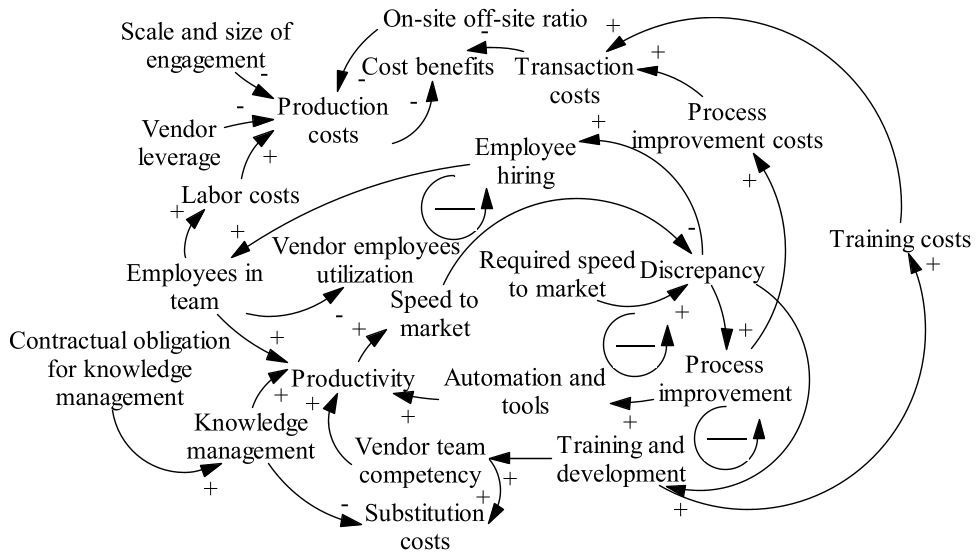 Figure 2: Causal logic for identifying production cost drivers.
Experiments: Quantifying the Qualitative
The researchers simulated a resource augmentation engagement for 300 days. By defining "Ideal" settings (benchmarks) and comparing them to simulated results, they generated a granular performance report.
Key Insight: The Automation-Knowledge Link
The simulation demonstrated that as Knowledge Management (KM) and Automation increase, the "Substitution Ease" (the ability to swap resources without losing productivity) improves, though substitution costs initially rise as vendor-specific knowledge grows.
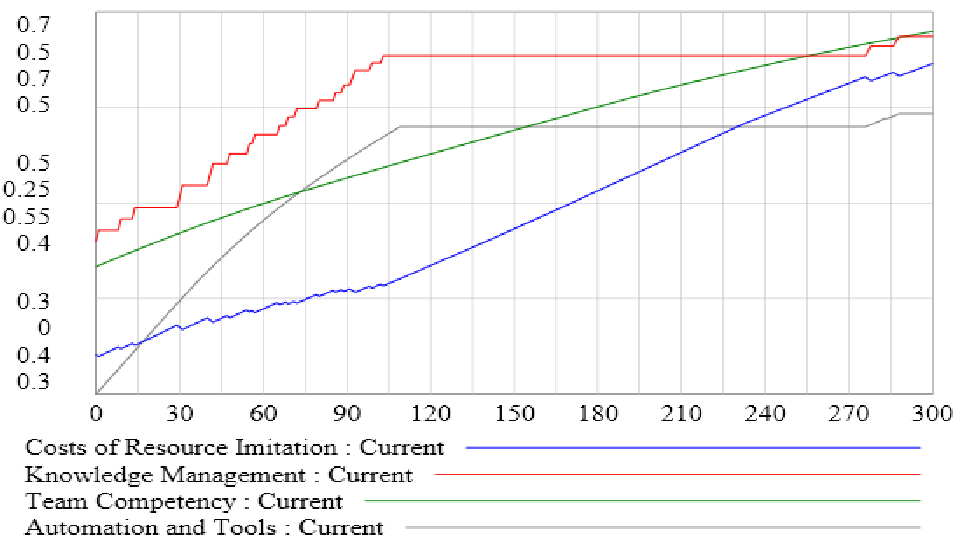 Figure 3: Time-series behavior of KM, Team Competency, and Automation over a 300-day simulation.
Results at a Glance:
- Cost Efficiency: The model identified that under ideal settings, total engagement costs could be reduced by 30%.
- Root Cause Analysis: The framework allowed managers to see that low "Vendor Resource Utilization" scores were not due to vendor incompetence, but a lack of contractual obligations for knowledge transfer.
Critical Analysis & Conclusion
This paper succeeds in providing a rigorous "Systems Thinking" lens to a field often dominated by qualitative surveys. By grounding CSFs in economic theories like Transactional Cost Theory and Social Exchange Theory, it ensures the assessment is Collectively Exhaustive.
Takeaways for the Industry:
- Predictive Power: Moving toward simulation allows for "What-if" analysis—e.g., "What happens to our innovation score if we reduce the vendor onsite ratio by 20%?"
- Beyond the SLA: Success is about goal alignment and resource exploitation, not just meeting uptime targets.
Limitations: The primary challenge remains the initial calibration. A System Dynamics model is only as good as the data and assumptions fed into it. For smaller engagements, the overhead of building such a model might outweigh the benefits, but for strategic, multi-million dollar deals, this framework is a prerequisite for long-term value.