
Beyond Star Ratings: Decoding Player Preferences in Social Gaming
Performance Characterization of Game Recommendation Algorithms on Online Social Network Sites
This paper evaluates neighborhood-based Collaborative Filtering (CF) algorithms for recommending online social games using a massive dataset from the Gatcha! platform. It compares explicit star ratings and implicit gaming behavior (play counts/duration), demonstrating that item-based CF significantly outperforms traditional content-based methods.
TL;DR
Social gaming is a multi-billion dollar industry, yet recommending the "right" game remains a challenge due to extreme user behavior and data sparsity. This research proves that Item-Based Collaborative Filtering (CF), particularly when combining explicit ratings with implicit gameplay data, drastically outperforms the content-based algorithms currently used by many platforms.
Context: Why Games are Different
Unlike movies where a fan of "Sci-Fi" will likely enjoy most high-rated Sci-Fi films, social gamers exhibit a unique "consumption exhaustion." If a user is currently addicted to a farming simulator, they are often less likely to play a clone of that same game simultaneously. This creates a massive failure point for Content-Based Filtering, which relies on item metadata similarity.
The Data Challenge: Extreme Skewness
The researchers analyzed data from Gatcha!, a major European gaming portal. Two major problems emerged:
- Extreme Ratings: Users rarely give a "7/10." They either love a game (10/10 accounts for 60% of all ratings) or hate it (1/10).
- Implicit Noise: How do you turn "150 game sessions" into a preference score? The authors proposed a mathematical bridge:
r = 1/2 + 1/2 * (arctan(c) * 2/π)^p
This formula ensures that as gameplay count (c) increases, the confidence in the "like" score reaches a plateau, filtered by a calibration parameter p.
Methodology: Item-Based vs. User-Based
While User-Based CF (finding "neighbors" who are similar people) is intuitive, it falls apart at the scale of millions of users. The study focused on Item-Based CF, which calculates the similarity between games based on who played them.
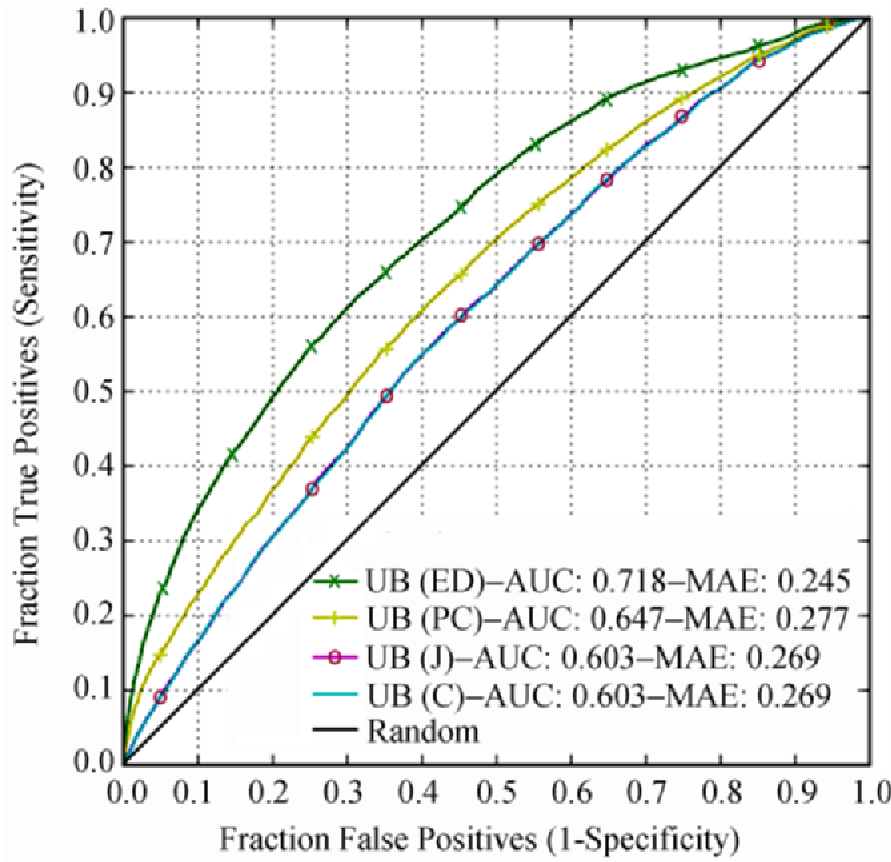
The figure above illustrates the ROC curves for different similarity metrics. Note how Euclidean Distance (ED) unexpectedly performs well in explicit scenarios due to the extreme "binary-like" nature of the star ratings.
Key Experimental Insights
- The Content-Based Failure: Content-based methods achieved an AUC of only 0.58—barely better than a coin flip (0.50).
- Similarity Metric Surprises: In most domains, Pearson Correlation is king. However, for explicit game data, Euclidean Distance won because it better captured the magnitude of the extreme ratings (1s and 10s).
- The Power of "Implicit": When using gameplay data, the Mean Absolute Error (MAE) dropped significantly. Why? Because the system had more "data points" per user to triangulate their actual tastes, even if they never clicked a "rate" button.
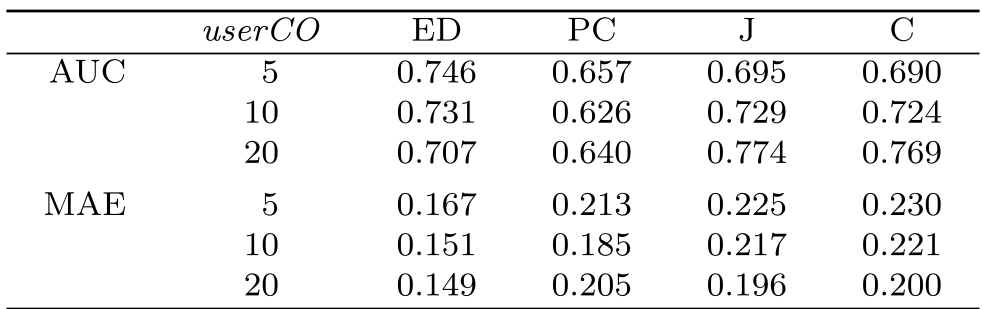
Table 3 shows that as we require more ratings per user (UserCO), the quality of recommendations (AUC) for metrics like Jaccard and Cosine improves dramatically.
Strategic Conclusion: The Hybrid Path
For a live production system, the authors recommend a Hybrid Item-Based CF with Pearson Correlation.
- Why Pearson? It proved to be the most "stable" when mixing explicit and implicit data.
- Why Hybrid? It captures the loud voice of the "10/10" rating while respecting the quiet signal of a user who plays a game 500 times without ever rating it.
This methodology was successfully deployed on the Gatcha! platform, proving that in the world of big data, the best insights often come from the things users do rather than the things they say.
Limitations & Future Work
The study acknowledges that temporal dynamics (old games vs. new viral hits) are not fully addressed. Future iterations will likely incorporate "time decay" functions—recognizing that a game played 2 years ago shouldn't weigh as heavily as one played yesterday.