
Benchmarking Neural Architectures: Unmasking Human Emotions through Deep Learning
Performance Evaluation of Artificial Neural Networks Applied in the Classification of Emotions
This paper presents a performance comparative study of Artificial Neural Networks (ANNs)—including Simple Perceptron, VGG, and a custom CNN—for automated facial emotion classification. Using the FER2013 and JAFFE datasets, the authors achieved SOTA-competitive results, notably reaching 73% accuracy on FER2013 and 96% on JAFFE.
TL;DR
Recognizing human emotions is intuitive for people but notoriously difficult for machines due to subtle facial variations. This study evaluates three neural network architectures—Simple Perceptron, VGG, and a custom CNN—across two major datasets (FER2013 and JAFFE). The findings reveal that deeper convolutional models, specifically when paired with the Adam optimizer, can achieve up to 96% accuracy, significantly outperforming traditional shallow networks and setting new competitive marks for the FER2013 benchmark at 73%.
Problem & Motivation: The "Subtle Difference" Trap
The human face is a complex canvas of eyes, nose, and mouth movements. For a computer, the difference between "Anger" and "Disgust" or "Fear" and "Surprise" is often a matter of a few pixels.
The authors identify two core pain points:
- Visual Similarity: Many emotional states share overlapping facial landmarks.
- Data Noise: Standard datasets like FER2013 are often cluttered with "dirty" data—cartoons, baby faces, or side profiles—that confuse models during training.
Their insight was simple: architectural depth + rigorous data cleaning = superior generalization.
Methodology: The Core Architectures
The research team didn't just throw data at a model; they tested the scaling laws of complexity by comparing three distinct approaches:
- Simple Perceptron: A baseline to measure the necessity of depth.
- VGG: A proven, deep architecture known for its small 3x3 filters.
- Custom CNN: A tailored arrangement of convolutional and max-pooling layers designed specifically for 48x48 and 50x50 grayscale inputs.
Architecture Overview
The CNN leverages the power of spatial hierarchies, using filters to slide across the image and calculate activation maps that represent "fear" or "joy" patterns.
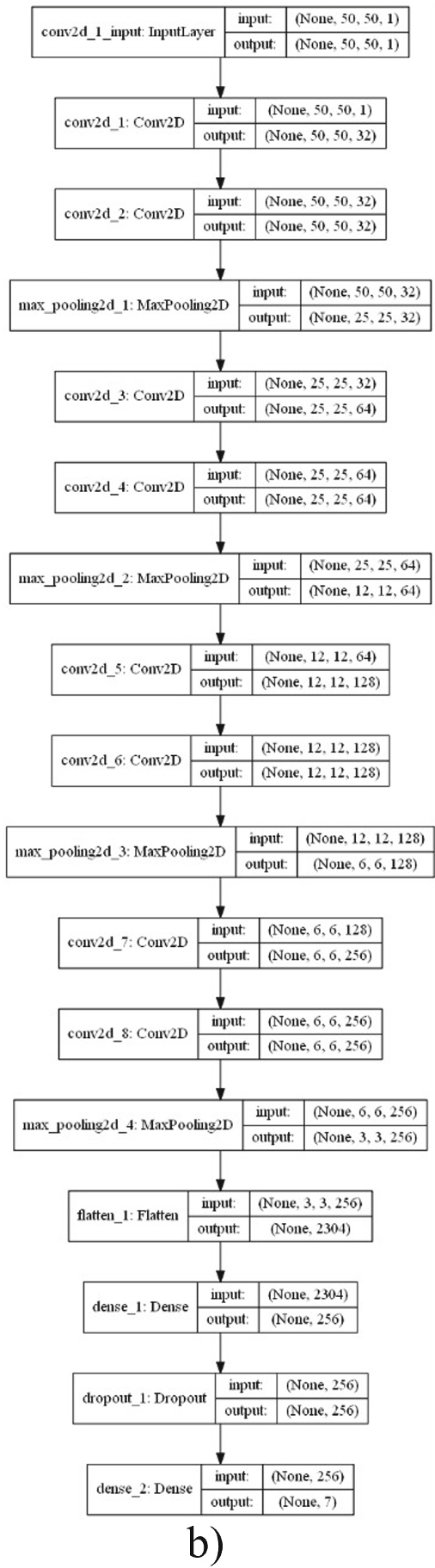 Figure: The implemented CNN architectures for FER2013 and JAFFE datasets.
The Preprocessing Guardrail
A critical step in this work was the manual intervention in the FER2013 dataset. By discarding non-conducive images (animated faces, letters, side profiles), the authors reduced the noise floor of the training process.
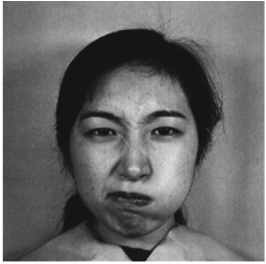 Figure: Examples of discarded noise in the FER2013 dataset that previously hindered classification accuracy.
Experiments & Results: Deep Learning Wins
The results confirm a clear hierarchy in performance. While the Simple Perceptron suffered from massive overfitting (high training accuracy but low test accuracy), the CNN and VGG models remained robust.
- VGG & Adam: Specifically excelled on the JAFFE dataset with 96% accuracy.
- CNN & RMSprop: Proved most effective for the larger, more varied FER2013 dataset, reaching 73%.
Comparative Performance Analysis
When compared against previous literature, the authors' custom CNN outperformed several existing benchmarks.
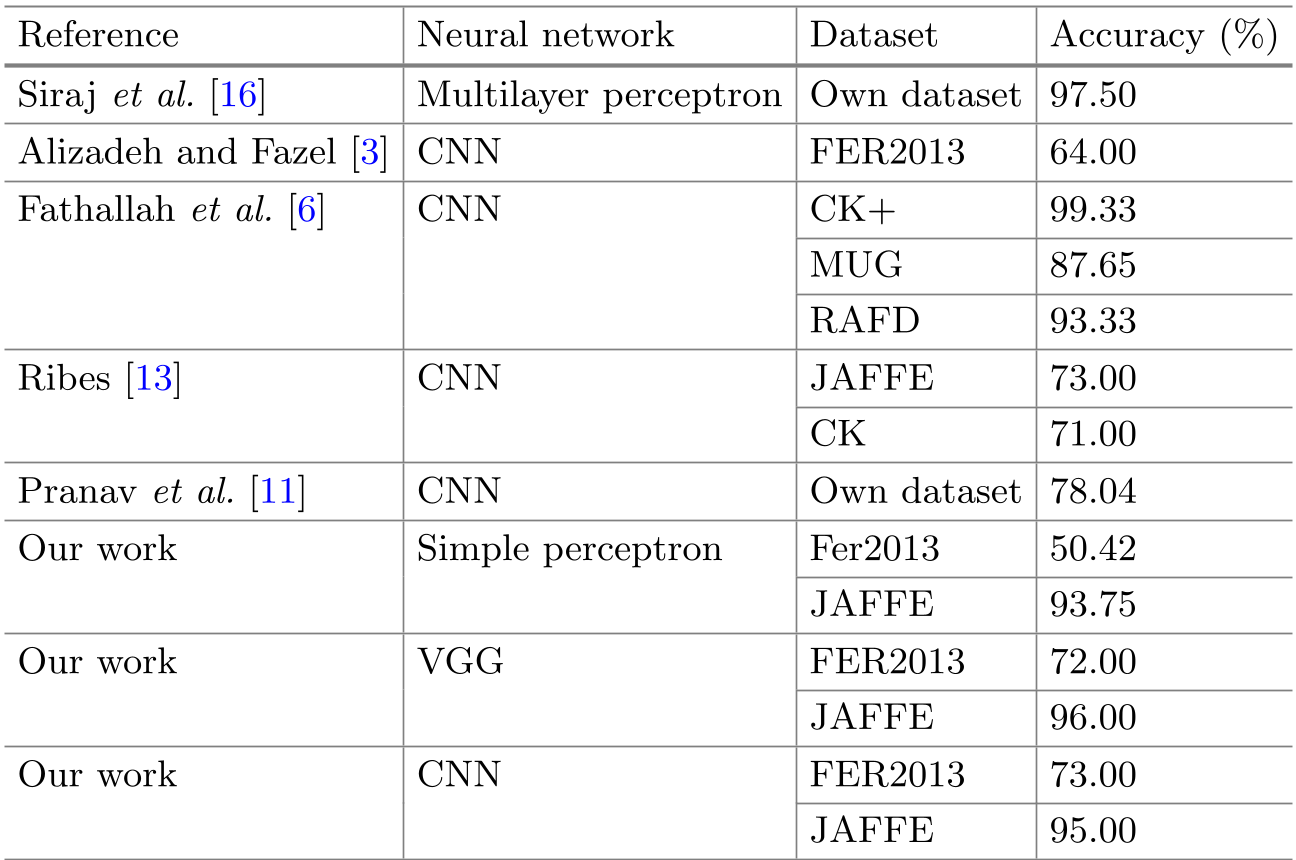 Table: The study's results (VGG/CNN) compared with other state-of-the-art methods in emotion recognition.
Critical Analysis & Conclusion
Takeaway
The study proves that deeper networks (VGG/CNN) are not just a luxury but a requirement for emotion classification. The choice of optimizer is equally vital; Adam consistently emerged as the most reliable driver for convergence in these multiclass tasks.
Limitations & Future Work
The "Disgust" category was dropped from the FER2013 experiments due to data imbalance, indicating a need for better data augmentation or synthetic data generation (GANs) to handle minority classes. The authors conclude that the next step lies in developing expert systems—moving from simple classification to real-time emotion-aware assistants.
As technology advances, the gap between human intuition and machine perception continues to close, one convolutional layer at a time.