
Beyond Empirical Formulas: Optimizing 3.7 GHz Rural Path Loss Prediction with Machine Learning
Performance evaluation of machine learning methods for path loss prediction in rural environment at 3.7 GHz
This paper evaluates and compares various machine learning (ML) architectures, including ANN, SVR, Random Forest (RF), and Bagging with k-NN (B-kNN), for path loss prediction at 3.7 GHz in rural environments. The study demonstrates that ML models significantly outperform traditional empirical models, with a three-hidden-layered ANN achieving a SOTA RMSE of 4.0 dB.
TL;DR
In the world of wireless network planning, predicting signal attenuation (path loss) accurately is the difference between seamless connectivity and a "dead zone." This paper moves beyond rigid empirical formulas like Hata and CI by implementing a suite of machine learning models. Using data from 2200 real-world links at 3.7 GHz, the authors prove that a specialized 3-layer Artificial Neural Network (ANN) can hit a Root Mean Square Error (RMSE) of just 4.0 dB—halving the error rate of traditional planning methods.
Background: The Rural Challenge
Rural environments present a unique "propagation nightmare": mountainous terrain, heavy vegetation, and varying antenna heights. Traditional Empirical Models (derived from simple regression) struggle with these non-linearities. Conversely, Deterministic Models (like Ray Tracing) are too slow for large-scale rural deployments. This research enters as a SOTA benchmark for the 3.7 GHz band (crucial for TD-LTE and 5G FWA), proving that ML can offer the "best of both worlds": speed and precision.
Methodology: The "Secret Sauce" of Feature Selection
A key insight of this paper is not just the algorithms, but the input data. Using Principal Component Analysis (PCA), the authors narrowed down 8 geographic features to 4 core predictors that explain 98.9% of the path loss variance:
- 3D Distance (): The primary driver of attenuation.
- Path Visibility (): A binary LOS/NLOS flag.
- Transmitter Height ().
- Receiver Height ().
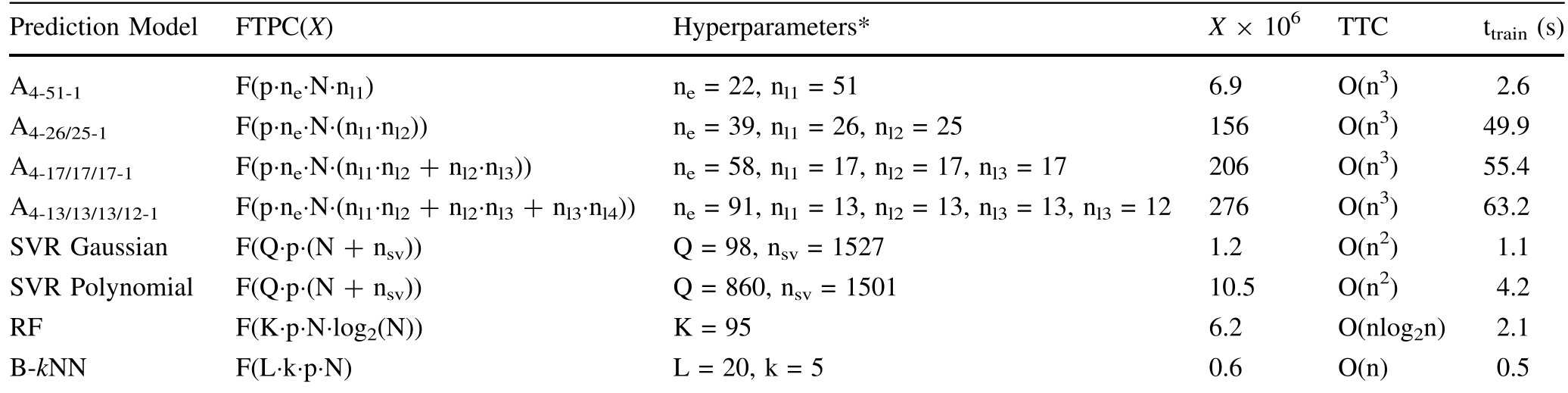
The authors didn't stop at simple ANNs; they tested Support Vector Regression (SVR), Random Forest (RF), and the first-ever application of Bagging with k-Nearest Neighbors (B-kNN) for this specific task.
Cracking the Neural Network Depth
One of the most valuable findings is the "Sweet Spot" for network depth. By testing ANNs with 1 to 4 hidden layers, the authors found that:
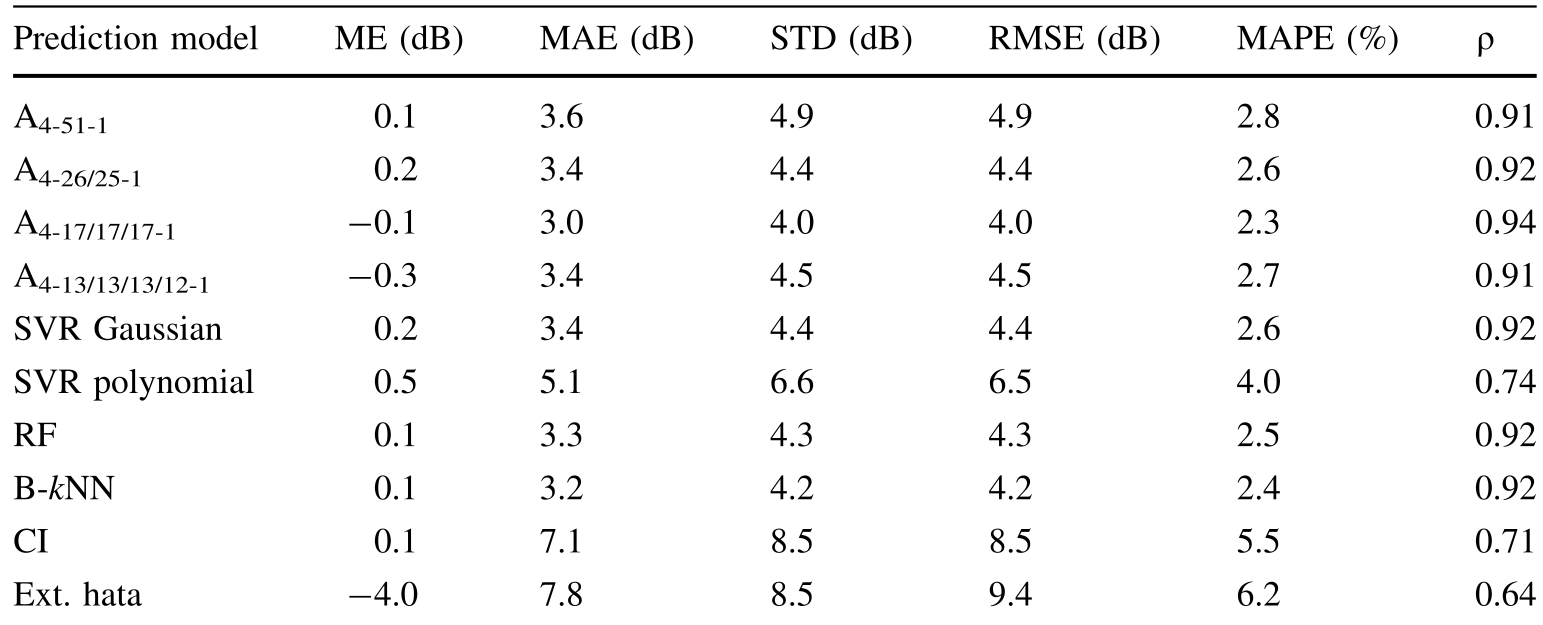
- Underfitting: A single layer (A4-51-1) is too simple (RMSE 4.9 dB).
- The Optimal Point: Three layers (A4-17/17/17-1) captures the complex multi-path dynamics of rural terrain perfectly (RMSE 4.0 dB).
- Diminishing Returns: Moving to four layers actually increased the error (RMSE 4.5 dB), likely due to overfitting on the limited 2200-sample dataset.
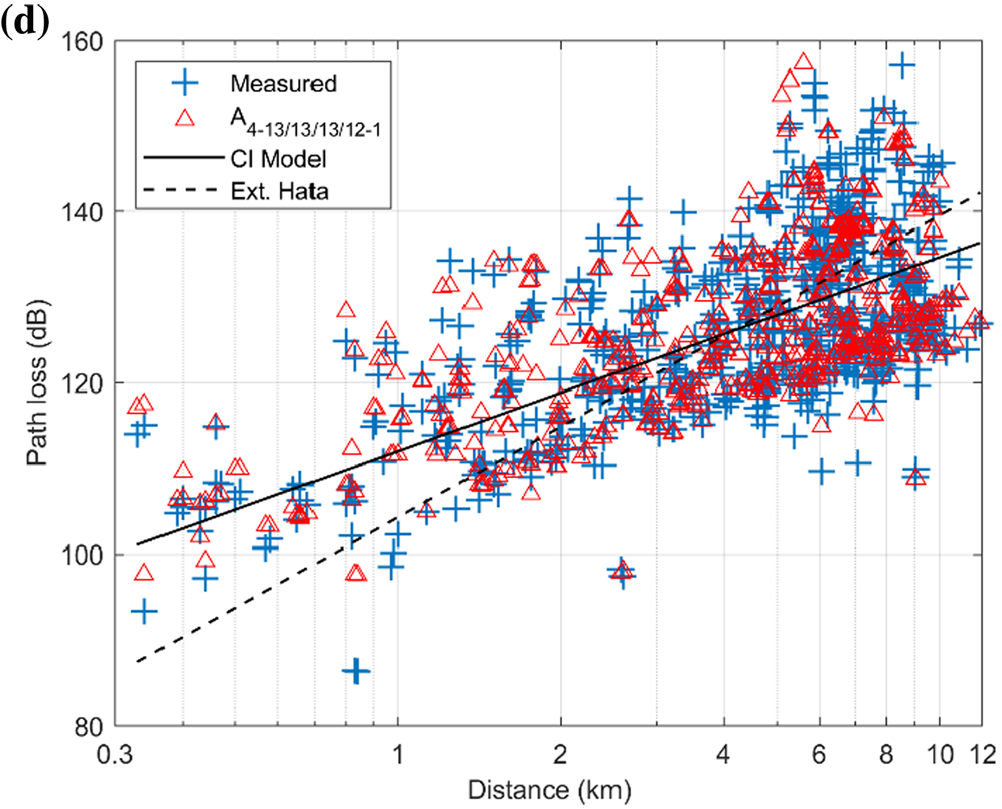 Fig 4c: The 3-layer ANN (red line) tracks the measured data (blue circles) with exceptional fidelity even in high-variance NLOS regions.
Results Unleashed
While the 3-layer ANN is the "Accuracy King," the study highlights Random Forest (RF) and B-kNN as the "Efficiency Heroes."
- B-kNN achieved a stunning 4.2 dB RMSE with a training time of only 0.5 seconds.
- RF provided stable, variance-reduced predictions (RMSE 4.3 dB) without requiring the extensive feature normalization that ANNs and SVR demand.
- Empirical Failure: The Extended Hata model showed an RMSE of 9.4 dB—a massive error margin that could lead to significant signal gaps in a real deployment.
Implementation Insights & Future Work
The paper concludes that for high-stakes radio coverage software, the 3-layer ANN is the recommended choice. However, for real-time dimensioning involving massive datasets, the B-kNN or RF approaches offer a superior trade-off.
Limitations: The model is highly specific to rural 3.7 GHz data. Future work aims to incorporate urban/suburban datasets and explore Ensemble Methods that combine these different ML architectures to squeeze out even higher precision.
This work serves as a definitive guide for engineers looking to replace outdated link-budget formulas with more robust, data-driven AI models.