
Benchmarking Financial Sentiment: Why Attention and Dense Embeddings Outperform Lexicons
Performance Evaluation of Word and Sentence Embeddings for Finance Headlines Sentiment Analysis
This paper presents a comprehensive performance evaluation of various word and sentence embedding techniques—including Word2Vec, GloVe, FastText, USE, and LASER—applied to financial sentiment analysis. Using datasets from the Financial Phrase Bank and SemEval 2017, the study identifies that a BiGRU+Attention architecture combined with GloVe word embeddings achieves the highest sentiment classification accuracy.
TL;DR
Financial markets move on information, but not all information is equal. This paper evaluates how modern NLP "embeddings"—mathematical representations of language—stack up against traditional financial dictionaries for sentiment analysis. The results are decisive: Deep Learning models, specifically BiGRU coupled with an Attention mechanism, drastically outperform traditional rules-based systems, achieving F1-scores near 0.89.
The "Bag of Words" Problem in Finance
For years, financial sentiment analysis relied on dictionaries like Loughran-McDonald (LM). These systems work by counting "positive" and "negative" words. However, finance is rarely that simple. A word like "liability" might be negative in a general context but neutral or descriptive in a balance sheet headline.
The authors point out that lexicon-based methods (VADER, LM) suffer from a lack of context, resulting in accuracy rates as low as 35% to 42%. The challenge lies in the "pragmatic layer" of language—understanding sarcasm, metaphors, and the weight of specific technical terms in a short headline.
Methodology: The Shift to Dense Vectors
The researchers pivoted from sparse, word-count methods to Dense Embeddings. They tested two main categories:
- Word Embeddings: Individual word vectors (Word2Vec, GloVe, FastText) where similar words reside in similar mathematical spaces.
- Sentence Embeddings: Encoders like Google’s Universal Sentence Encoder (USE) and Facebook’s LASER that map an entire headline into a single vector.
The Winning Architecture: BiGRU + Attention
The core contribution is the application of a Bidirectional Gated Recurrent Unit (BiGRU) with an Attention Layer.

- Why BiGRU? It processes the sentence in both directions, capturing context from both the start and end of the headline.
- Why Attention? In a 10-word headline, perhaps only two words carry the actual sentiment (e.g., "Company X surges despite fears"). The Attention mechanism "learns" to focus on these high-impact words during training.
Experimental Showdown
The authors merged the Financial Phrase Bank and SemEval 2017 datasets to create a robust testing ground.
Word Encoders vs. Sentence Encoders
| Encoder Model | Best Architecture | F1-Score |
|---|---|---|
| GloVe (Word) | BiGRU+Attention | 0.893 |
| LASER (Sentence) | BiGRU | 0.889 |
| FastText (Word) | BiGRU+Attention | 0.890 |
| VADER (Lexicon) | Rule-based | 0.410 |
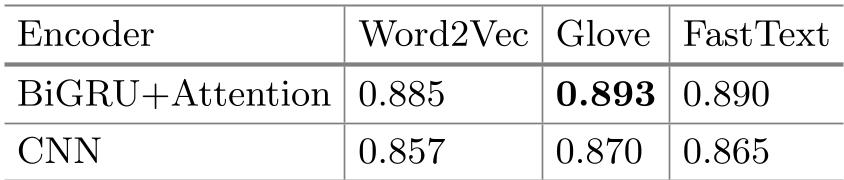
The data reveals that while sentence-level encoders like LASER are highly efficient, word-level architectures with Attention still hold a slight edge. This suggests that in short headlines, the ability to explicitly weigh specific words is more valuable than a global sentence summary.
Deep Insight: Positive vs. Negative Bias
Interestingly, the confusion matrices showed that the models were consistently better at identifying positive sentiment than negative.
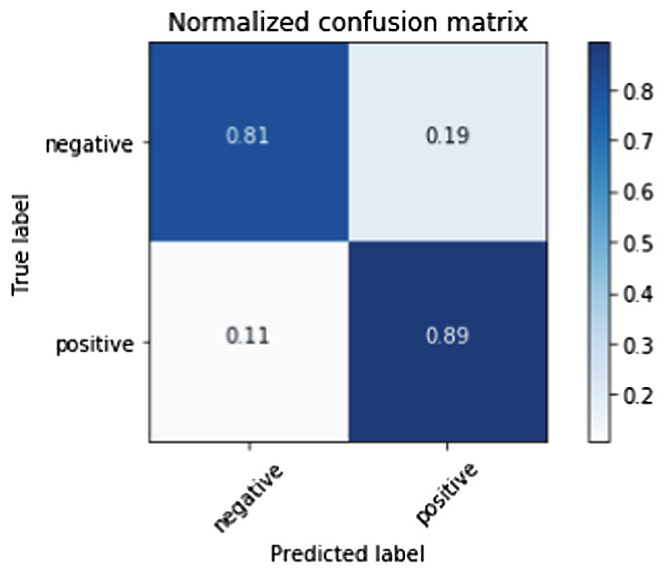
This is a common hurdle in financial NLP: negative sentiment in finance is often expressed through subtle, clinical language ("underperformed expectations" rather than "failed") or through the absence of positive news, making it harder for models to catch than exuberant "surge" or "growth" headlines.
Conclusion & The Path to SOTA
This paper serves as a vital bridge between traditional financial analysis and modern deep learning. It proves that Attention is the "secret sauce" for dealing with the density of financial information.
Limitations to Consider:
- Dataset Size: The study used roughly 3,000 samples. In the age of Large Language Models (LLMs), this is considered a small-scale study.
- Missing Transformers: While BiGRUs were SOTA at the time of this research, modern "FinBERT" models (Transformer-based) likely push these F1-scores even higher by using self-attention across massive pre-training corpora.
For practitioners, the takeaway is clear: Stop using word counts. If you want to capture market sentiment, you need models that understand context and weight importance dynamically.