
[CVPR 2024] The Perils & Promises of Fact-checking with Large Language Models
The Perils & Promises of Fact-checking with Large Language Models
This paper evaluates the performance of GPT-3.5 and GPT-4 in automated fact-checking tasks using a ReAct-based agent framework. By integrating iterative Google Search retrieval with LLMs, the authors achieve high accuracy in verifying claims across multiple languages and timeframes, significantly outperforming zero-shot baselines.
TL;DR
In an era where misinformation spreads faster than human verification can keep up, this research introduces an automated fact-checking agent powered by GPT-4 and the ReAct framework. By allowing LLMs to browse the live web, the system moves beyond "memorized facts" to active reasoning. The results are clear: GPT-4 is a formidable fact-checker, but its prowess is heavily gated by language—translating claims to English is often the "secret sauce" for accuracy.
Problem & Motivation: The Bottleneck of Truth
Professional fact-checking is a grueling task. A single viral claim can take a journalist days to debunk. While Large Language Models (LLMs) offer a potential solution, they face two massive hurdles:
- The "Stateless" Knowledge Trap: Models like GPT-4 are frozen in time (training cutoffs). Without live web access, they cannot verify fresh news.
- The Explainability Gap: A "True" or "False" label isn't enough; journalists and the public require evidence and citations.
The authors set out to determine if LLMs can act as autonomous agents that not only fetch information but explain why a claim is deceptive.
Methodology: Reasoning through Action (ReAct)
The core of the system is the ReAct (Reason + Act) framework. Instead of a single-shot prompt, the agent follows an iterative cycle:
- Thought: The model analyzes the claim and plans a search query.
- Action: It executes a Google Search (with fact-checking domains filtered out to prevent "cheating").
- Observation: It reads the snippet results.
- Decision: It either concludes with a verdict or refines its query for another round (up to 3 iterations).
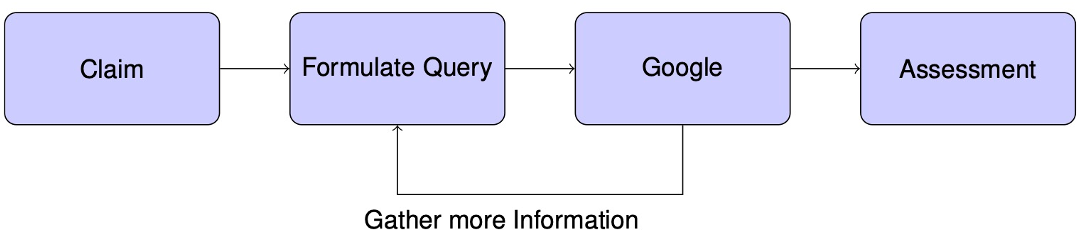
Figure: The iterative workflow where the agent bridges the gap between raw web data and logical verdicts.
Experiments & Results: Living in an English-Centric World
The researchers tested the system on two massive datasets: PolitiFact (US politics) and Data Commons (Multilingual).
Key Findings:
- GPT-4 vs. GPT-3.5: GPT-4 is significantly superior, especially in handling nuance. While both models excel at identifying "Pants-on-Fire" (obvious lies), GPT-4 is better at identifying "Mostly True" statements that require complex synthesis of evidence.
- The Context Dividend: Adding web search results (Context Condition) consistently boosted accuracy across the board, proving that LLMs are better synthesizers than they are encyclopedias.
- The Language Barrier: One of the most striking findings was the performance in non-English languages. As shown in the graph below, translating a claim to English (blue circles) before asking the model to verify it almost always resulted in higher F1 scores than asking in the original language (squares).
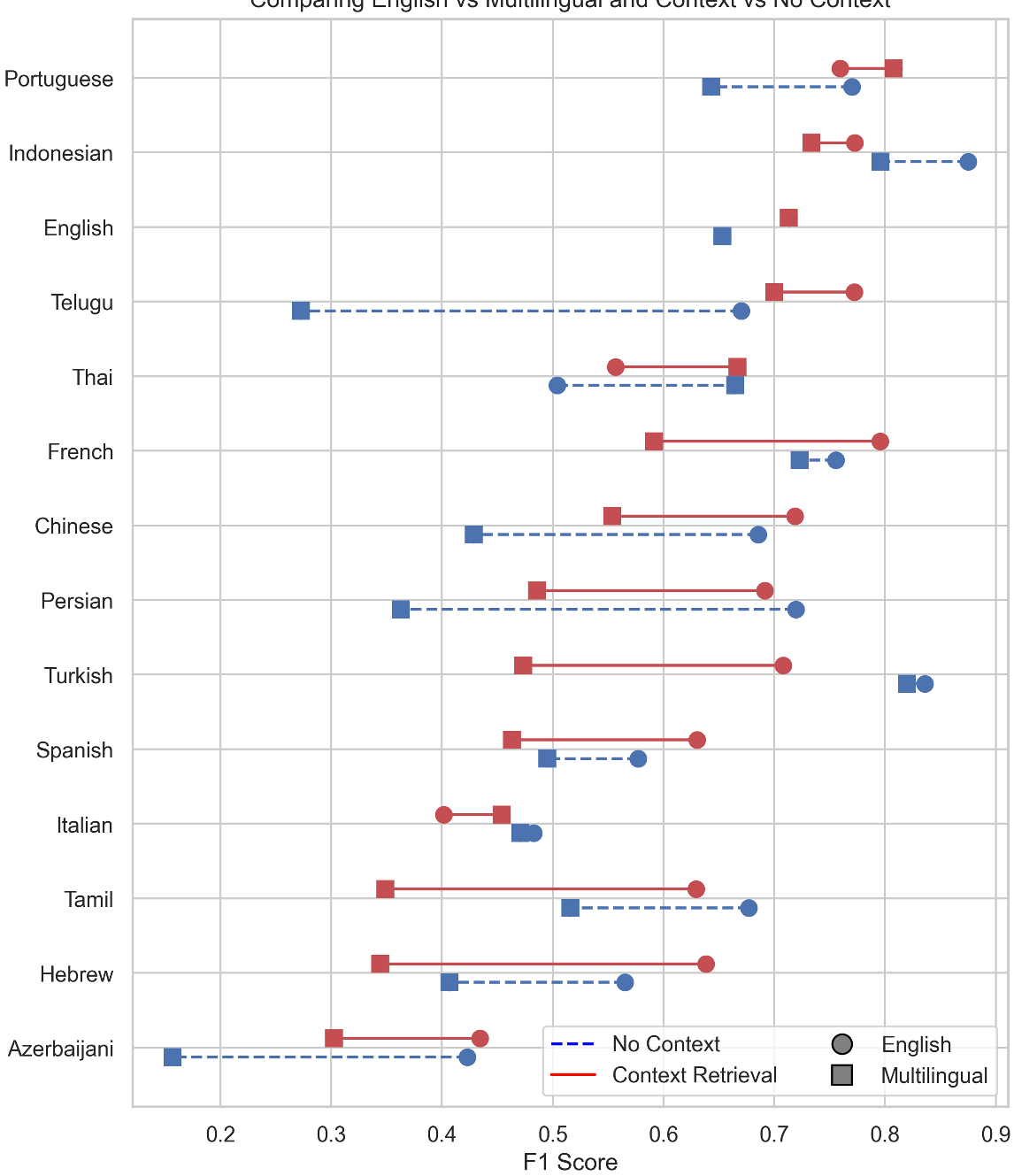
Figure: Comparison of F1 scores across languages. Note how the English translation (circles) consistently outperforms the native language processing (squares).
Critical Analysis: Can We Fire the Fact-Checkers?
Not yet. The study reveals that LLMs struggle with "ambiguous shades of truth." Categories like "Half-True" or "Mostly False" remain a challenge because they require weighing conflicting evidence—a task where human judgment is still superior.
Furthermore, while the "Data Leakage" concern (the model having seen the fact-check during training) is real, the authors found that providing live context allows models to verify claims even after their knowledge cutoff date, which is a promising sign for the longevity of this method.
Conclusion & Takeaways
This work marks a shift from LLMs as "answer engines" to LLMs as reasoning agents. The strategic takeaway for developers and researchers is two-fold:
- Tool-Augmentation is Mandatory: For high-stakes factual tasks, an LLM without a search engine is a liability.
- Language Normalization: In global applications, using English as an intermediate reasoning language (Translate -> Reason -> Translate Back) is a viable, albeit imperfect, workaround for the current limitations of multilingual training.
As we move toward 2025 and beyond, these agents will likely become the "first responders" for content moderation, filtering the noise so human experts can focus on the most complex deceptions.