
The paper introduces PERMA, a novel benchmark for evaluating personalized memory agents that shifts the focus from static preference recall to longitudinal persona consistency. It utilizes event-driven dialogue reconstruction and realistic task environments to assess how Large Language Models (LLMs) and memory systems maintain user profiles across time and domains.
TL;DR
Researchers from USTC and other institutions have released PERMA, a rigorous benchmark designed to stress-test how AI agents remember you over time. Unlike previous tests that just ask a model to find a "needle" in a text haystack, PERMA requires agents to infer evolving preferences from noisy, multi-session dialogues and maintain a consistent "persona state" across multiple life domains.
The Problem: Static Memory in a Dynamic World
Most current "personalized" AI systems are essentially stateless. They use Retrieval-Augmented Generation (RAG) to look up past sentences based on keyword similarity. However, human preferences aren't static snippets; they are event-driven. We change our minds, refine our tastes, and discuss different topics (travel, finance, shopping) that often overlap.
Existing benchmarks suffer from:
- Preference-Centric Framing: They provide models with a "cheat sheet" of preferences instead of making them work for it through conversation.
- Ignoring Noise: Real users are messy—they switch topics, use slang, and give inconsistent feedback.
- Conflated Metrics: It’s often unclear if a model failed because its memory failed or because its reasoning was weak.
Methodology: Building a Realistic Mirror of Life
PERMA reconstructs a user’s "digital life" through a two-stage process:
- Timeline Generation: A high-level planner creates a chronological sequence of events (e.g., "Establishing travel preferences" followed weeks later by "Refining hotel choices").
- Dialogue Reconstruction: These events are turned into 1.8 million tokens of style-aligned, noisy dialogues.
The Core Mechanism: Decoupled Evaluation
To truly see what’s happening "under the hood," PERMA uses:
- Temporal Probing: Testing the model at the start (Zero-Memory), immediately after a preference emerges (In-Time), and after many distracting sessions (Post-Intervention).
- Interactive Simulation: An LLM-based "User Simulator" provides feedback if the agent misses a preference, measuring how many turns it takes to get things right.
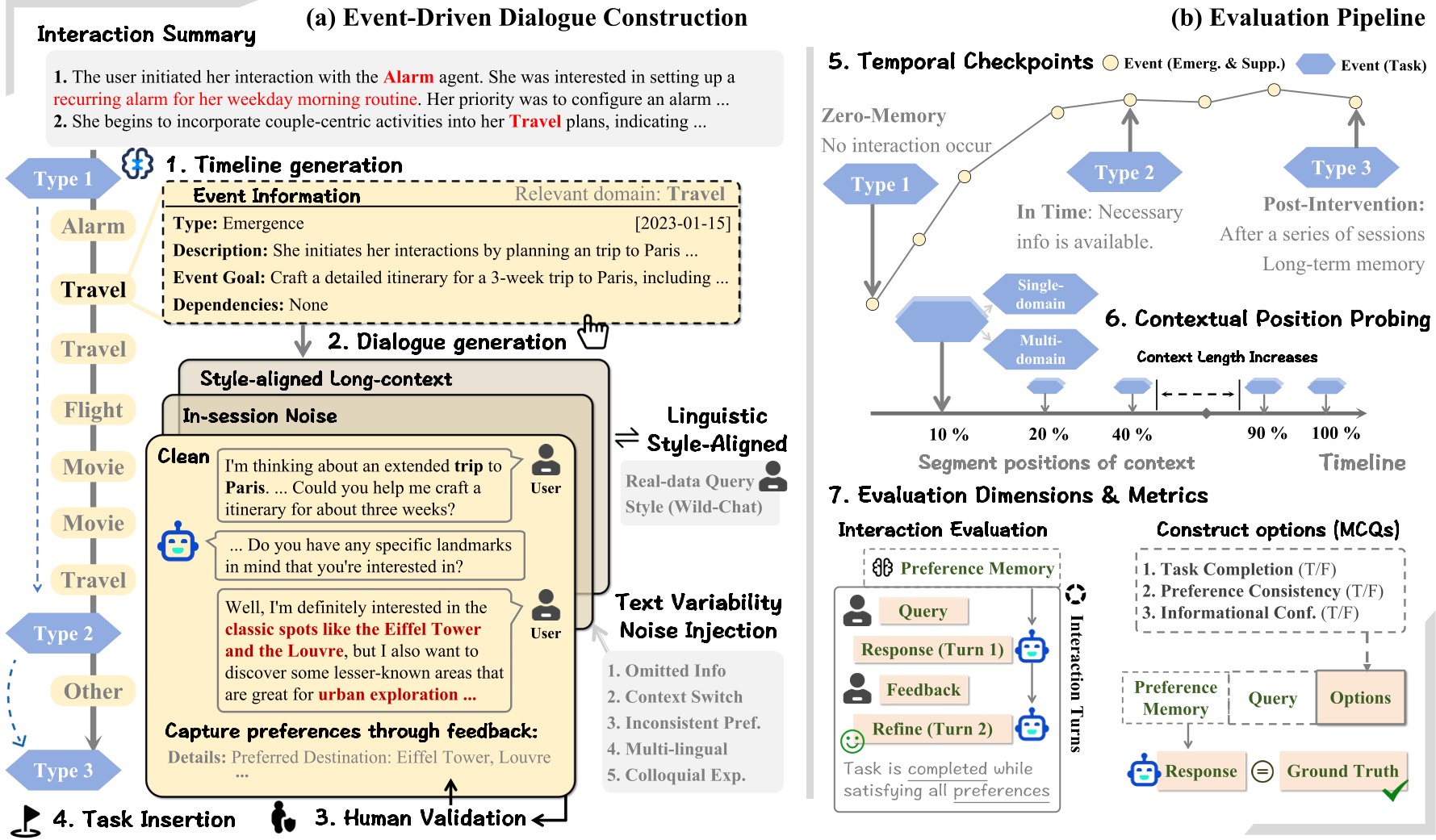 Figure 1: The PERMA pipeline for event-driven dialogue reconstruction and task insertion.
Key Insights from the Lab
The researchers tested a variety of models, from standalone giants like GPT-4o and Kimi-K2.5 to dedicated memory systems like MemOS and Mem0.
1. Memory Systems vs. Long Context
While models like Kimi-K2.5 and Qwen2.5-1M can ingest massive amounts of text, dedicated memory systems (like MemOS) are far more efficient. They achieve comparable accuracy while using 99% fewer tokens, drastically reducing the "interaction burden" and cost.
2. The "Noise" Paradox
Interestingly, the study found that for some memory systems, noise can be a catalyst. When a user is inconsistent or vague, it forces the system to pay closer attention to preference signals, occasionally leading to better extraction than in perfectly "clean" chats.
3. The Multi-Domain Wall
The biggest challenge remains Cross-Domain Synthesis. Models that are great at remembering your coffee order struggle when they have to combine your "budget-conscious finance persona" with your "luxury-seeking travel persona." Performance in multi-domain tasks showed a significant "persona drift" as context grew.
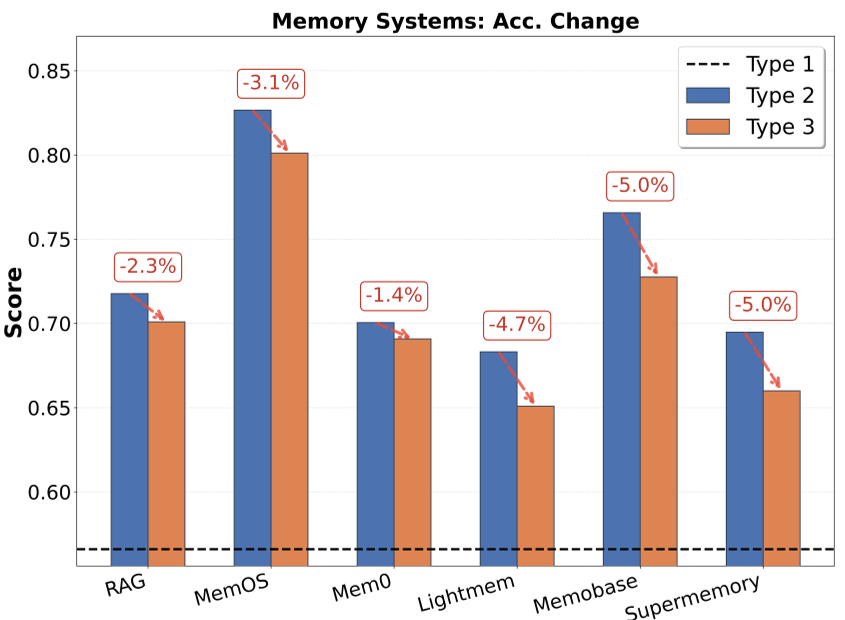 Figure 2: Accuracy consistently declines as temporal depth and cross-domain interference increase.
Critical Analysis: The Road to Lifelong Companionship
PERMA reveals that we are still far from "Jarvis." While RAG can find facts, it fails to abstract them. A true memory agent shouldn't just store "User likes hotel with pool"; it should understand the underlying why—the user values relaxation and wellness.
Limitations: The benchmark is currently dependent on LLM-as-a-judge for some metrics, which can introduce its own biases. Furthermore, the "noise" types, while comprehensive, may still not capture the full erratic nature of human emotion.
Conclusion
PERMA is a vital wake-up call for the AI industry. To build agents that feel like lifelong companions, we must stop treating memory as a search engine and start treating it as a persistent, evolving state. The future of AI isn't just about having a bigger context window; it’s about having a smarter way to fill it.