
Selective Social Awareness: How Random Boolean Networks Balance Traffic
Permission to make digital or hard copies of all or part of this work for personal or classroom use is granted without fee provided that copies are not made or distributed for profit or commercial advantage and that copies bear this notice and the full citation on the first page. To copy otherwise, to republish, to post on servers or to redistribute to lists, requires prior specific permission and/or a fee
This paper introduces a novel decision-making framework for route choice in multi-agent systems using Random Boolean Networks (RBN). By mapping the actions of a driver's social network (acquaintances) through boolean functions, the approach achieves a self-organizing traffic equilibrium where individual agents adapt their strategies based on local information.
TL;DR
Researchers have leveraged the logic of Random Boolean Networks (RBN)—originally a tool for biology—to solve the "Minority Game" of traffic congestion. By treating driving decisions as a product of what your friends do, the system achieves a global equilibrium without any central authority, proving that limited social information is actually better for coordination than "information overload."
The Problem: The Isolated Driver Fallacy
Most traffic simulations treat you as a lone wolf: you look at the map, see the delay, and choose. But in reality, decision-making is socially coupled. We listen to colleagues, follow trends, or react to a specific group of peers.
Prior work focused on pure Reinforcement Learning (RL), where agents only look at their own historical rewards. The flaw? It ignores the topological structure of information. How does a specific "social network" of acquaintances influence the stability of a city's traffic?
Methodology: Logic Gates in the Driver’s Seat
The authors propose that every driver is a node in a network, regulated by neighbors.
- The RBN Formalism: Each agent has a "strategy" defined by a Boolean function (like AND, OR, XOR). For example: "I will take Route A only if my neighbor X and neighbor Y both stayed home."
- The Evolution: Agents aren't stuck with one logic gate. They carry a "portfolio" of 10 functions. Using an -greedy strategy with simulated annealing, they test these functions and keep the ones that minimize travel time.
- Input/Output: The inputs are the binary choices (Route M vs. Route S) of acquaintances from the previous time step.
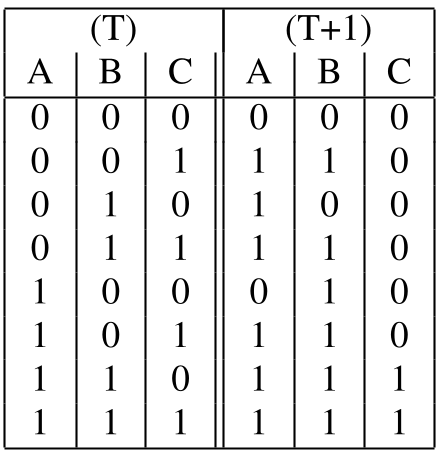 Figure 1: A network of 3 agents () where decisions are interconnected via logic gates.
Experiments: The Paradox of Information
The study tested scenarios with 18 drivers (small scale) and 900 drivers (large scale).
1. The Sweet Spot of Connectivity ()
A fascinating insight emerged: More information is not always better.
- When or , the agents quickly found an equilibrium.
- When , the number of possible logic functions explodes to over 4 billion (). The agents were overwhelmed; they couldn't explore the strategy space fast enough, and the system remained chaotic.
2. Convergence to Equilibrium
In the scenario, the system reached a perfect distribution where 2/3 of the agents took the main route—the mathematical "Wardrop's Equilibrium"—solely through local boolean adaptations.
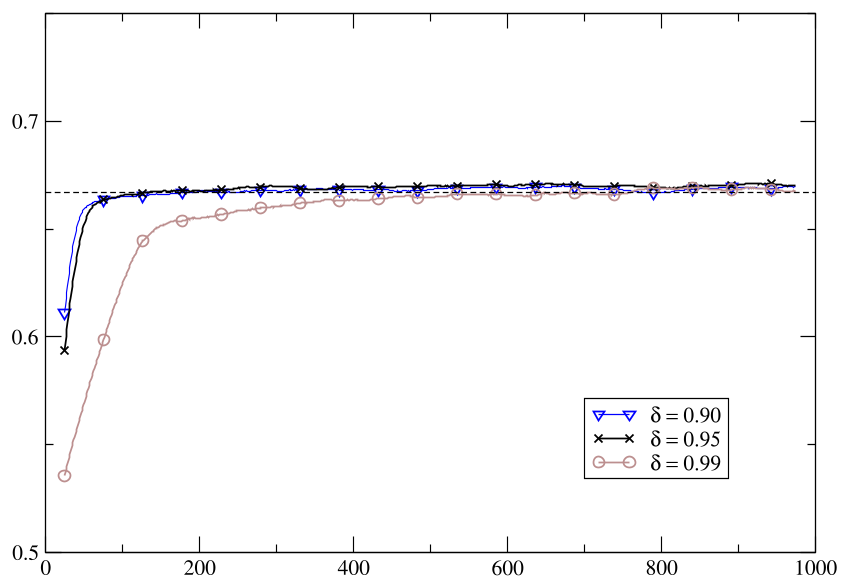 Figure 2: Fraction of drivers on the main route (M) stabilizing at the 0.66 target over time.
Critical Insights & Takeaways
This paper highlights the power of Inductive Bias in multi-agent systems. By constraining the way agents process information (using RBNs), the authors actually made the coordination problem easier to solve.
Key Takeaway: To build a self-organizing traffic system for autonomous vehicles, we don't need a "God-eye" server. We need "socially aware" pods that react to a small, consistent group of nearby vehicles using simple, evolvable logic.
Limitations:
- The RBN assumes a static social network. In real traffic, your "neighbors" change every minute.
- The 10-function limit per agent is an arbitrary constraint that helps convergence but might limit the "intelligence" of the agents in highly complex topologies.
Conclusion: Toward Social Autonomous Vehicles
The future of traffic isn't just "smart" cars; it's social cars. By using Random Boolean Networks, this work provides a blueprint for how collective intelligence can emerge from the bottom up, ensuring that when vehicles "talk" to each other, they actually reach a finish line that benefits everyone.