
The Architecture of Agreement: Why Persistent Relations Rule Social Networks
The Role of Persistent Graphs in the Agreement Seeking of Social Networks
This paper investigates opinion dynamics in social networks by introducing the concept of "Persistent Graphs," where arcs represent enduring relations with infinite cumulative influence. It establishes necessary and sufficient conditions for reaching global belief agreement in both discrete-time and continuous-time systems.
TL;DR
Is a global consensus in a social network driven by every interaction, or just a select few? This paper by Shi and Johansson proves that common opinions are determined strictly by Persistent Graphs—a subset of the network consisting of bonds with "infinite" cumulative influence. Whether in discrete or continuous time, the network reaches agreement if and only if this persistent backbone is quasi-strongly connected.
Problem & Motivation: The Flaw in Static Models
Most classical consensus models (like the DeGroot model) rely on a simplified assumption: that the "strength" of influence between two people is either constant or stays above a certain threshold.
In reality, social influence is messy. We might be briefly swayed by a viral tweet (vanishing influence) but deeply guided by a lifelong mentor (persistent influence). The authors ask: Which of these actually matters for long-term social cohesion? They argue that to understand belief evolution, we must separate transient noise from the persistent structural signals that define the network.
Methodology: Defining Persistency
The authors categorize arcs based on their "energy" or cumulative weight over an infinite horizon.
- Persistent Arcs: An arc is persistent if the integral (continuous) or sum (discrete) of its weight over time is infinite.
- Persistent Graph (): The subgraph containing only these persistent arcs.
The Core Insight
The researchers shifted the focus from the Underlying Graph (all possible interactions) to this . Using non-smooth analysis—specifically Dini derivatives to track the "spread" between the maximum and minimum belief in the network—they established that the ability to reach an agreement is a purely topological property of .
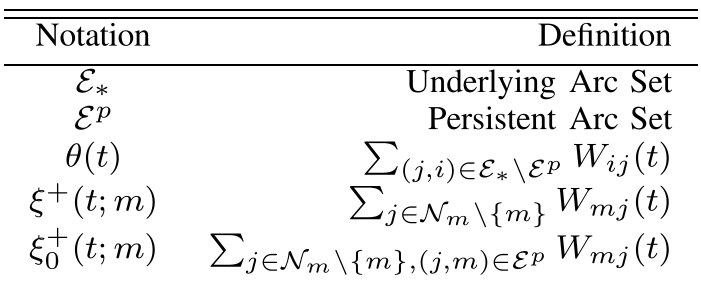 Table 1: Key notations used to separate persistent influence from non-persistent "noise".
Technical Deep Dive: The Conditions for Consensus
The paper provides a rigorous mathematical proof for two modes of evolution.
Discrete-Time Evolution
For the model , the authors identify three pillars for -agreement (exponentially fast convergence):
- Stochasticity: Weights must sum to 1.
- Self-confidence: Nodes must value their own opinion slightly ().
- Quasi-Strong Connectivity: There must be a "root" node in that can reach every other node through a path of persistent arcs.
Continuous-Time Evolution
In the continuous case , the result is even more striking. Global agreement is achieved if and only if is quasi-strongly connected. Here, the "Self-confidence" required in discrete time is naturally handled by the differential structure.
 Formulas (1) and (2): The fundamental dynamics for discrete and continuous belief revision.
Experiments & Results: The Power of the Diameter
The authors didn't just prove that they converge; they proved how fast. They demonstrated that the convergence rate is explicitly tied to the diameter () of the Persistent Graph.
- A "Flat" World: Small diameters (tightly knit persistent groups) lead to rapid consensus.
- The Bound: For discrete systems, the convergence follows: Where the decay factor is heavily penalized as the diameter increases.
Critical Insight: Why This Matters for Social Platforms
This research offers a sobering perspective on modern social media. If we want a society to reach a common understanding:
- Ephemeral interactions don't count: High-frequency but short-lived interactions (like a one-day trending topic) do not technically contribute to the "Persistency" required for a global shift in belief.
- The "Bridge" is vital: Even if everyone is talking, if the Persistent Graph is fragmented (not quasi-strongly connected), the network will never reach agreement. It will remain in a state of "persistent disagreement."
Limitations
The model assumes Arc Balance (the ratio between strongest and weakest persistent links is bounded). In highly polarized networks where some voices are infinitely louder than others, this assumption might break down, leading to more complex "fragmented" consensus states not covered here.
Conclusion
Shi and Johansson’s work elevates the study of social networks from simple connectivity to "temporal depth." By proving that the Persistent Graph is the true skeleton of social influence, they provide a roadmap for understanding how long-term friendships and institutional bonds—rather than fleeting interactions—steer the collective mind.