
Modeling the Economic "Gut": Predicting Individual Choice via Neural Dipoles
Person-by-person prediction of intuitive economic choice
2014-09-16
Summary
Problem
Method
Results
Takeaways
Abstract
This paper introduces a hybrid neural model based on the Grossberg-Schmajuk Recurrent Associative Gated Dipole (READ) architecture to forecast individual economic choices. By personalizing differential equations for each subject, the study successfully predicts the decision-making patterns of "intuitive" thinkers in a complex four-supplier marketplace experiment.
## Executive Summary
**TL;DR**: While standard economics treats humans as rational calculators, this research proves that many of us choose based on a biological "balance sheet" of emotions. By applying a system of nonlinear differential equations—originally designed to model neurons—to individual laboratory participants, the author successfully predicted "intuitive" market choices with startling precision, sometimes reaching 100% accuracy for a specific person.
**Academic Positioning**: This work bridges the gap between **Mathematical Neuroscience** and **Behavioral Economics**. It moves beyond the phenomenological descriptions of Prospect Theory into the realm of "Biologically Inspired Forecasting," positioning the **READ (REcurrent Associative gated Dipole)** circuit as a potential substrate for "System I" intuitive thinking.
## The Problem: The Failure of Aggregate Models
Most econometric models (like Multinomial Logit) suffer from the "average person" fallacy. They assume that if you have enough data from a thousand people, you can predict the next person. However, human intuition is deeply idiosyncratic and time-sensitive.
Prior work often ignores the **temporal dynamics of emotion**—how a single bad experience "depletes" our trust (neurotransmitter) and how we recover over time. The challenge is: *Can we model the internal emotional state of a single individual well enough to predict their next move in a competitive market?*
## Methodology: The READ Neural Circuit
The core of the methodology is the **READ circuit**, a sophisticated architecture consisting of 18 differential equations. The model tracks three distinct layers of human memory:
1. **Short-Term Memory (STM)**: Immediate neural activation in response to a supplier's offer.
2. **Medium-Term Memory (MTM)**: The chemical "gate"—modeling how neurotransmitters deplete during disappointment and recover during satisfaction.
3. **Long-Term Memory (LTM)**: The "Reputation" factor, where the link between a specific supplier and an emotional valance is stored.
### Model Architecture
The system uses a **Gated Dipole**, which acts like an emotional see-saw. When a supplier over-delivers, the "on-channel" (satisfaction) is triggered. When they fail, the "off-channel" (disappointment) takes over.
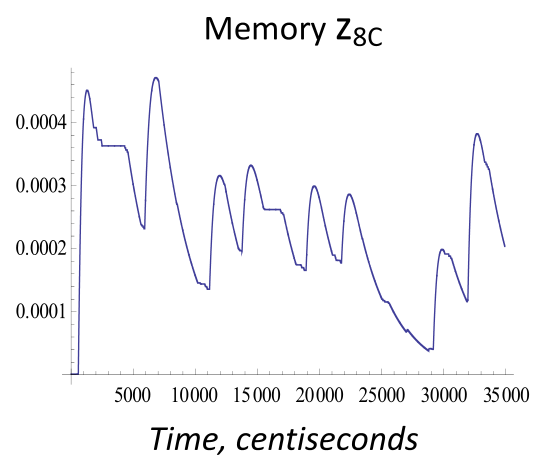
The author combined these neural outputs into a **Three-Factor Decision Rule**:
- **Factor 1 (The Present)**: The immediate reaction to the current offers.
- **Factor 2 (The Reputation)**: The LTM ratio of positive to negative past experiences.
- **Factor 3 (The Specific Memory)**: The specific satisfaction level from the very last deal with that supplier.
## Experiments: The "Omnium Bonum" Game
Participants had to choose between four suppliers of a fictitious good. The suppliers had different risk profiles: some were reliable but modest, others offered huge potential but were prone to "disappointing" the user.
### Key Results: Intuition vs. Strategy
The model's success was binary: it worked brilliantly for "instinctive" players and failed for "strategists."
- **High Predictability**: For about 20% of the subjects, the model matched their choices almost perfectly. These were people guided by "gut feelings."
- **Complex Tasks**: When the author added complex economic data (like GDP-style forecasts), the model's accuracy dropped. Why? Because complexity forced users out of "System I" (Intuition) and into "System II" (Analysis), which the READ circuit isn't designed to model.
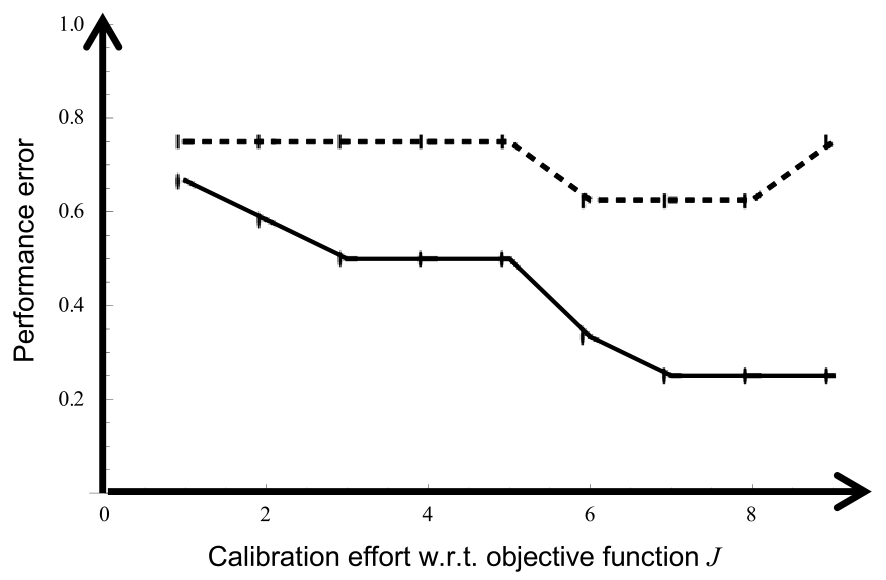
*Note how the calibration error (solid) drops, while the test error (dotted) shows the model's ability to generalize to future rounds.*
## Critical Analysis & Deep Insights
The most profound takeaway is that **human intuition has a predictable mathematical structure**. While "rational" strategy is flexible and hard to pin down, "primitive intuition" follows the laws of biological feedback loops.
### Limitations
- **Non-stationarity**: Humans change. A person who starts out choosing by "gut" might switch to a "strategy" halfway through, causing the model to lose its grip.
- **Parameter Instability**: With 11 parameters per person, multiple combinations can produce the same behavior, making it hard to say *exactly* which emotional factor was the primary driver.
## Future Outlook
This research paves the way for **Heterogeneous Agent-Based Models (ABM)**. Future economic simulations shouldn't just have "risky" or "safe" agents; they should have "Intuitive Agents" powered by neural dipoles and "Strategic Agents" powered by symbolic logic.
By quantifying the "gut feeling," we move one step closer to an economic science that actually understands the biological machine doing the choosing.