
Self-Joint Attention: Redefining Gender Classification with RGB-D Data
Person Gender Classification on RGB-D Data With Self-Joint Attention
This paper introduces a deep learning-based human gender classification framework specifically designed for RGB-D data. It features a novel Self-Joint Attention (SJA) mechanism that fuses color and depth modalities, achieving SOTA performance on the SRL RGB-D Human Attributes dataset.
Executive Summary
TL;DR: Researchers from Khalifa University have developed a deep learning framework that solves the "pose and occlusion" problem in gender classification by intelligently fusing RGB and Depth information. Using a Self-Joint Attention (SJA) mechanism, the model learns to focus on discriminative body features even when the person is walking, carrying luggage, or facing away from the camera.
Academic Positioning: This work represents a shift from hand-crafted geometric descriptors (like HOG/HOD) to end-to-end multi-modal deep learning. It addresses the fusion bottleneck in RGB-D perception by moving beyond simple feature concatenation to a dynamic, attention-driven integration strategy.
The Motivation: Why 2D is Not Enough
Most gender classification systems are "face-centric." While high-performing in controlled environments, they break down in real-world surveillance where faces are often occluded or viewed from the side. Depth sensors (like Kinect) provide a 3D structural "silhouette" that remains stable under lighting changes, but the industry has struggled to effectively blend this structural data with traditional color imagery without losing the nuances of either.
The authors identified that previous methods ignored the inter-dependency between how a person looks (RGB) and how they are shaped (Depth).
Methodology: The Self-Joint Attention (SJA) Module
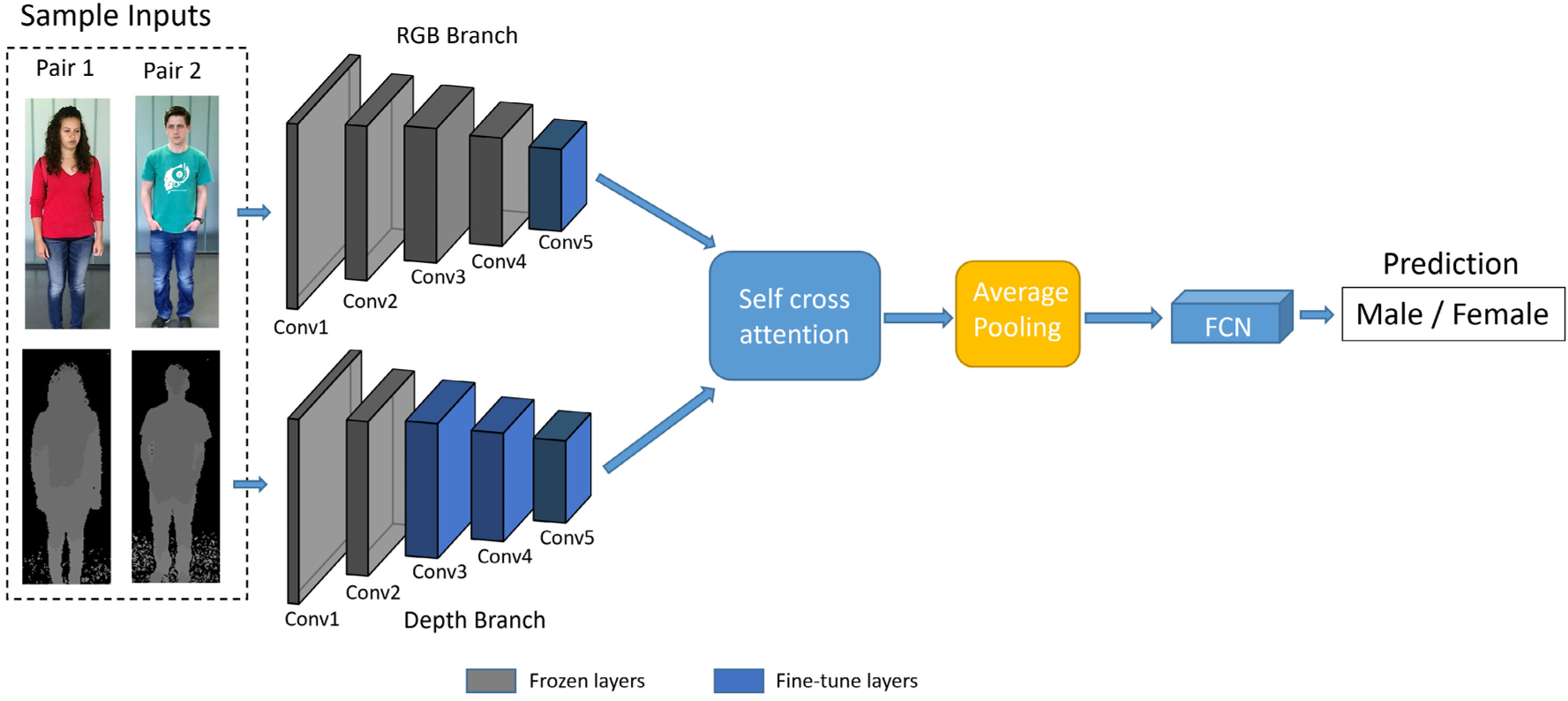
The core innovation is the SJA module, which sits atop a dual-branch CNN backbone (validated with VGG and ResNet).
1. Dual-Branch Feature Extraction
The model processes the RGB image and the Depth map (replicated into 3 channels) through separate CNN streams. Crucially, the authors found that fine-tuning more layers in the Depth branch was necessary since pre-trained ImageNet weights are optimized for color, not geometric maps.
2. Multi-Head Self-Joint Attention
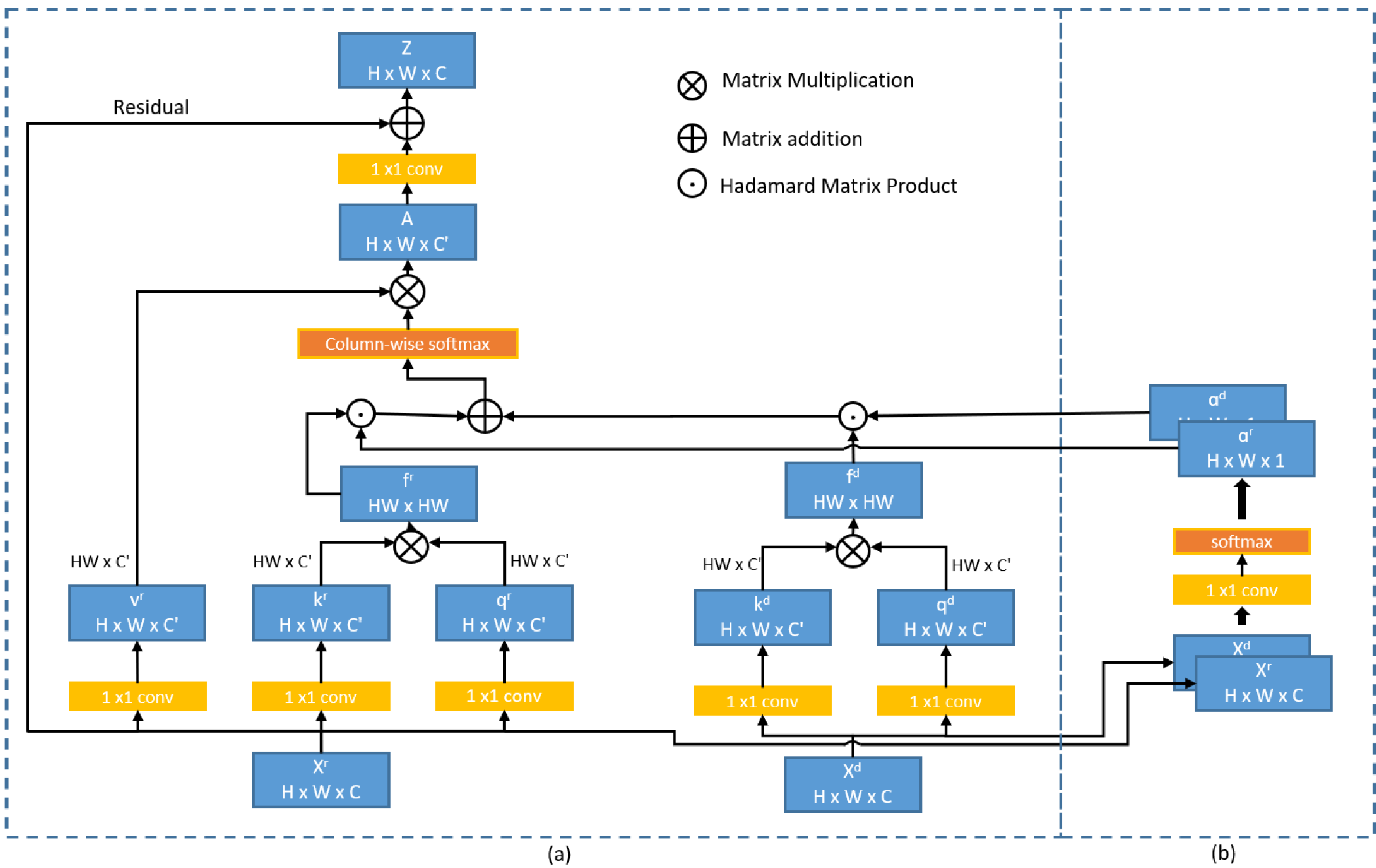
Inspiration was drawn from the Transformer architecture. Instead of processing modalities in isolation, the SJA computes Query (), Key (), and Value () vectors. The attention score is derived from a weighted sum of RGB and Depth interactions:
This allows the model to "attend" to areas where both modalities agree on a feature's importance (e.g., body proportions or shoulder width).
3. Selective Fusion
Not all depth data is reliable; sensors often produce "holes" or noise. The model uses a Selective Fusion scheme where a learnable weight map () dynamically prioritizes the modality that provides more discriminative information at a specific pixel location.
Experimental Results: Breaking the SOTA
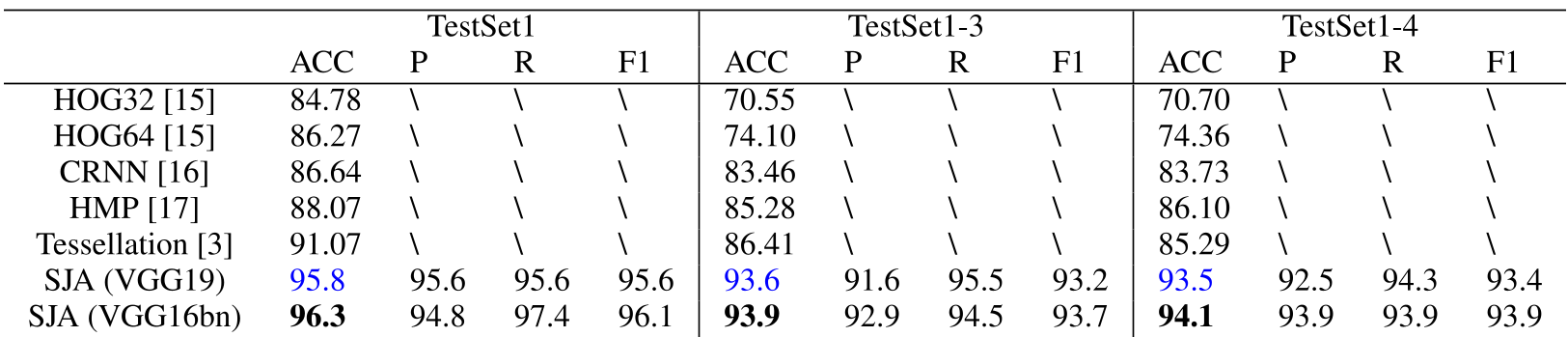
The framework was tested on the SRL RGB-D Human Attributes Dataset, which includes challenging scenarios like walking in circles and close-up interactions.
- Massive Gains: On the most difficult "Interaction" test set (TestSet1-4), the model achieved 94.1% accuracy, an 8.7% improvement over the previous SOTA (HMP).
- Ablation Consensus: The study confirmed that "Late Fusion" (at the Conv5 layer) is superior. Early fusion (Conv3/Conv4) led to a catastrophic drop in accuracy because the spatial features were too raw for the attention mechanism to find meaningful global context.
Visual Evidence: What is the Model "Seeing"?
Heatmap visualizations (Grad-CAM style) reveal that while the "No Attention" baseline often stares at the floor or background, the SJA-equipped model tightly focuses on the human torso and head, identifying gender-specific morphological cues.
Critical Analysis & Conclusion
Takeaway
This research proves that attention is the "glue" for multi-modal fusion. By allowing the RGB stream to be guided by the geometric cues of the Depth stream, the model achieves a level of pose invariance that 2D-only systems simply cannot match.
Limitations & Future Work
- Computation: While the attention module itself is "lightweight," running two CNN backbones simultaneously increases inference latency (approx. 0.5s/frame).
- Generalization: The model was trained on Kinect-2 data; its robustness against lower-resolution mobile ToF (Time-of-Flight) sensors remains an open question.
- Future Path: Integrating temporal information (video sequences) instead of single-frame RGB-D pairs could further stabilize predictions during fast movement.
Final Verdict: A robust, mathematically sound approach to a classic problem, demonstrating that the future of person attribute recognition lies in the "joint" understanding of color and geometry.