
Deciphering the Silent Language of Muscles: Person-Independent Emotion Estimation
Person-independent estimation of emotional experiences from facial expressions
This paper presents a method for person-independent estimation of emotional valence using facial electromyography (EMG). Specifically, it monitors the zygomaticus major and corrugator supercilii muscles to classify emotional experiences as positive or negative, achieving accuracy rates of up to 80% for video stimuli.
TL;DR
This research tackles the challenge of identifying whether a user is feeling positive or negative emotions without needing to "train" the system for every new user. By measuring the electrical activity of just two facial muscles—the ones responsible for smiling and frowning—the researchers developed a real-time system that correlates physical muscle contraction directly with subjective emotional valence, hitting an impressive 80% accuracy for video-induced emotions.
Background: Beyond the Camera Lens
In the landscape of Affective Computing, most eyes are on Computer Vision (CV). While CV has made leaps in recognizing facial landmarks, it remains susceptible to "real-world" noise: poor lighting, head rotations, and occlusions. This paper, published in the Tenth International Conference on Intelligent User Interfaces (IUI'05), pivots toward Electromyography (EMG). EMG measures the actual electrical discharge of muscle fibers, providing a direct pipeline to the user's physiological response that is invisible to the naked eye and immune to lighting conditions.
The Core Insight: The Valence Bipolarity
The researchers grounded their work in the Dimensional Emotion Framework. Instead of trying to detect complex categories like "disgust" or "surprise" (which are often culturally dependent), they focused on Valence: the spectrum from negative to positive.
The biological "sensors" used were:
- Zygomaticus Major: The "smile" muscle.
- Corrugator Supercilii: The "frown" muscle.
The innovation here is the Person-Independent approach. While previous iterations required a calibration phase to understand a specific user's "muscle baseline," this study tested whether the direction of change (increase vs. decrease relative to a neutral state) was enough to judge emotion across different people.
Methodology: The Difference Score
The authors proposed three models to interpret muscle data:
- Zygomaticus Only: High activity = Positive.
- Corrugator Only: High activity = Negative.
- Difference Score: (Zygomaticus - Corrugator). If the result is positive, the emotion is positive; if negative, the emotion is negative.

The experiment involved 10 subjects exposed to both static IAPS (International Affective Picture System) images and video clips with high emotional resonance.
Results: Videos vs. Pictures
The findings revealed a fascinating discrepancy: humans react more strongly and predictably to dynamic stimuli.
- Pictures: The system achieved ~70% accuracy.
- Videos: The system surged to over 80% accuracy.
The "Difference Score" proved to be the most robust metric, as it captures the push-and-pull relationship between the two muscle groups.
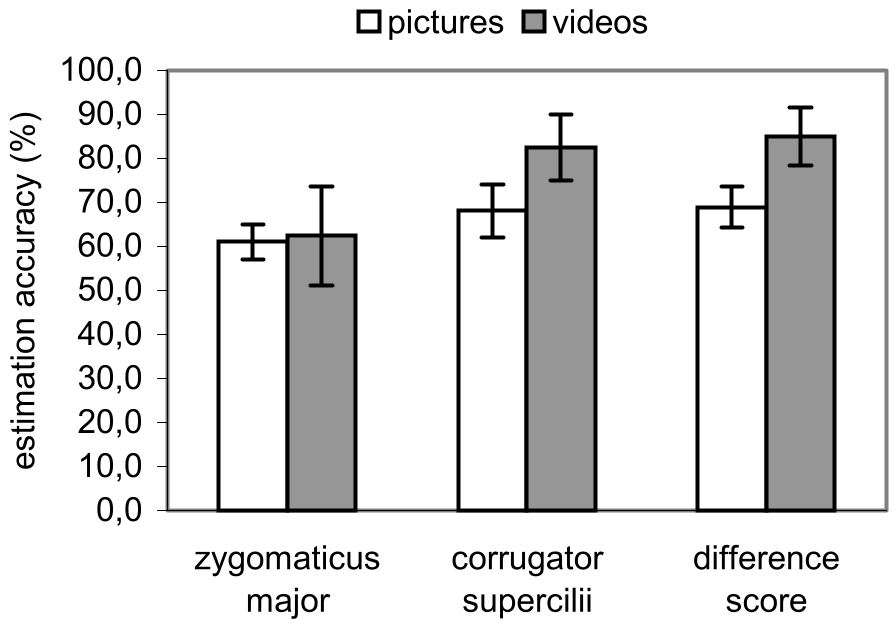 Figure 1: Comparison of the three models across pictures and videos. Note how the combination of muscles (Difference Score) provides the most reliable person-independent signal.
Why This Matters for HCI
Imagine a computer that realizes you are frustrated (high corrugator activity) before you even click "Help." Or an e-learning platform that detects a student's positive engagement (zygomaticus activation) with certain material and adapts the curriculum accordingly.
By proving that these signals are person-independent, the research removes a massive barrier to entry: the need for tedious calibration. It suggests that while our faces look different, the underlying "muscle-to-emotion" logic is remarkably universal.
Critical Analysis & Conclusion
While this work is a milestone for physiological HCI, it does have limitations:
- Physical Connection: Traditional EMG requires surface electrodes attached to the face, which is intrusive for everyday use.
- Resolution: The bipolar "Positive vs. Negative" classification is a great start but lacks the nuance to distinguish between "Anger" and "Sadness" (both are negative valence).
Future Outlook: The authors suggest that these EMG findings can actually inform better Computer Vision algorithms. By knowing which muscle sites provide the cleanest valence signal, CV researchers can focus their tracking on the lip corners and inner brows with higher mathematical weight. As wearable tech (like smart glasses) evolves, integrated EMG sensors could finally make this "invisible" emotional intelligence a standard feature of our digital lives.