
PERSONA: Decoding the Algebra of Personality in LLMs
PERSONA: Dynamic and compositional inference-time personality control via activation vector algebra
The paper introduces PERSONA, a training-free framework for dynamic and compositional personality control in Large Language Models. By leveraging Activation Vector Algebra, it achieves a 9.60 score on PersonalityBench, nearly matching the 9.61 upper bound of supervised fine-tuning (SFT) across diverse model families like Llama, Qwen, and Mistral.
Executive Summary
TL;DR: Harbin Institute of Technology and HKU researchers have unveiled PERSONA, a framework that treats LLM personality not as a text-prompting trick, but as a geometric problem. By manipulating "personality vectors" in the model's internal activation space, they achieve results that rival Supervised Fine-Tuning (SFT) without updating a single weight.
This work marks a shift from Black-box Prompting to Interpretable Activation Engineering, allowing models to dynamically turn up "Carelessness" or turn down "Neuroticism" in real-time as a conversation evolves.
The "Static Personality" Bottleneck
In current LLM applications (healthcare, education, roleplay), we usually give a model a "System Prompt" like 'You are a friendly doctor'. However:
- Instability: The model might "forget" its persona halfway through a long chat.
- Rigidity: It cannot easily blend traits (e.g., 70% extraverted but 30% cautious).
- Cost: Fine-tuning a specific model for every possible persona is computationally ruinous.
The authors argue that personality is dynamic and compositional. Human behavior shifts based on context—even a "dependable" person might become "nervous" under deadline pressure.
Methodology: The Geometry of Human Traits
The PERSONA framework is built on a three-tier architecture:
1. PERSONA-BASE: Extracting the Big Five
Using the OCEAN (Openness, Conscientiousness, Extraversion, Agreeableness, Neuroticism) model, the researchers used contrastive analysis to find the specific "directions" in the model's hidden layers that represent these traits. They found that these dimensions are approximately orthogonal (independent), meaning you can adjust one without accidentally breaking the others.
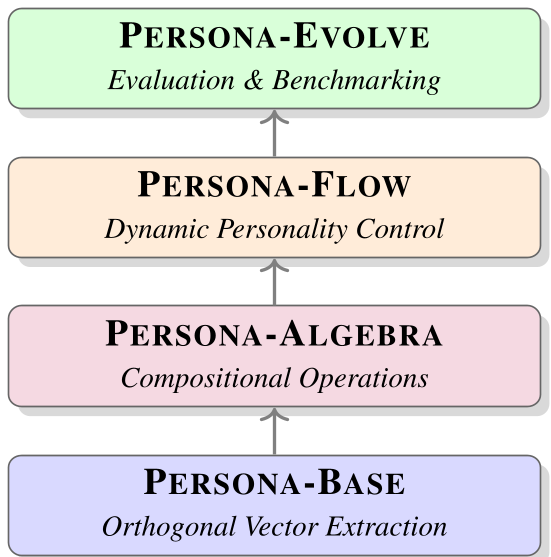
2. PERSONA-ALGEBRA: Vector Arithmetic
Since these traits are vectors, we can use math to control them:
- Scaling (): Increase or decrease trait intensity.
- Addition (): Compose multi-faceted personas (e.g., Inventive + Outgoing).
- Subtraction (): Suppress unwanted traits (e.g., removing 'Self-interest' from an assistant).
3. PERSONA-FLOW: Real-time Steering
Unlike a static system prompt, PERSONA-FLOW uses a "predict-then-steer" loop. For every turn in a dialogue, the model first predicts the required shift in personality, then injects the resulting composite vector into its own residual stream.
Performance: Matching the SFT Gold Standard
The most striking result is found in PersonalityBench. PERSONA-BASE achieved a mean score of 9.60, effectively identical to the 9.61 achieved by Supervised Fine-Tuning (LoRA).

Beyond static scores, the PERSONA-EVOLVE benchmark (800 multi-turn scenarios) showed that this method achieved win rates of up to 91% against vanilla models in terms of Trait Adherence and Authenticity.
Deep Insight: Why Does Vector Algebra Work?
The success of PERSONA suggests that LLMs don't just "simulate" personality through words; they organize concepts into linear structures within their latent space.
The authors observed "Alignment Resistance": when trying to steer a model to be purely "Self-interested" (anti-social), the model's safety-aligned layers actually resisted the vector injection. This reveals a fascinating tug-of-war between a model's base training and the steerable activation space.
Critical Analysis & Future Outlook
While the method is revolutionary, it has its limits:
- Information Fidelity: While the model's vibe was perfect, its factual accuracy (Information Fidelity) didn't see the same massive gains as its personality scores.
- Safety: Inducing "Carelessness" can inadvertently increase the model's likelihood of following harmful adversarial prompts.
Conclusion: PERSONA proves that we no longer need to "beg" LLMs to stay in character using elaborate prompts. By speaking the model's internal language—activation vectors—we can achieve precise, stable, and dynamic behavioral control.