
REK: Deciphering the "Social" in Social IoT through Experience and Reputation
From Personal Experience to Global Reputation for Trust Evaluation in the Social Internet of Things
This paper introduces REK, a comprehensive trust evaluation model for the Social Internet of Things (SIoT) that imitates human cognitive processes. It evaluates trust through three indicators: Reputation, Experience, and Knowledge, specifically proposing mathematical models for Experience (direct interaction history) and Reputation (global perception derived from weighted peer recommendations).
TL;DR
The Social Internet of Things (SIoT) isn't just about connected devices; it's about entities forming relationships. This paper presents REK, a trust evaluation framework that mirrors human psychology. By combining personal Experience, global Reputation, and direct Knowledge, REK provides a mathematically rigorous way for devices to decide who to trust in a world of billions of autonomous agents.
Background: Why "Trust" is the New "Security"
In the traditional IoT, security is binary: you have the key, or you don't. In the Social IoT (SIoT), the landscape is murkier. Devices act on behalf of owners, making decisions (like car-sharing or data-swapping) that involve inherent risk.
The authors argue that "Trust" is the perception of a trustee’s trustworthiness under specific environment risks. To navigate this, they propose that a device needs more than just a firewall; it needs a social brain.
Methodology: The REK Triad
The REK model (Reputation, Experience, Knowledge) decomposes trust into three distinct sources:
- Experience (Personal): "How has this device treated me in the past?"
- Reputation (Global): "What does the entire network think of this device?"
- Knowledge (Direct): "What do I observe about this device's current attributes?"
1. The Experience Model: Gain Slowly, Lose Fast
The authors model Experience using mathematical difference equations that capture three social realities:
- Development: Trust builds linearly through cooperative interactions.
- Loss: Trust drops significantly faster than it builds when a device fails (the authors use a factor , meaning one failure undoes two successes).
- Decay: Relationships weaken over time without "maintenance" interactions.
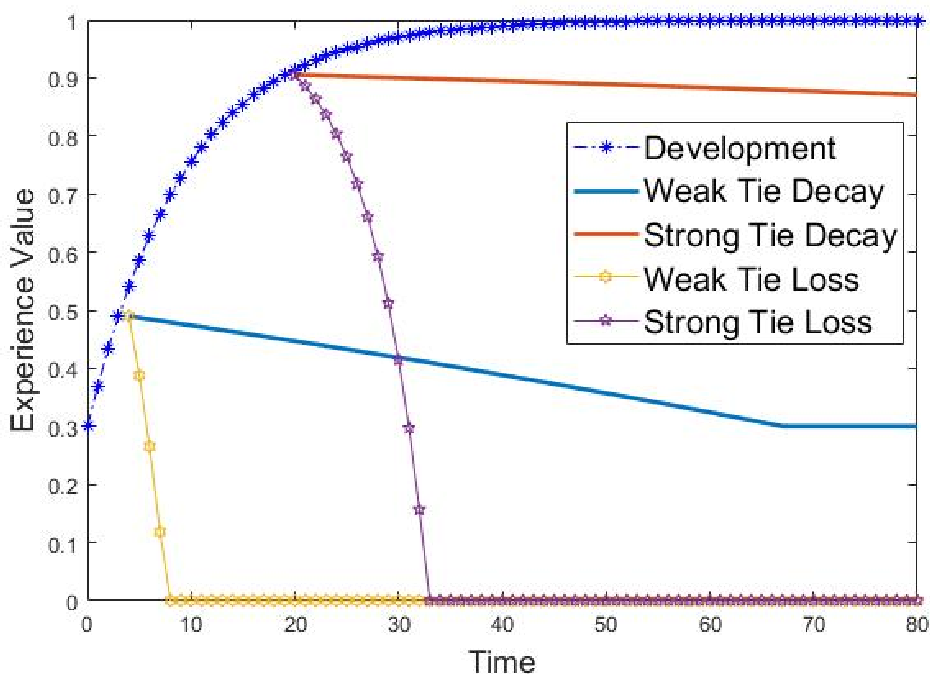 The graph shows how Experience asymptotically approaches 1, but drops sharply upon uncooperative behavior.
2. The Reputation Model: A PageRank for Things
How do you trust a stranger? You ask others. However, not all opinions are equal. The REK Reputation model uses an iterative approach inspired by Google PageRank. The reputation of Entity X is a weighted sum of recommendations from its peers. Crucially, a recommendation is weighted by the recommender's own reputation. If a highly reputable device says Entity X is good, Entity X’s reputation surges.
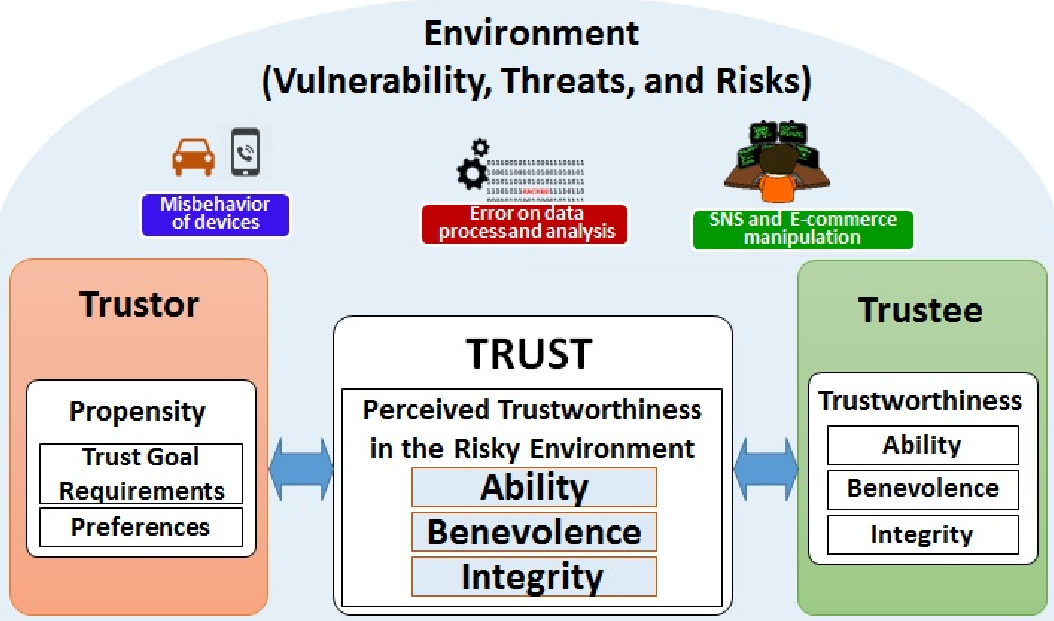 The conceptual framework mapping Trustworthiness Attributes (Ability, Benevolence, Integrity) to the final Trust evaluation.
Experimental Validation
Using Matlab simulations, the authors verified that their reputation algorithm converges even as the network scales.
- Convergence: The system reaches stability within 50 iterations for an 800-node network.
- Scalability: The complexity grows linearly with the number of interactions, suggesting it can handle the dense traffic of a Smart City.
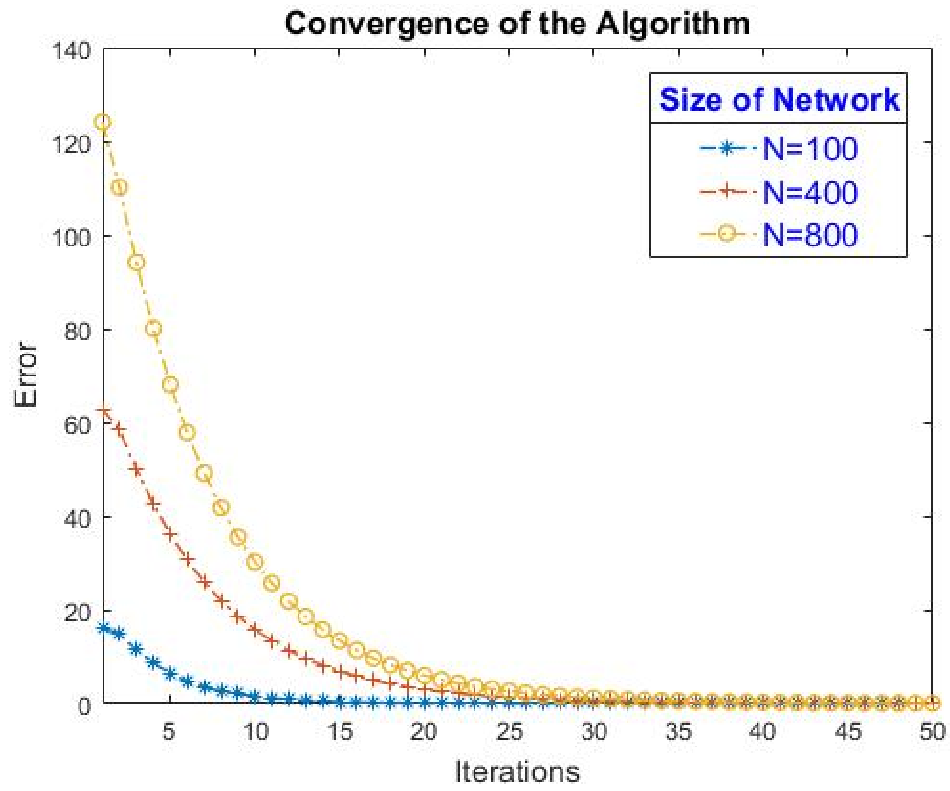 Results show the algorithm's stability across different network sizes (N=100, 400, 800).
Critical Insight & Analysis
The brilliance of the REK model lies in its asymmetry. Most IoT models treat trust as a static score. REK acknowledges that Experience is subjective (Trustor-centric) while Reputation is objective (Trustee-centric). By separating these, the model prevents a single "bad day" from destroying a device's global reputation while still allowing individual users to remain cautious based on their own poor experiences.
Limitations
- Cold Start Problem: New entities with no history (low Knowledge and no Experience) may be unfairly marginalized.
- Centralization: While the math is solid, the paper notes that managing billions of interactions might require a semi-distributed architecture to solve memory constraints.
Conclusion
As we move toward a Cyber-Physical-Social System (CPSS), the REK model provides a vital blueprint for how machines can navigate social complexity. By quantifying "Experience" and "Reputation," the authors move SIoT from a simple network of sensors to a sophisticated ecosystem of trusted partners.
Takeaway for Researchers: The integration of weighted social ranking (PageRank style) with temporal decay (Experience) is the current SOTA direction for maintaining long-term stability in dynamic, large-scale IoT environments.