
Social Network Capital: Decoding Personal Gains and Usage Disparities in the UK and Germany
Personal Gains from Materials in Social Networks
This paper investigates the personal gains and usage patterns of Social Network Sites (SNS) among users in the United Kingdom and Germany. It employs a quantitative survey method to compare metrics such as contact counts, daily time spent, and motivations for SNS participation, identifying "social dialogue" as a primary driver.
TL;DR
This study provides a comparative quantitative analysis of how individuals in the UK and Germany derive value from Social Network Sites (SNS). By analyzing contact counts, time investment, and user motivations, the research highlights that while usage metrics differ across borders, the core value of SNS has shifted toward active social dialogue and information efficiency rather than simple relationship maintenance.
Background & Motivation
Despite the global nature of the internet, social network usage is far from uniform. Cultural and historical backgrounds play a significant role in how "Social Capital" is accumulated and utilized. The authors set out to move beyond generalities, seeking to answer: How much time do people actually spend on these platforms? and What is the tangible "gain" that keeps them logged in?
The study addresses the friction between the theoretical "Social Capital" (the value derived from networks) and the empirical reality of daily digital habits.
Methodology: A Statistical Comparison
The researchers utilized a survey-based approach, focusing on two of Europe's largest digital economies: the UK and Germany. A unique aspect of the methodology is the use of a 1–6 evaluation scale, which aligns with the German academic grading system (where 1 is "Strongly Agree/Excellent" and 6 is "Strongly Disagree/Fail").
Key Metrics Tracked:
- Network Size: Total contacts on the user's primary SNS.
- Engagement Time: Daily minutes spent on the platform.
- Tenure: Number of years the user has been a member.
- Psychographic Drivers: Why they use the site (Information, Price, Dialogue, or Relationship maintenance).
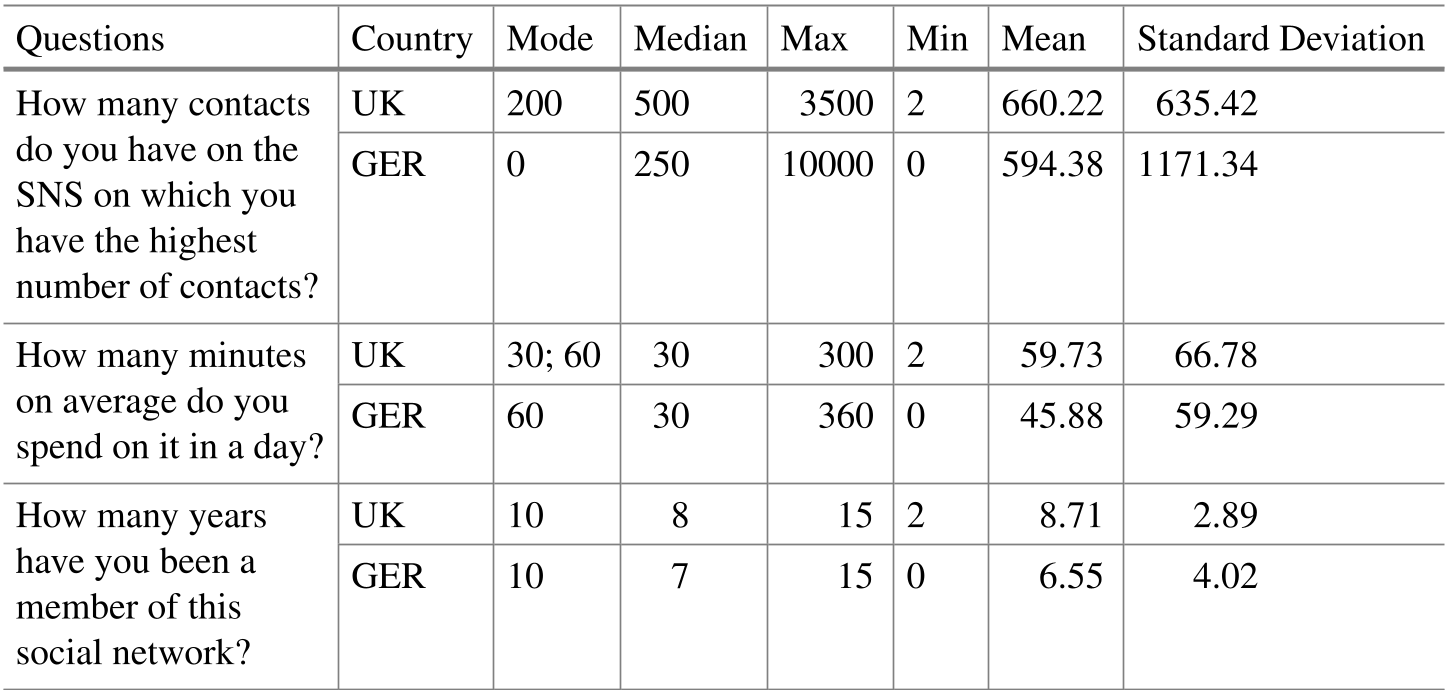
Deep Dive: UK vs. Germany
The data reveals distinct "digital personalities" for each country:
- The Hyper-Connected UK: Respondents in the United Kingdom boast a higher average of contacts (660.22) and spend significantly more time per day on SNS (nearly an hour) than their German counterparts.
- The Conservative German User: German users maintain smaller networks (avg. 594.38) and spend less time daily (45.88 mins). However, the standard deviation for German contact counts is remarkably high (1171.34), suggesting a massive disparity between "power users" and "casual users" in Germany compared to a more uniform usage pattern in the UK.
Why We Log In: Dialogue Over Updates
The most striking finding of this paper is the hierarchy of user motivations. Contrary to the initial "social" intent of platforms like Facebook, the "maintenance of relationships with friends or family" was rated as less important than active participation.
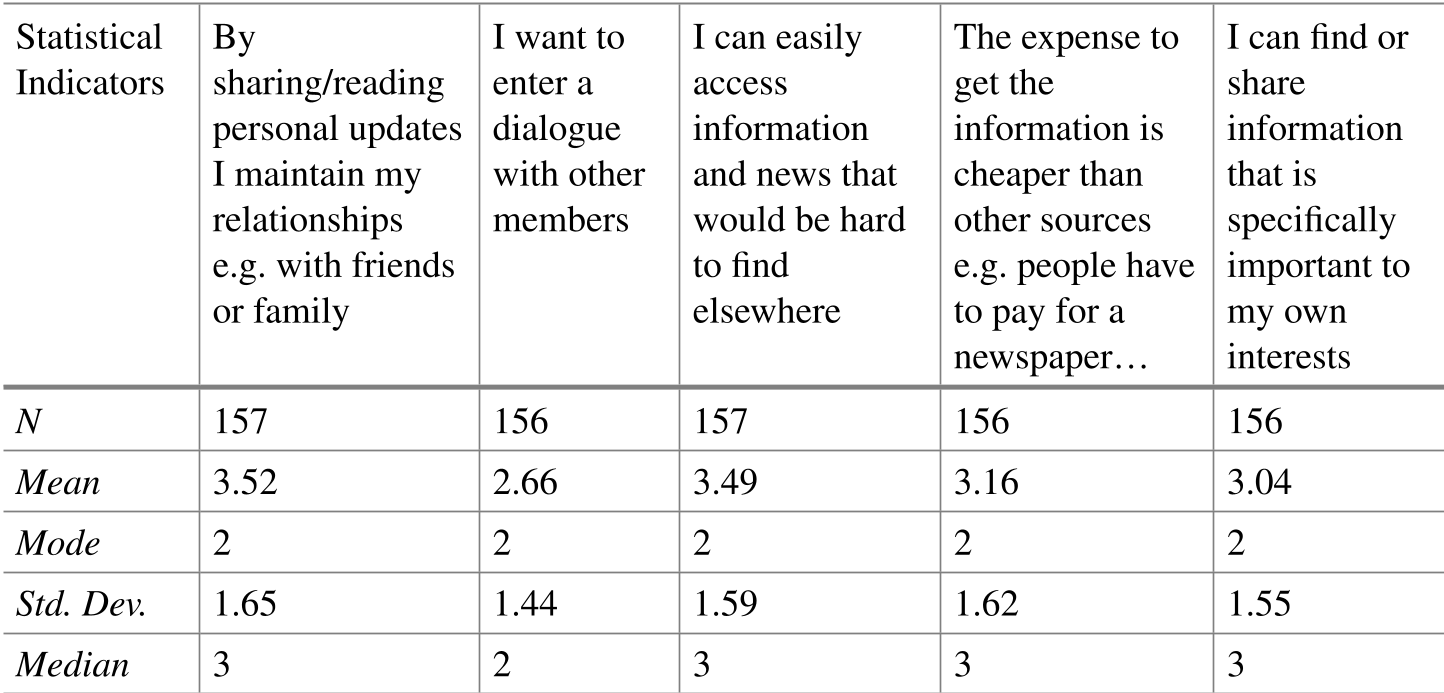
- The Winner: Social Dialogue. The drive to "enter a dialogue with other members" received the strongest agreement (Mean: 2.66).
- The Utility Aspect: Finding unique information and cost-saving (e.g., getting news for free instead of buying a newspaper) were mid-tier drivers.
- The Unexpected Low: Maintaining family relationships via updates (Mean: 3.52). This suggests that for high-stakes, personal relationships, users still prefer direct, non-SNS contact.
Critical Insight & Conclusion
The study concludes that Social Network Sites have evolved into Information and Dialogue Hubs rather than mere digital scrapbooks for family photos. The "Personal Gain" is identified as the efficiency of communication and the ability to find niche information that was previously "hard to find elsewhere."
Limitations & Future Work
The study relies heavily on descriptive statistics; future research could benefit from regression analysis to see if "Time Spent" directly predicts "Perceived Gain." Additionally, as the digital landscape shifts towards short-form video (TikTok) and decentralized networks, these 2026 perspectives on "contacts" and "membership years" may need to be redefined to account for algorithmic feeds rather than static social graphs.
Takeaway: In the digital economy of the UK and Germany, the "Material Gain" of a social network is not the size of the friend list, but the quality of the dialogue it enables.