
ph-REST: Decentralizing Recommendations via Personal RESTful Engines
Personal-Hosting RESTful Web Services for Social Network Based Recommendation
The paper introduces ph-REST, a decentralized personal-hosting RESTful web services architecture for social network-based recommendations. It leverages a relay-based mechanism where each user acts as both a service provider and consumer through a dedicated REST-engine to facilitate distributed information sharing.
TL;DR
The paper presents ph-REST, an architecture that transforms how we think about social recommendations. Instead of a central server telling you what you like, ph-REST gives every user their own RESTful web services engine. These engines talk to each other, relaying requests through "co-peers" (friends with shared interests) to produce highly personalized, distributed recommendations that mimic real-world human social behavior.
The Problem: Centralized Filtering vs. Human Intuition
Most modern Recommender Systems (RS) rely on Collaborative Filtering (CF) or Content-Based (CN) filtering. While effective, they suffer from two major flaws:
- Centralization: They require a global dataset, which raises privacy concerns and creates a single point of failure.
- Social Disconnect: They often ignore the "relay" nature of human knowledge—how we ask a colleague, who asks their mentor, who then passes a specific, trusted suggestion back to us.
The authors argue that current methods don't work effectively when a specific group wants to share info within their own social structure.
Methodology: The "Personal-Hosting" Logic
The core innovation is the REST-engine. Every user hosts an engine that handles both the provision and consumption of services.
1. The Co-Peer Graph (CPG)
The system defines relationship "arcs" based on Co-Rated Items (CRI). If you and I have both rated the same paper, we are co-peers. This forms a directed acyclic graph where a recommendation request () travels through peers.
2. The Relay & Prediction Formula
When a request reaches a peer, that peer doesn't just pass it on; they adjust it. Using a Minimum Mean Square Error principle, the system calculates a predictive rating that accounts for the "bias" in different users' rating styles (e.g., one user might be a "harsh grader" while another is generous).
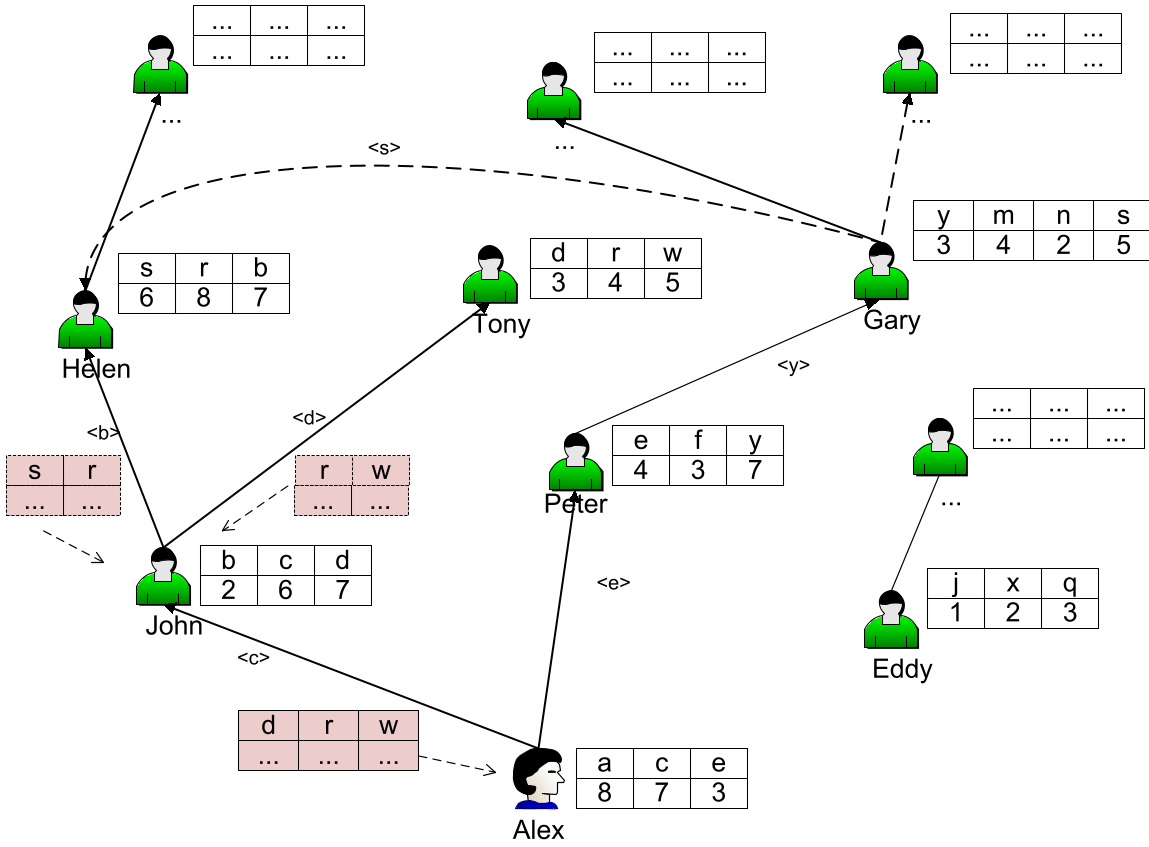 Figure 1: The architecture of the REST-engine, showing how the Relay Manager coordinates with the HTTP stack.
The prediction uses a constant to bridge the gap between user and user 's rating history, ensuring the final recommendation fits the requester's personal "modus operandi."
Experiments and Results
The authors tested ph-REST using a prototype built on the Restlet framework and data from the ISI Web of Knowledge.
- Accuracy: The NMAE (Normalized Mean Absolute Error) averaged 0.1994, suggesting the predicted ratings were very close to what users would actually give.
- Personalization: One of the most striking findings was how the system handled different "styles." As shown in the results, two different users receiving the same recommendation would see different predicted scores, perfectly aligned with their historical average ratings.
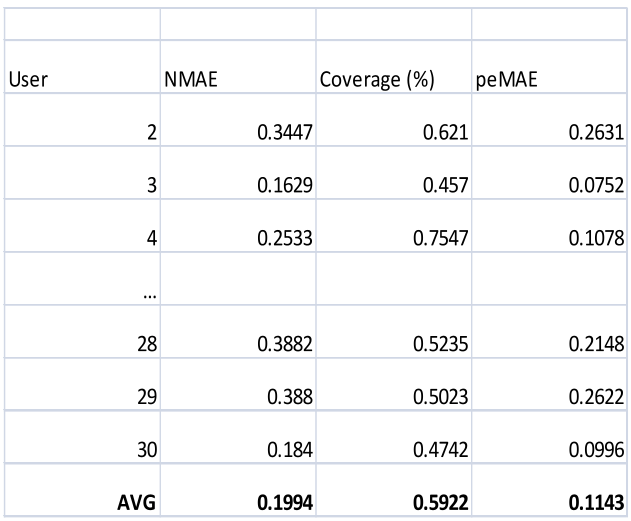 Figure 2: Performance metrics showing NMAE, Coverage, and peMAE across different users.
Critical Insight: Beyond Content Relevance
The 60% coverage rate might seem lower than centralized SOTA models at first glance. However, the authors provide a sharp insight: in social networks, novelty and serendipity are often more valuable than raw content relevance. By relying on a chain of peers, ph-REST uncovers "hidden gems" that a global algorithm might smooth over as noise.
Conclusion & Future Work
ph-REST successfully demonstrates that Cloud and Service computing can be decentralized to a personal level. It effectively models the "word-of-mouth" process in a digital environment.
Limitations & Future Directions: The current model relies heavily on CRIs to establish peerage. Future iterations could integrate more complex social dimensions like trust levels, expertise scores, or social centrality to further refine which "relay" paths are most reliable.