
Social Biometrics: Turning Your Peer Group into a Human Firewall against Clone Attacks
Personal Marks and Community Certificates: Detecting Clones in Wireless Mobile Social Networks
This paper introduces "Personal Marks" and "Community Certificates," a dual-protocol defense system designed to detect identity clones in Wireless Mobile Social Networks (WMSNs). By leveraging human mobility patterns as a social biometric, the system achieves fast clone detection—often within 1.5 to 3.5 days—across diverse real-world and synthetic datasets.
TL;DR
What if your friends—not your password—were the key to proving your identity? This paper introduces a decentralized security framework that detects "cloned" smartphones by analyzing the social physical contacts of the user. By combining Personal Marks (for close-range detection) and Community Certificates (for long-range behavior validation), the system can identify an identity thief even if they possess all your secret keys and certificates.
The Problem: When Everything Secret is Stolen
In the world of Wireless Mobile Social Networks (WMSNs), the "clone attack" is a nightmare scenario. Imagine an adversary steals your phone for five minutes, dumps its entire memory—including your private keys, SSL certificates, and saved passwords—and returns it. You feel safe, but a clone now exists.
Current detection methods fail because:
- Centralized systems require constant connectivity to a base station, which isn't available in opportunistic networks.
- Geographic checks (detecting a node in two places at once) fail if the clone moves similarly to the victim.
- Cryptographic tokens are useless because the clone has the exact same secrets as the legitimate owner.
The Insight: Social Regularity as a Biometric
The authors' core observation is that human movement is not random. We follow "do-repeat" cycles: we meet the same colleagues, family, and friends with predictable frequency. This physical contact history acts as a social biometric. An attacker might steal your keys, but they cannot easily replicate your entire life's social schedule.
Methodology: The Two-Pronged Defense
1. Personal Marks (The Insider Trap)
This protocol targets clones operating within the victim’s social circle.
- How it works: Every time node meets friend , they exchange a "mark"—a uniquely signed and timestamped token.
- The Check: When meets next time, they check the previous mark. If has been cloned, the clone and the original will eventually hold different marks (because updated the mark with one but not the other).
- Result: The next encounter creates an "unforgeable proof of clone," as the node will present an outdated mark that contradicts signs of a newer encounter.
2. Community Certificates (The Outsider Shield)
This targets clones trying to use the identity away from the victim's social group.
- Architecture: A node is issued a certificate that lists its "Best Friends" and their typical meeting intervals (FI).
- Validity: To stay "valid," the node must "check-in" physically with friends within their expected timeframes.
- The Catch: An outsider clone cannot stay valid because it doesn't meet the victim's friends. If it tries to meet them to refresh the certificate, it triggers the Personal Marks trap.
Experiments & Results
The researchers tested their protocols using real-world traces from Dartmouth and MIT (Reality Mining).
- Detection Speed: In the Dartmouth trace, 90% of clones were caught in under 1.5 days. Even in sparser datasets like MIT’s Reality, detection happened within 3.5 days.
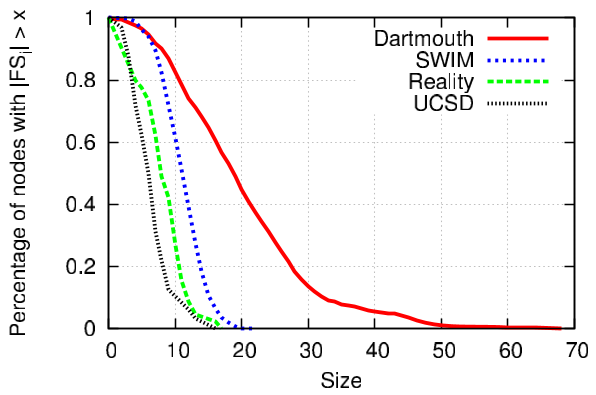
- Accuracy: By tuning the parameter (the number of friends needed for a valid certificate), they achieved a near-zero false-positive rate. Most users could successfully maintain their certificates by meeting just 10-20% of their social circle.
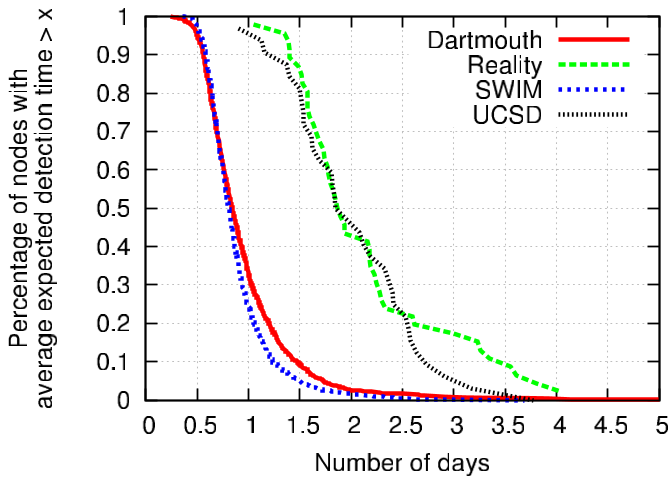 The chart above shows the distribution of detection times across various traces, highlighting the efficiency in active social environments (like SWIM).
Critical Insight & Conclusion
The brilliance of this work lies in orthogonal security. It doesn’t replace encryption; it adds a layer of "behavioral proof."
Limitations:
- Socially Isolated Users: If a user has no regular "friends" in the network, the system fails or generates false positives.
- Coordinated Attacks: If an adversary clones an entire "clique" of people, they could theoretically valid each other’s certificates.
The Takeaway: As our devices become more integrated with our physical lives, our social patterns become a robust defense mechanism. This paper proves that in mobile networks, "who you know" is just as important for security as "what you know."