
Personal Media Reunion: Solving the "Scattered Memory" Problem in the Social Media Era
Personal Media Reunion: Re-collecting Media Content Scattered over Smart Devices and Social Networks
The paper introduces "Personal Media Reunion," a multi-modal retrieval framework designed to re-collect media content scattered across smartphones and social networks like Facebook. By leveraging a novel social-context-aware face recognition approach and probabilistic fusion, it automatically links private mobile content with public/friend-shared content to reconstruct social events.
TL;DR
In our hyper-connected world, the photos of a single birthday party are often fragmented: some sit in your phone's gallery, others are on your Facebook wall, and even more are buried in your friends' accounts. Personal Media Reunion is a technical framework that uses a handful of "seed" photos to automatically hunt down every related photo and video across different devices and social circles, even when critical metadata like GPS or timestamps are missing.
The Problem: The "Metadata Black Hole" of Social Networks
While smartphones record rich EXIF data (time, location, camera settings), social platforms like Facebook often strip this information for privacy and optimization. This creates a "metadata-unfriendly" environment where traditional clustering algorithms fail.
Current SOTA methods rely on:
- Manual Tags: Only 10% of photos are tagged.
- Temporal Clustering: Useless when platform timestamps reflect the "upload time" rather than the "capture time."
The authors realized that the missing physical metadata could be replaced by social metadata—the people who appear together and the visual consistency of their clothing.
Methodology: The Core Engine
The framework operates in three sophisticated stages to bridge the gap between private and public media.
1. Representative Scene Extraction
For videos, the system uses the Color and Edge Directivity Descriptor (CEDD) to detect scene boundaries on the phone. This ensures that video content is treated as a set of high-quality "seed" images, making them interoperable with photo-matching algorithms.
2. Social-Context-Aware Face Recognition
This is the paper’s primary innovation. Standard face recognition looks at pixels; this model looks at relationships. Using a Bayesian probability model, it calculates the likelihood of an identity based on who else is in the frame.
If Person A often appears with Person B in tagged Facebook photos, the system uses this "social bond" to identify Person A in an untagged phone photo where Person B is present.
 Figure 1: The overall workflow from seed selection to social network retrieval.
3. Probabilistic Fusion & Near-Duplicate Detection
To handle the lack of EXIF data, the system employs:
- High-Entropy SIFT: Matching only the 20 most distinct visual features to find "near-duplicates" (the same shot taken by different people).
- Clothes-based Features: Since people rarely change clothes during a single event, the color and texture of the torso area become a powerful proxy for "event-belonging."
Performance & Experiments
The authors conducted a lab study with 15 users across diverse events (weddings, vacations, festivals).
Key Findings:
- Recognition Boost: When at least 5 people are in a photo, the social context approach improves recognition accuracy by 40% compared to visual-only baselines.
- High Recall: By "extending the seeds" (using phone photos to find more Facebook photos), the system reached an 81% recall rate.
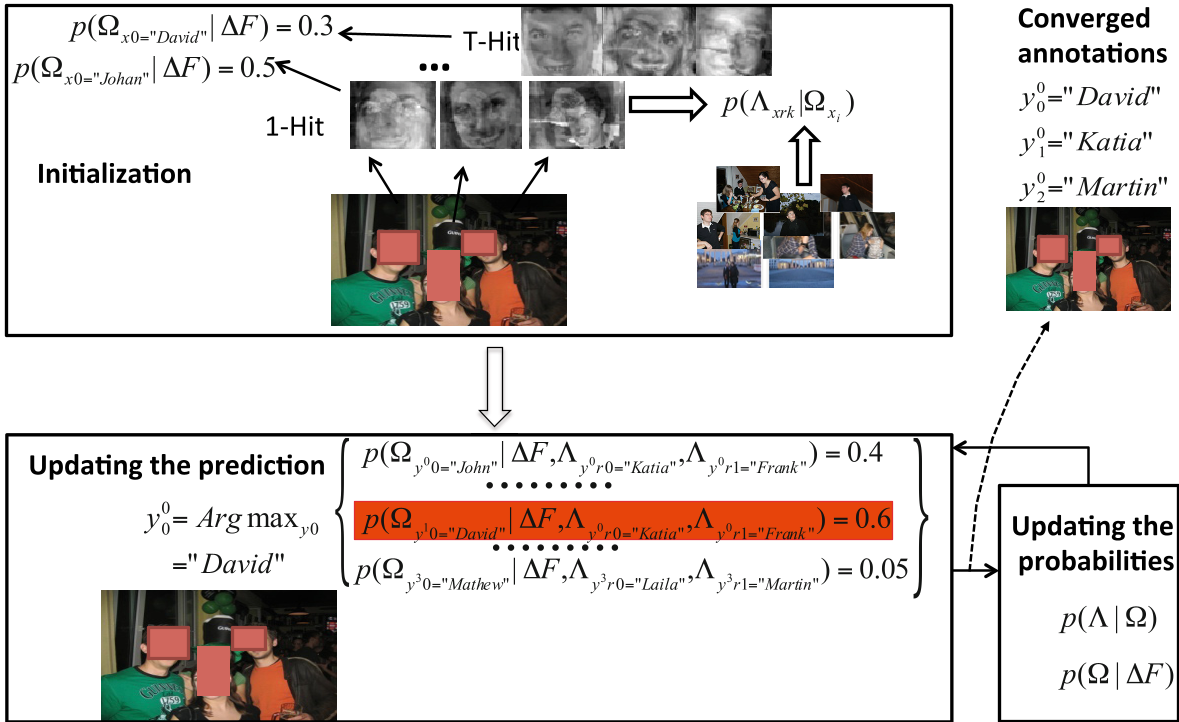 Figure 2: The iterative EM process for updating person identification based on social context.
Critical Insight & Conclusion
The real value of this research lies in its Inductive Bias: the assumption that human social structures are as predictable as digital metadata. By modeling the "who" (social context) and the "what" (visual clothes/duplicates), the authors effectively bypass the "when" and "where" (EXIF) that platforms strip away.
Takeaway: As privacy concerns lead to more aggressive metadata stripping, future media organization tools must move toward "Contextual Intelligence"—understanding the human relationships within the frame rather than the data packets attached to it.
Limitations: The system relies heavily on an initial "seed" being somewhat representative. If the user only selects a "scenery-only" photo with no people, the social-context engine remains idle, falling back on visual-only matching which is significantly less robust.