
Beyond Mere Ties: The Multidimensional Impact of Social Networks on Aging in South Africa
Personal social networks and health among aging adults in Agincourt, South Africa: A multidimensional approach
2018-06-23
Summary
Problem
Method
Results
Takeaways
Abstract
This study employs a multidimensional framework to examine the influence of personal social networks (SN) and social determinants of health (SDH) on the physical well-being of aging adults in Agincourt, South Africa. Using multiple linear regression on the HAALSI cohort data, the research identifies complex associations between network composition, financial support, and environmental perceptions on self-reported health.
## TL;DR
While we often assume "more social support is better," this study of aging adults in rural South Africa paints a far more complex picture. Using a multidimensional approach, researchers found that while spouses and financial aid boost health, high levels of emotional support and living in the same household as network members can actually be detrimental. The findings suggest that in rural settings, social ties provide not just "capital" but also a "burden" of social control.
## Problem & Motivation: The "Causes of the Causes"
Most gerontological research in Western contexts highlights the benefits of diverse social networks. However, in Agincourt, South Africa—a rural area undergoing rapid health and demographic transitions—the dynamics are different.
The authors identified a gap: existing studies often look at social network (SN) structure *or* function in isolation. They argued that to truly understand health among the elderly, one must analyze the **multidimensionality of networks** (structure, function, quality) alongside **Social Determinants of Health (SDH)** like community trust and childhood history.
## Methodology: A Triadic View of Sociality
The study utilized the HAALSI (Health and Aging in Africa: A Longitudinal Study of an INDEPTH Community) baseline data, focusing on:
1. **Structure**: Who is in the network (kin vs. non-kin) and where do they live?
2. **Function**: What are they providing (Emotional, Physical, Informational, or Financial support)?
3. **Quality**: How often do negative interactions (fighting, humiliation) occur?
### Model Architecture of the Study
The researchers used a two-step multiple linear regression. Model 1 focused purely on SN dimensions, while Model 2 integrated social determinants like village safety, life satisfaction, and PTSD symptoms.
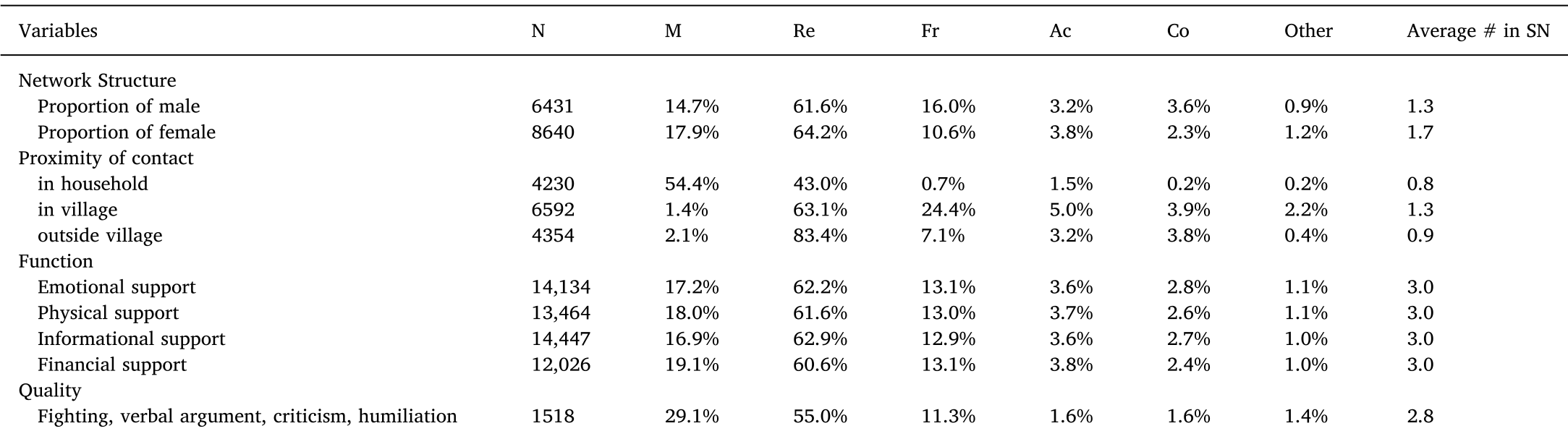
*Table: Composition and average size of social networks across structure, function, and quality.*
## Deep Dive into Results: The "Support Paradox"
The data revealed several counter-intuitive findings that challenge Western-centric social support theories:
* **The Kinship Burden**: Participants had more kin in their networks than friends. Interestingly, those whose contacts lived primarily within the household reported *worse* health. This suggests that physical proximity in rural settings might lead to increased caregiver burden or excessive social monitoring.
* **The Emotional Support Negative**: One of the most striking findings was that **emotional and informational support negatively affected physical health**. The authors hypothesize that in "closed" kin networks, these ties act as "binding social capital," leading to social control that may limit individual agency or increase stress.
* **Financial Support is King**: Unlike emotional support, financial aid was consistently and significantly associated with better physical health, highlighting the critical role of material resources in resource-scant environments.
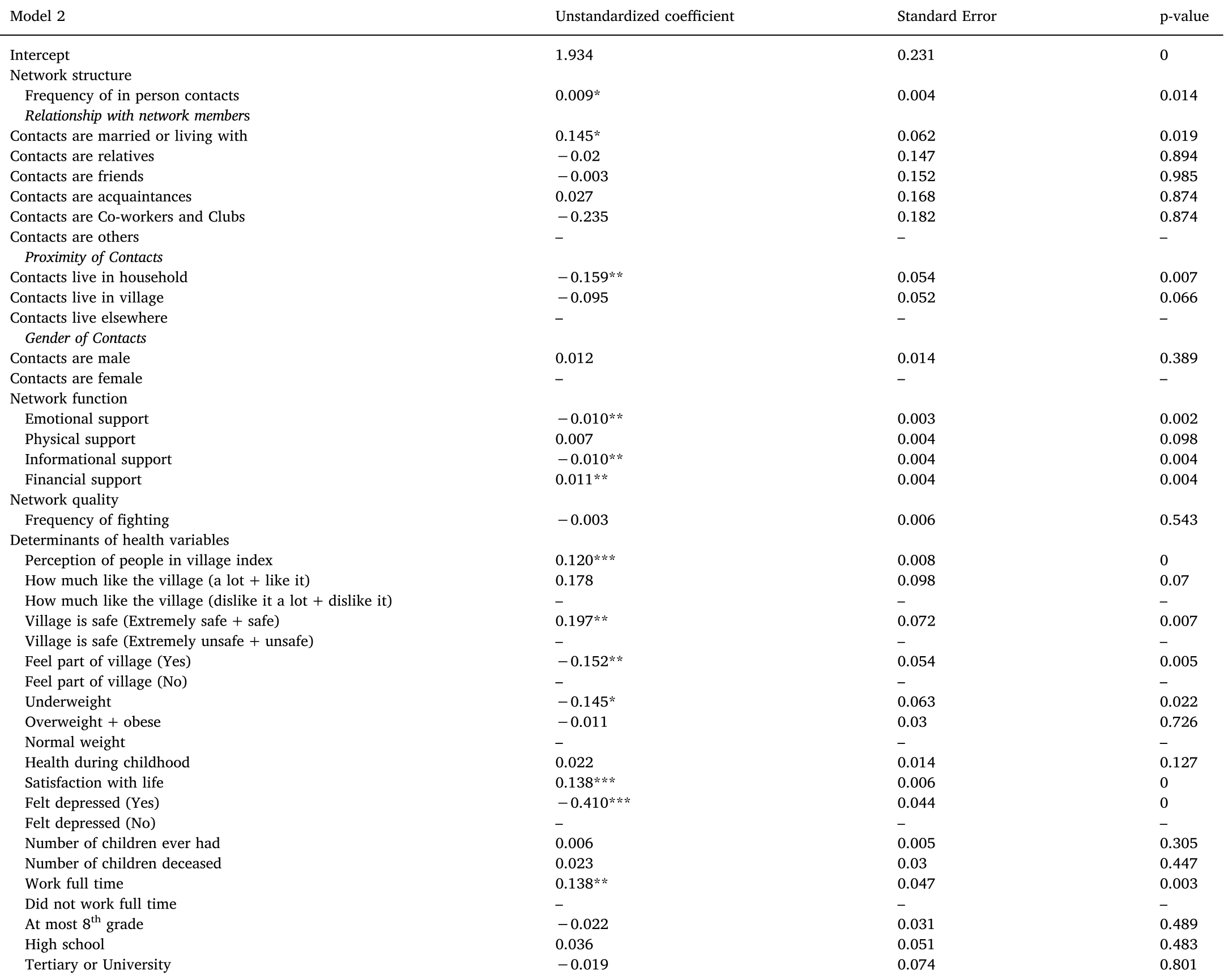
*Table: Multiple Linear Regression showing the influence of SDH and SN on Health Status.*
## Critical Analysis & Conclusion
This research provides a vital "tectonic shift" in how we view social networks in global health:
* **Institutional Insights**: Community safety and village perception (Sense of Place) are just as important as individual network ties. Older adults who felt the village was safe reported significantly better health.
* **Limitations**: As a cross-sectional study, it faces the "reverse causality" trap—does poor health cause people to seek more emotional support, or does the support itself cause stress? Long-term longitudinal data (the "convoy model") will be needed to untangle this.
### Future Outlook
As Africa's aging population grows, care providers must recognize that not all social ties are beneficial. Future interventions should focus on **financial security** and **community-level safety** rather than just encouraging more family interaction, which in some contexts, can become a source of "social friction" rather than "social support."
**Takeaway**: In the aging landscapes of the Global South, the *type* of support and the *context* of the community are far more predictive of health than the mere *size* of one's social circle.