
Meta-Interest: Solving the Recommendation Cold-Start via Personality Computing and Metapath Discovery
Personality-Aware Product Recommendation System Based on User Interests Mining and Metapath Discovery
The paper introduces Meta-Interest, a personality-aware recommendation system that leverages the Big-Five personality model and metapath discovery in Heterogeneous Information Networks (HIN). It achieves state-of-the-art performance in product recommendation, particularly excelling in the precision and recall of cold-start scenarios.
TL;DR
Meta-Interest is a novel recommendation framework that moves beyond simple user-item interaction history by incorporating Big-Five personality traits and Topical Interest Mining. By representing the ecosystem as a Heterogeneous Information Network (HIN) and discovering latent "metapaths," it effectively solves the cold-start problem, delivering high precision even when user history is non-existent.
The Problem: The "History Trap" of Recommendation
Traditional Collaborative Filtering (CF) and Content-Based Filtering (CBF) suffer from a fundamental limitation: they are reactive. They require a trail of "bread-crumbs" (clicks, likes, purchases) to function. This leads to two critical failures:
- Cold Start: How do you recommend a product to a user who just signed up?
- Redundancy: Why keep suggesting footballs to someone who just bought one, instead of suggesting something complementary they haven't seen yet?
The authors argue that a user's personality is a stable, predictive anchor that can bridge these gaps.
Methodology: The Fusion of Psychology and Graph Theory
Meta-Interest operates on a three-layered Heterogeneous Information Network (HIN) comprising Users (U), Topics (T), and Products (P).
1. Personality as the "Static Anchor"
The system measures the "Big-Five" traits (Openness, Conscientiousness, Extraversion, Agreeableness, Neuroticism). Unlike browsing history, personality is relatively stable. The system uses these traits to:
- Predict initial topical interests for new users.
- Match personality facets (e.g., "Artistic") with corresponding item categories (e.g., "Imaginative/Creative products").
2. Metapath Discovery: Finding the Hidden Connections
Instead of simple link prediction, Meta-Interest utilizes Metapaths—predefined sequences of relations that capture diverse semantics.
- Interest Metapaths (U-T-P): Matches users to products via shared topical interests.
- Friendship Metapaths (U-U-P): Traditional CF logic via similar users.
- Content Metapaths (U-P-P): Traditional CBF logic via item similarity.
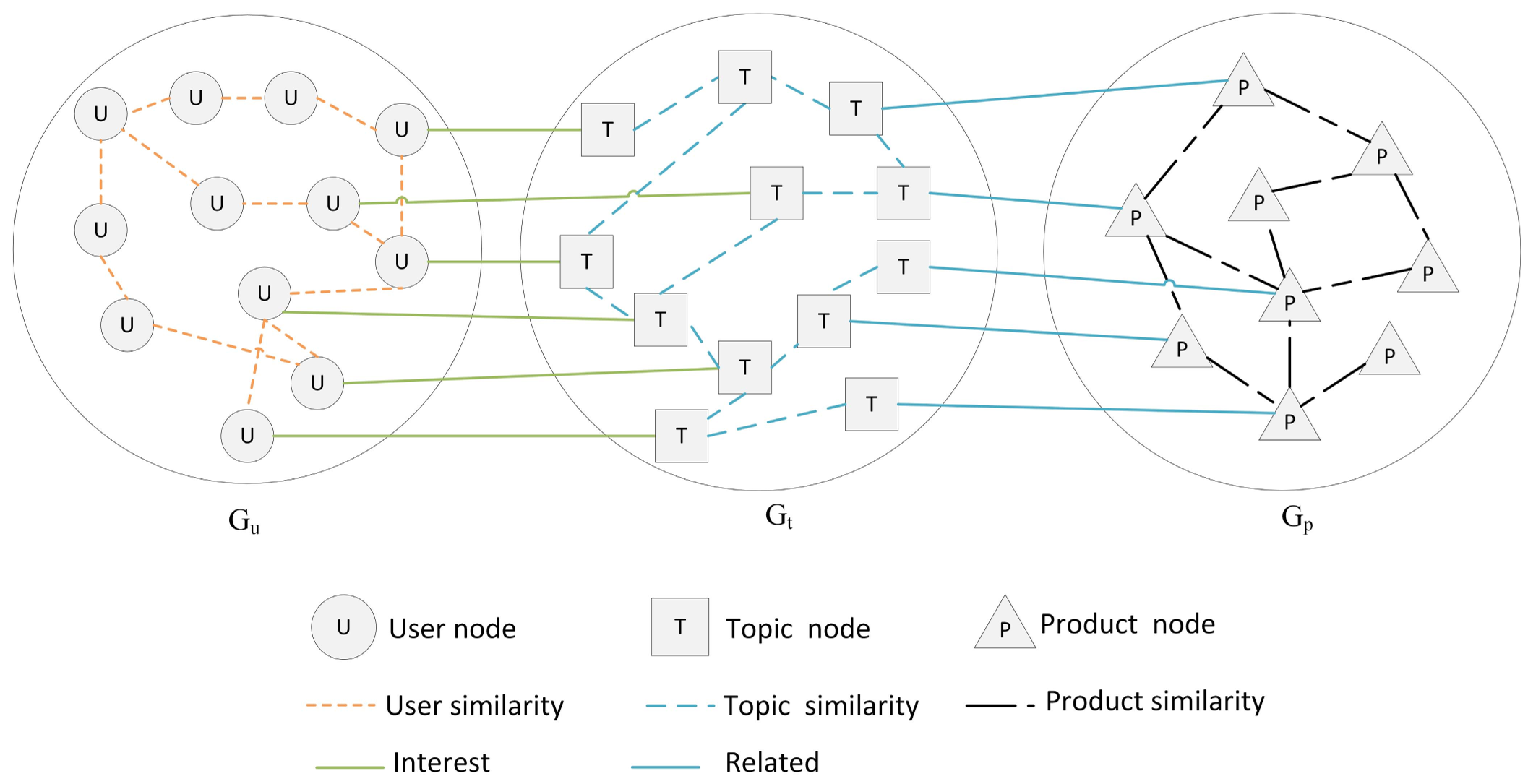 Figure 1: The Meta-Interest Framework showing the interplay between personality measurement, interest mining, and item mapping.
Experiments: Superiority in Scarcity
The researchers compared Meta-Interest against heavyweights like GNN-SEAL (Graph Neural Networks) and metapath2vec.
The Cold-Start Performance
The most striking result is found in the cold-start tests. While Deep Learning models like GNN-SEAL struggle with "sparse nodes," Meta-Interest maintains high precision by falling back on personality-topical mappings.
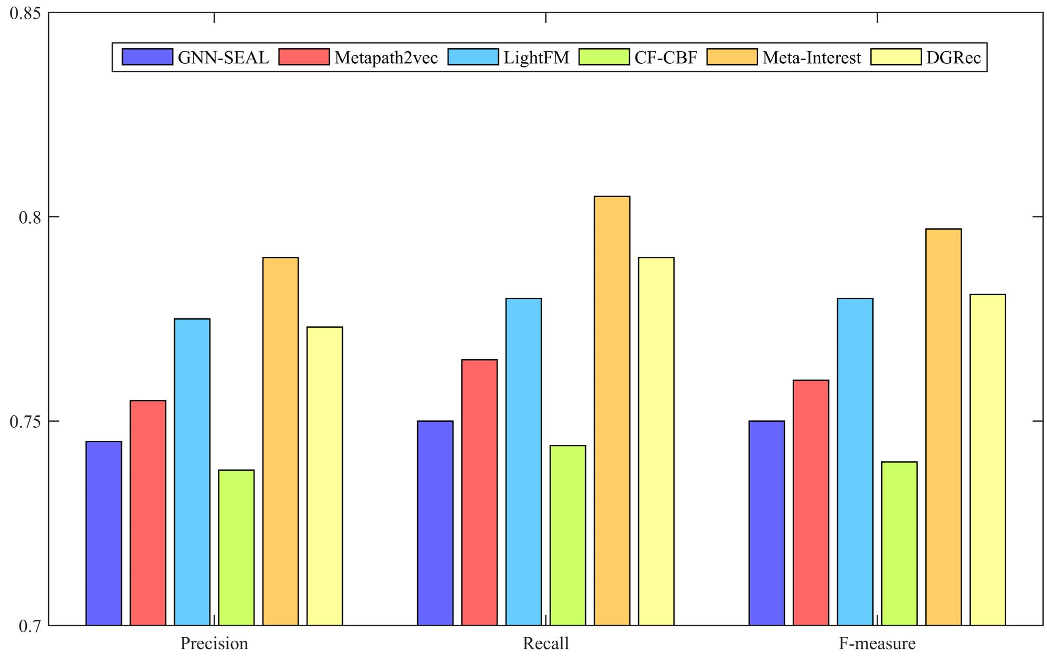 Figure 2: Meta-Interest consistently outperforms baselines in Precision, Recall, and F-Measure.
Computational Efficiency
While some embedding-based methods (metapath2vec) are slightly faster in initial calculation, Meta-Interest wins in dynamic environments. When new users or items are added, embedding methods usually require a full re-computation of the latent space. Meta-Interest simply updates the weights of the new metapaths, making it 4x faster for updates.
Critical Insights & Takeaways
- Inductive Bias Matters: By injecting human psychology into the graph structure, Meta-Interest creates a powerful inductive bias that allows it to "guess" user needs with higher accuracy than pure data-driven models in low-data regimes.
- Beyond Embedding: While the industry has moved toward black-box embeddings, this work shows that explicit Metapath Discovery remains relevant for interpretability and update efficiency.
Limitations
Currently, the system relies on questionnaires for personality measurement, which is a friction point for UX. The authors suggest that moving toward Automated Personality Recognition (APR) via social media text analysis is the next logical step to make this seamless for the end-user.
Conclusion
Meta-Interest proves that recommendation systems don't have to be "blind" when history is missing. By understanding who the user is, rather than just what they did, we can build smarter, more diverse, and more efficient shopping experiences.