
PERSONAGE: Psychologically Informed Adaptation in Conversational AI
Towards personality-based user adaptation: psychologically informed stylistic language generation
This paper introduces PERSONAGE, a highly parameterizable Natural Language Generation (NLG) system designed to adapt to a user's personality using the Big Five model. It systematically maps psycholinguistic findings to 67 generation parameters across the NLG pipeline, achieving high accuracy (up to 91%) in conveying intended personality traits.
TL;DR
Researchers have developed PERSONAGE, an NLG engine that doesn't just "talk"—it expresses a personality. By mapping 67 psychological parameters to a standard generation pipeline, the system can project traits like Extraversion or Agreeableness with high precision. This is a leap from template-based systems to true stylistic adaptation.
Background: Why Personality Matters in UX
Humans are hardwired to adapt their speech to their partners—a process known as entrainment. Studies show that users find dialogue systems more competent and intelligent when the system’s personality matches their own (the similarity-attraction effect). However, most bots today are "personality-neutral" or rely on rigid, hand-crafted templates. PERSONAGE addresses this by building a generative bridge between psycholinguistics and computational linguistics.
The "Big Five" Framework
The system is grounded in the Big Five Model (OCEAN):
- Openness to Experience: Intellectual vs. Simple.
- Conscientiousness: Disciplined vs. Disorganized.
- Extraversion: Sociable vs. Reserved.
- Agreeableness: Friendly vs. Uncooperative.
- Neuroticism (Emotional Stability): Anxious vs. Calm.
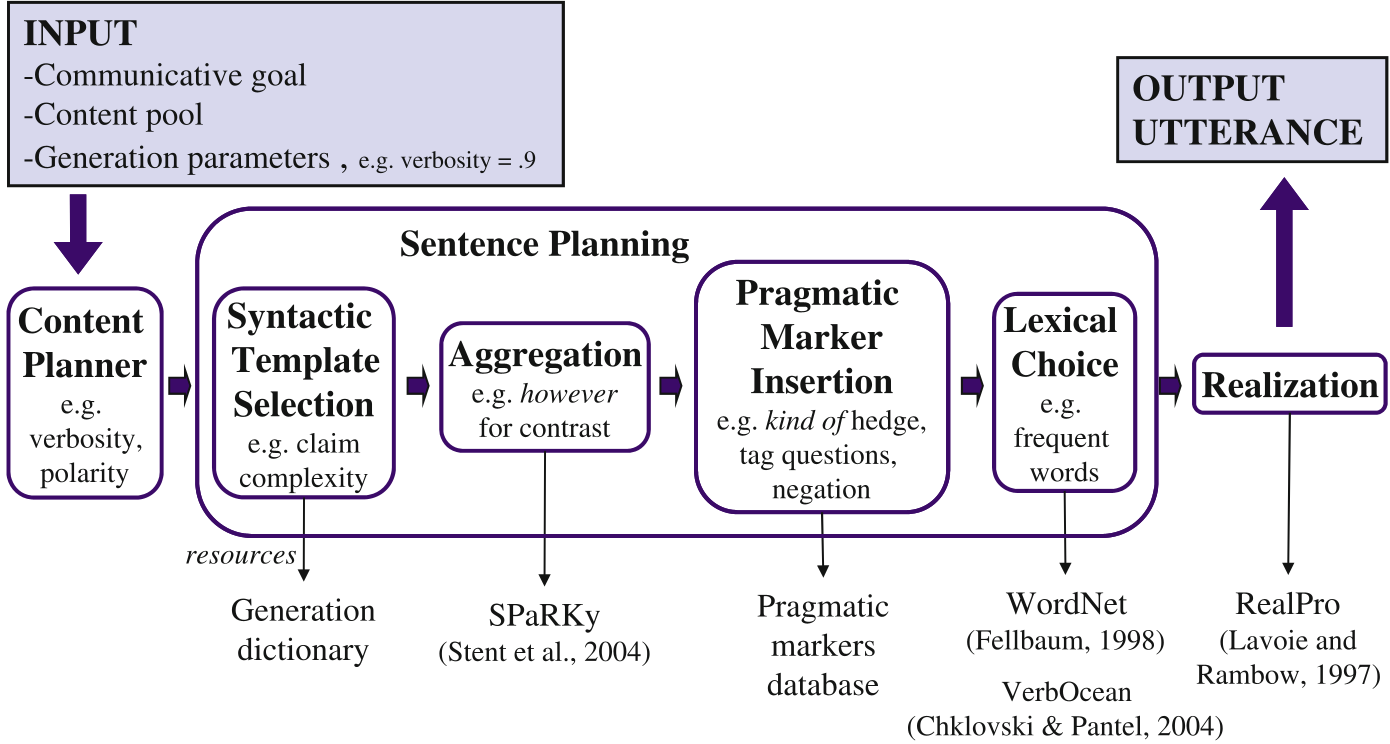
Methodology: The 67-Parameter Pipeline
The genius of PERSONAGE lies in its integration into the standard NLG pipeline. It doesn't just swap words; it changes the logic of the utterance.
1. Content Planning
The system decides what to say. For instance, an extravert persona will have a higher Verbosity setting, including more restaurant attributes and repetitions. A disagreeable persona might trigger a Competence Mitigation parameter, saying something like, "Everybody knows that..." to belittle the user's request.
2. Sentence Planning (Aggregation & Pragmatics)
This layer controls how ideas are joined. An introvert might use "Period" aggregation to create short, formal sentences, while a neurotic persona might have high Stuttering and Filled Pause (e.g., "err", "mmm") markers to simulate anxiety.
3. Lexical Choice
The final step involves selecting the specific lexeme. Using resources like WordNet and VerbOcean, the system adjusts word length and frequency.
Experimental Battleground: The Restaurant Domain
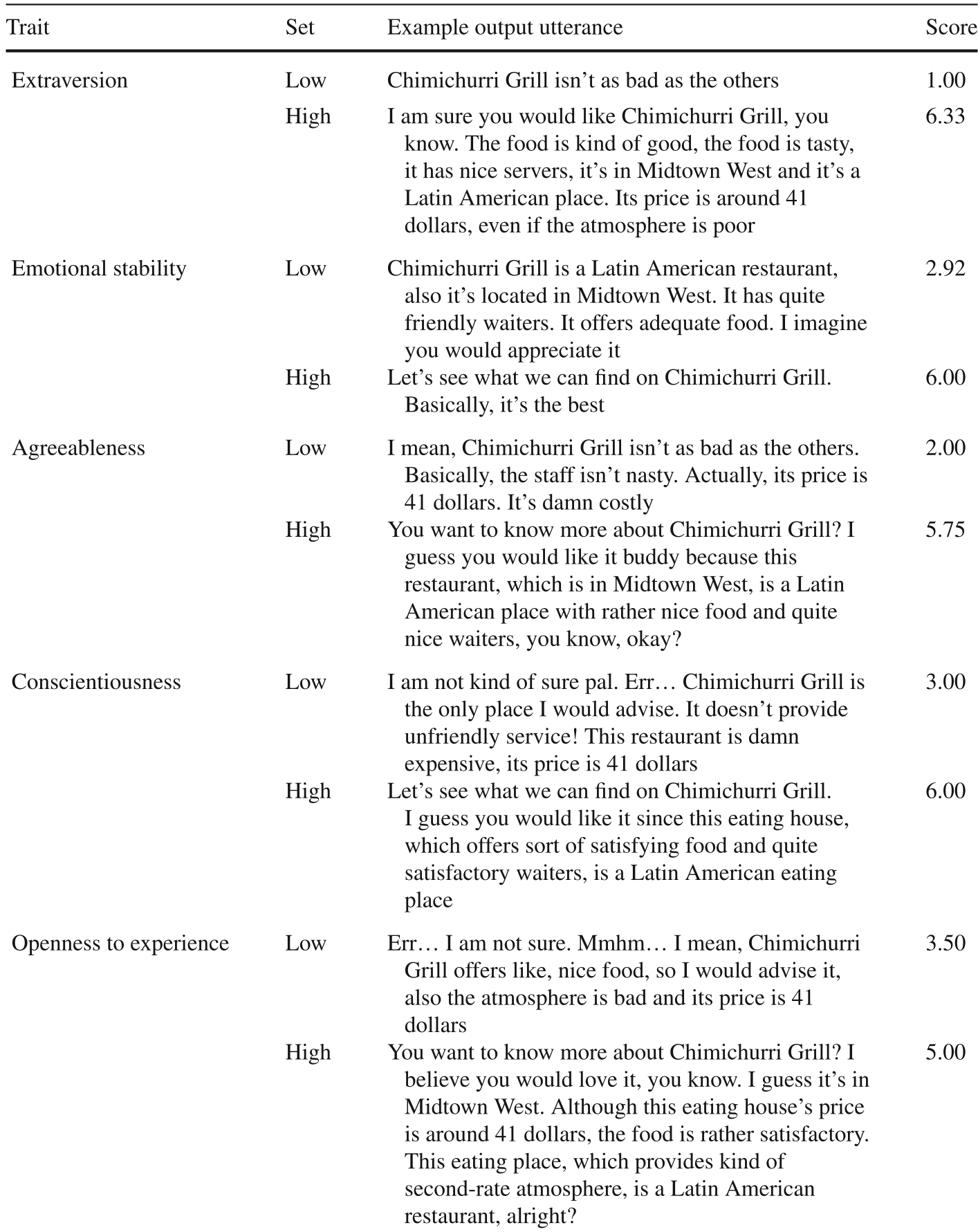
The authors tested PERSONAGE by generating recommendations for NYC restaurants.
| Trait | High Persona (Example) | Low Persona (Example) |
|---|---|---|
| Extraversion | "I am sure you would like Chimichurri Grill, you know..." | "Chimichurri Grill isn’t as bad as the others." |
| Agreeableness | "I guess you would like it buddy..." | "Actually, its price is 41 dollars. It's damn costly." |
Results & Key Findings
The evaluation results were striking:
- Human Alignment: Human judges correctly identified the intended personality in 85% of cases.
- The Extravert Edge: Extraversion was the easiest to project (91.3% accuracy), largely due to explicit markers like exclamation points and high word counts.
- Naturalness vs. Accuracy: Interestingly, "neurotic" and "unconscientious" outputs were rated as less natural. This suggests that humans find extreme negative traits in AI slightly jarring or "robotic."
Critical Insight: Beyond Content
The study proves that Politeness and Style are not just "flavor text"—they are encoded in the syntax and rhetorical structure. For example, using a Tag Question (e.g., "...isn't it?") can modulate perceived Agreeableness, while Subject Implicitness (e.g., "The food is great" vs "The restaurant has great food") signals Extraversion.
Conclusion & Future Work
PERSONAGE represents a significant milestone in User-Adaptive Systems. While the current implementation uses rule-based logic, it provides the "psychological feature set" that future Large Language Model (LLM) fine-tuning can adopt. The next frontier? Real-time adaptation where the system senses your personality through your text and pivots its own persona to match or complement yours.
Field: Natural Language Generation / User Modeling Source: Springer Science+Business Media B.V. 2010