
Personality Classification via k-Means: Bridging Jungian Psychology and Unsupervised Learning
Personality Classification by Applying k-Means Clustering
This paper presents an automated personality classification approach using the k-means clustering algorithm applied to responses from a Jungian Type Inventory-based survey. The study successfully partitions individual psychological data into 16 distinct clusters, mapping directly to the 16 Myers-Briggs Type Indicator (MBTI) personality profiles.
TL;DR
This study explores the intersection of psychometrics and machine learning by applying the k-means clustering algorithm to the Jungian Type Inventory. By moving beyond simple binary inputs to a nuanced Likert scale, the researchers successfully grouped 105 participants into 16 clusters—paralleling the 16 MBTI types—while achieving a significant reduction in model inertia (from 700 to 107).
The Core Challenge: The Bias of Human Judgment
Traditional personality assessment relies heavily on manual evaluation, which is not only slow but susceptible to the psychological biases of the evaluator. In fields like staff selection or career counseling, these biases can lead to poor outcomes. While automated personality prediction using machine learning is not new, previous attempts often suffered from low accuracy or "middle-ground" data loss where participants didn't fit neatly into binary categories (Extrovert vs. Introvert).
The authors identify a critical bottleneck: data granularity. Using simple "Yes/No" answers led to over 35% of results being undetermined. To solve this, the study adopts a 5-point Likert scale, allowing the algorithm to capture the spectrum of human behavior.
Methodology: Engineering the Psychological Space
The research follows a three-stage pipeline: Data Collection, Preparation, and Hyper-parameter Tuning.
1. The Archetype Survey
Based on Jung’s theory, the survey covers four dichotomies:
- Extraversion (E) - Introversion (I): Energy orientation.
- Sensing (S) - Intuition (N): Information perception.
- Thinking (T) - Feeling (F): Decision-making.
- Judging (J) - Perceiving (P): World orientation.
2. The k-Means Engine
Since personality types were not pre-labeled in the raw survey data, the authors utilized Unsupervised Learning. The k-means algorithm works by iteratively assigning data points to the nearest "centroid" (mean point) and then updating those centroids until the clusters stabilize.
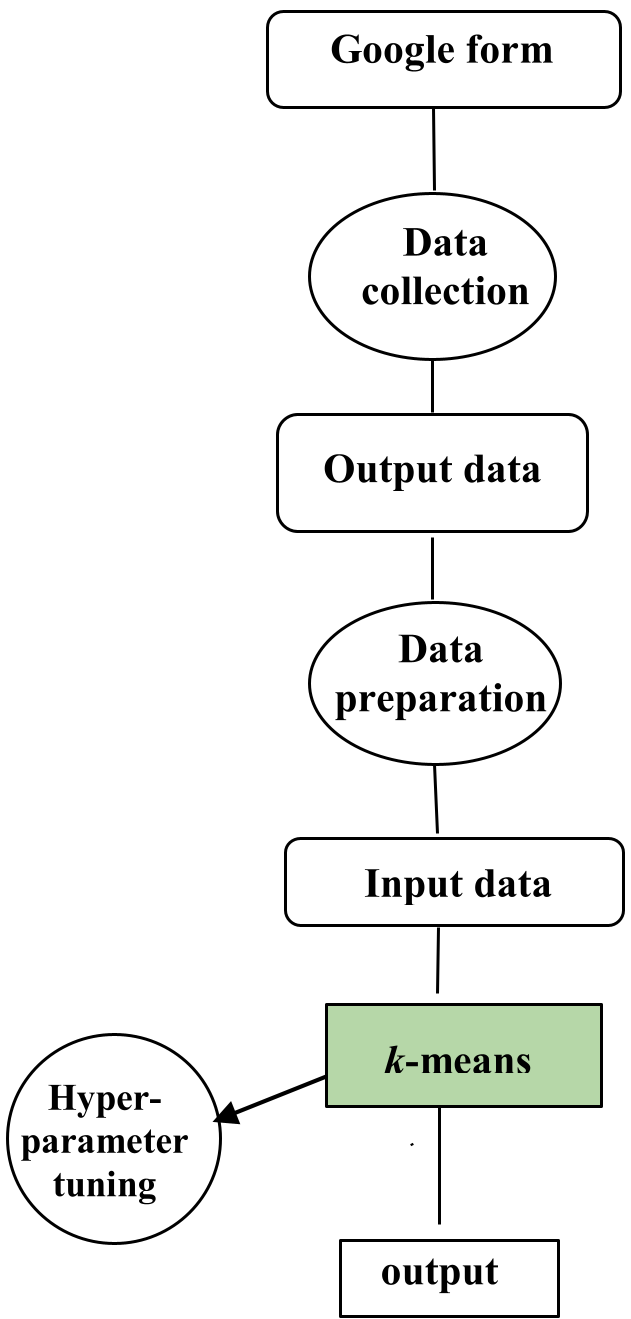 Fig 1. Personality Classification workflow by applying K-means clustering.
3. Optimization via Inertia
The "Inertia" value—the sum of squared distances within a cluster—was the primary metric for success. The logic is simple: Lower inertia = Tighter, more cohesive personality groups.
Experiments and Results
The model was trained on data from 105 Computer Science students. The results demonstrated a clear "elbow" in performance as the number of clusters increased.
- Initial Setup (): Inertia was a staggering 700.
- Final Model (): Inertia dropped to 107, a healthy indicator of model fit.
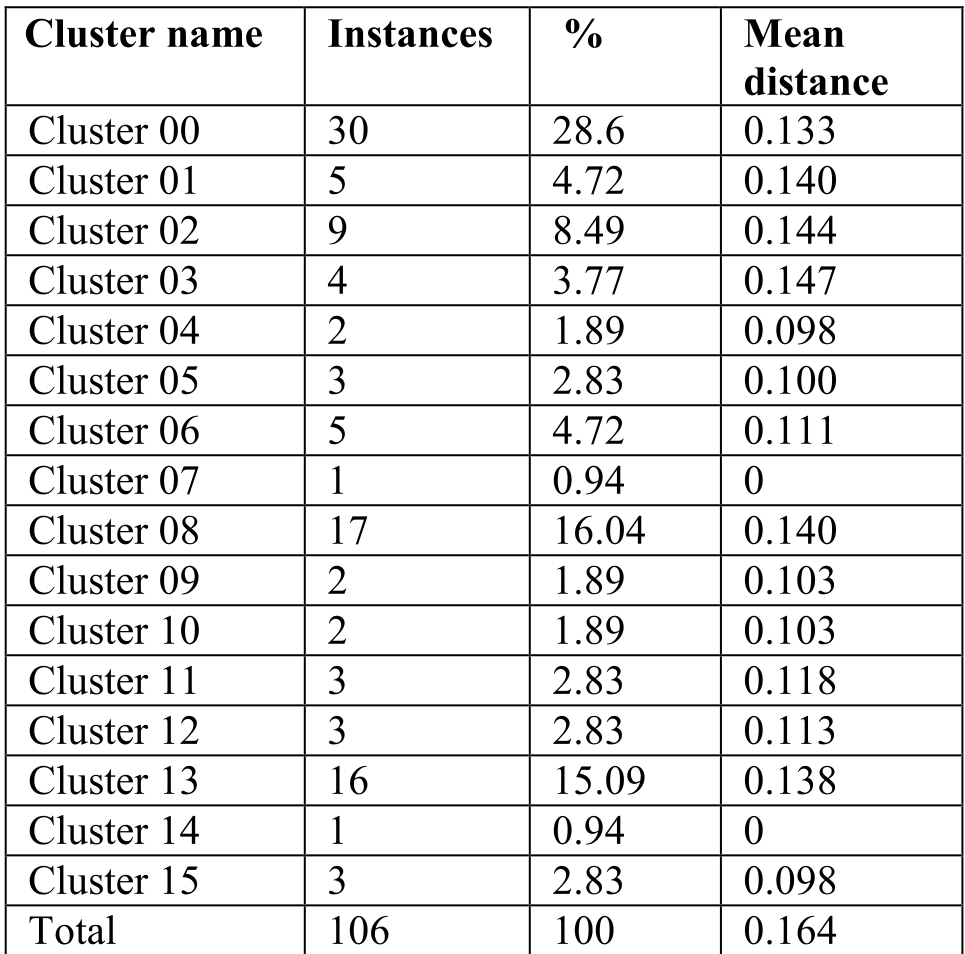 Table 2. Distribution of instances across the 16 clusters.
One of the most fascinating findings came from the Association Analysis. The algorithm discovered logical rules within the human psyche, such as the reciprocal relationship between "communication awareness" and "empathy regarding group reaction."
Critical Insight & Future Outlook
While the k-means approach successfully identified 16 clusters, the authors honestly address the "Black Box" of unsupervised learning: the algorithm can tell you that a person belongs to Cluster 08, but it cannot intrinsically explain what that cluster represents psychologically without expert intervention.
Limitations:
- Geometric Bias: k-means assumes spherical clusters, which may not perfectly align with the complex, non-linear reality of human personality.
- Sample Size: With only ~100 participants, the model requires larger datasets to avoid overfitting local patterns.
The Roadmap Ahead:
The next phase of this research involves expanding the dataset and implementing Cross-Validation to refine the predictive power, potentially moving the prototype into a production-ready tool for academic and career counseling.
Conclusion
This paper proves that the "Euclidean distance" between two people’s survey answers can effectively categorize them into psychological archetypes. By combining Jungian theory with automated clustering, we move one step closer to bias-free, scalable personality assessment.