
Deciphering the News: How Photo Coreference Networks Reveal Hidden Social Contexts
Studying a Personality Coreference Network in a News Stories Photo Collection
This paper constructs and analyzes a personality coreference network derived from 1.5 million news photo descriptions, where nodes represent celebrities and edges denote co-occurrence in the same image metadata. Using modularity optimization, the authors identify distinct professional communities and demonstrate how these social clusters can serve as contextual anchors for tasks like text illustration, entity disambiguation, and search enhancement.
TL;DR
By mapping how famous personalities "co-appear" in 1.5 million news photo descriptions, researchers created a coreference network that naturally clusters into professional communities like "Finance," "Soccer," and "Portuguese Politics." This graph-based approach doesn't just show who knows whom—it provides a structural map that helps AI systems disambiguate names and find better illustrations for news articles.
Background: Beyond Keyword Matching
In the world of News Information Retrieval (IR), simply knowing who is in a photo isn't enough. A photo of a politician at a charity event might be indexed under "Politics," but its social context is much broader. Most prior work focused on simple metadata; this paper, however, treats personal mentions as a Coreference Network. If two people are mentioned in the same caption, there is a contextual "edge" between them.
The Methodology: Building a 5,000-Node Social Map
The researchers utilized the SAPO Labs news photo collection, parsing descriptions with an average length of 59 words.
- Network Construction: They built an adjacency matrix where nodes are personalities. An edge is formed if two people are referenced in the same photo description.
- Community Detection: Using the Louvain modularity optimization algorithm, they partitioned the network into seven distinct spheres based on connection density.
- Validation: They cross-referenced these clusters with Wikipedia data and term-frequency vectors (Word Clouds) from the original news text to verify if the "Politics" cluster actually discussed political topics.
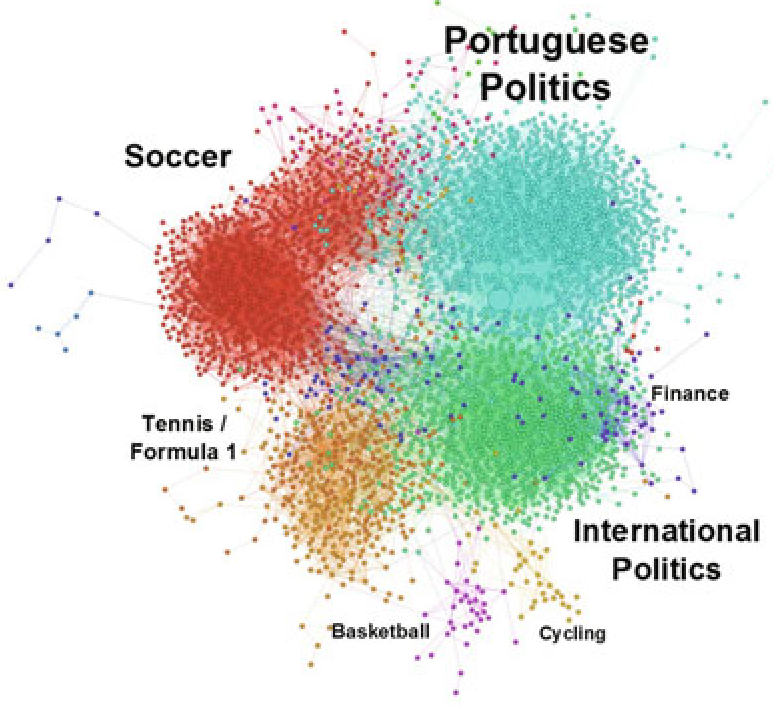
Key Insights from the Social Graph
The network turned out to be a "Small World"—nearly 99% of people are separated by only 2 to 6 degrees. However, the connectivity patterns vary wildly between professions:
- The Basketball Effect: This was the densest community (12.12%). It suggests that news coverage of basketball is highly insular—players are almost exclusively mentioned alongside other basketball figures.
- Soccer as a Hub: The Soccer community featured the highest "Mean Degree," reflecting its dominance in journalistic photo-ops and its broad reach.
- The Disambiguation Power: One of the most striking findings was the ability to solve the "Identity Crisis." For example, the name "Axel Weber" could refer to a pole vaulter or an economist. Because the network placed his node in a cluster with other bankers and finance ministers, the system could automatically conclude he was the economist.
Why It Matters: Context is King
The authors highlight that these networks are dynamic. Sometimes, a personality appears in a "wrong" community. For instance, entertainer Thomas Gottschalk appeared in the Tennis/F1 community. Is the algorithm broken? No. Manual investigation revealed he hosted a show where tennis star Boris Becker was a guest.
This "cross-pollination" captures real-world events that traditional static ontologies might miss. By leveraging these community structures, search engines can move beyond keywords and understand the situational context of an image.
Critical Analysis & Future Outlook
While the study provides a robust proof-of-concept for community-driven IR, it currently relies on some manual labeling of clusters. The authors recognize this, suggesting that future iterations should integrate DBpedia Ontologies for fully automated labeling. Additionally, as news cycles move fast, incorporating a "temporal" axis into the network—tracking how communities evolve over months or years—would be a logical and exciting next step for this research.
Takeaway for Engineers
If you are building an entity-heavy search engine, don't just index tags. Map the relationships. The "community" of an entity is its most reliable metadata.