
Beyond the Big Five: Why Course Collaboration is the "Missing Link" in MOOC Performance Prediction
The Effect of Personality and Course Attributes on Academic Performance in MOOCs
This paper investigates the predictive power of the Big Five personality traits and course collaboration levels on academic performance within MOOCs. By comparing machine learning models (SVM and Logistic Regression) across two different feature sets, the authors demonstrate that personality alone is insufficient for grade prediction, but achieving SOTA-level accuracy requires integrating course-design attributes like social interaction and community sense.
TL;DR
For years, educational psychology has relied on the Big Five personality traits to predict student success. However, new research from the University of Alberta suggests that in the wild world of MOOCs (Massive Open Online Courses), personality alone tells us almost nothing. To accurately predict grades, we must look at the "Social Fabric" of the course—specifically, the Level of Collaboration. By combining personality data with collaboration metrics, researchers boosted predictive accuracy by over 10%, outperforming standard baselines.
The "Classroom-to-Cloud" Gap
In a traditional university setting, traits like Conscientiousness and Openness are strong indicators of a high GPA. But MOOCs aren't traditional. They are global, diverse, and plagued by high dropout rates. This study identifies a critical gap: we cannot simply transplant "Classroom Wisdom" into the digital void. The lack of social interaction is a notorious barrier to online learning, yet it is rarely modeled as a core predictor alongside psychological traits.
Methodology: Synergy of Psychology and Data
The researchers tested three hypotheses across two Coursera MOOCs (Epidemics and Disaster Preparedness). They utilized two distinct feature sets:
- Personality Only: Scores for Extraversion, Neuroticism, Openness, Agreeableness, and Conscientiousness.
- Personality + Collaboration: The above plus the Classroom Community Scale (CCS) and forum interaction density (Questions/Answers per active user).
Model Architecture and Baseline
Because MOOC data is often imbalanced (with "Dropout" being the most frequent outcome), the researchers used the Zero Rule as a baseline. If a model can't beat the Zero Rule (which simply predicts the majority class for everyone), it’s effectively useless.
Key Findings: The Power of Interaction
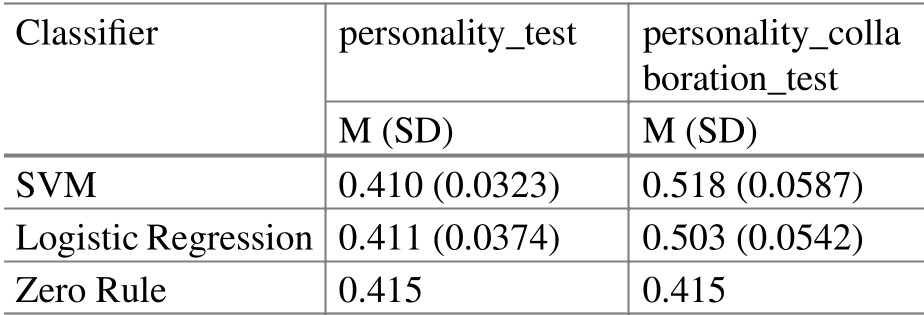
The results were striking. As seen in the table above, the personality_test models (SVM and Logistic Regression) were virtually indistinguishable from the Zero Rule (approx. 41% accuracy).
However, when Course Collaboration was added:
- SVM Accuracy: Jumped from 41% to 51.8%.
- Statistical Significance: The p-value was < 0.001, with a large effect size (d = -0.75).
- Insight: This suggests that the data is likely linearly separable when social factors are included, allowing even simple classifiers like SVM and Logistic Regression to find meaningful patterns.
Why Does This Matter? (Academic Insight)
The failure of H1 (predicting grades by personality alone) is perhaps the most interesting result. It highlights the Inherent Bias in MOOC design. If a course is designed solely for "Self-Starters" (high Conscientiousness), it might alienate "Social Learners" (high Extraversion).
The author's intuition is that an introvert might thrive in a low-collaboration, quiz-heavy course but struggle in a community-driven one, whereas an extrovert might drop out of a "lonely" course. Academic performance is not just who the student is, but how the student fits within the course's social architecture.
Critical Analysis & Future Outlook
Limitations
The study is constrained by a relatively small sample (N=306) and focuses on a narrow definition of collaboration. While forum posts are a good proxy, they don't capture the quality of the interaction or the nuances of peer-to-peer mentorship.
The Future: Personalized Course Design
This research paves the way for Adaptive MOOCs. Imagine a system that:
- Detects a student's personality via an entry survey.
- Dynamically adjusts the "Collaboration Level."
- Introverts get more AI-agent interactions or independent deep-dive assignments.
- Extroverts are nudged toward high-density subcommunities and group projects.
Takeaway: To solve the MOOC attrition crisis, we must stop treating online courses as static content delivery systems and start viewing them as dynamic social ecosystems that must adapt to the psychological diversity of a global student body.