
Beyond the Bit-Rate: How Your Personality and Culture Shape Video Perception
9902_Do Personality and Culture Influence Perceived Video Quality and Enjoyment
This paper investigates the impact of human factors—personality (Big-Five) and culture (Hofstede’s dimensions)—on the perceived Quality of Experience (QoE) and enjoyment of video content. By combining statistical modeling with machine learning on a cross-cultural dataset, the authors demonstrate that human traits account for a significant portion of variance in user perception, achieving up to 9% improvement in predictive accuracy over system-only models.
TL;DR
Is "high quality" a technical measurement or a psychological state? This paper proves it’s both. By analyzing 114 viewers across different cultures, researchers found that human factors (personality and culture) explain nearly twice as much variance in perceived quality (24.3%) as system factors like bit-rate and resolution (13.7%). Using this insight, they built predictive models that significantly outperform traditional system-centric benchmarks.
The "Black Box" Problem in QoE
For decades, the multimedia industry has treated Quality of Experience (QoE) as a math problem: higher bit-rates plus higher resolution equals happier users. However, this approach ignores a crucial variable: the human at the end of the screen.
Current compression and streaming algorithms are often "over-designed," wasting bandwidth because they don't account for the viewer's psychological tolerance or cultural context. The authors argue that failing to model the individual leads to a fundamental misunderstanding of what makes a video "enjoyable."
Methodology: The Twin-Center Cross-Cultural Study
The researchers gathered data from two major hubs—Singapore and the UK—capturing a diverse range of 16 nationalities.
1. The Dataset (CP-QAE-I)
They used 144 video sequences derived from 12 movie excerpts. They didn't just vary the technical specs (bit-rate, frame rate, resolution); they chose clips specifically to evoke different affective responses (emotions).
2. The Factors Measured
- System Factors: Bit-rate (384/768 kbps), Resolution (480p/720p), Frame Rate (5/15/25 fps).
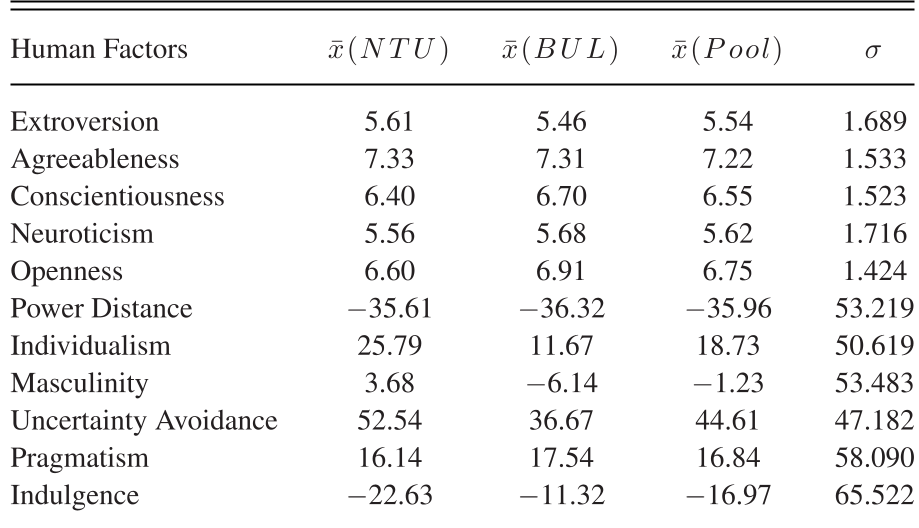
- Personality (Big Five): Openness, Conscientiousness, Extroversion, Agreeableness, Neuroticism.
- Culture (Hofstede): Individualism, Masculinity, Power Distance, etc.
3. Modeling the "Invisible"
The paper compares three statistical views:
- Baseline: Only looks at the tech (The "What").
- Extended: Adds personality and culture (The "Who").
- Optimistic: Models each individual as a random effect to find the theoretical limit of human influence.
Key Insights: Why Personality Matters
The results were striking. Certain traits act as "filters" for how we see quality:
- Conscientiousness & Masculinity: These were "universal" predictors, significantly influencing both quality ratings and enjoyment.
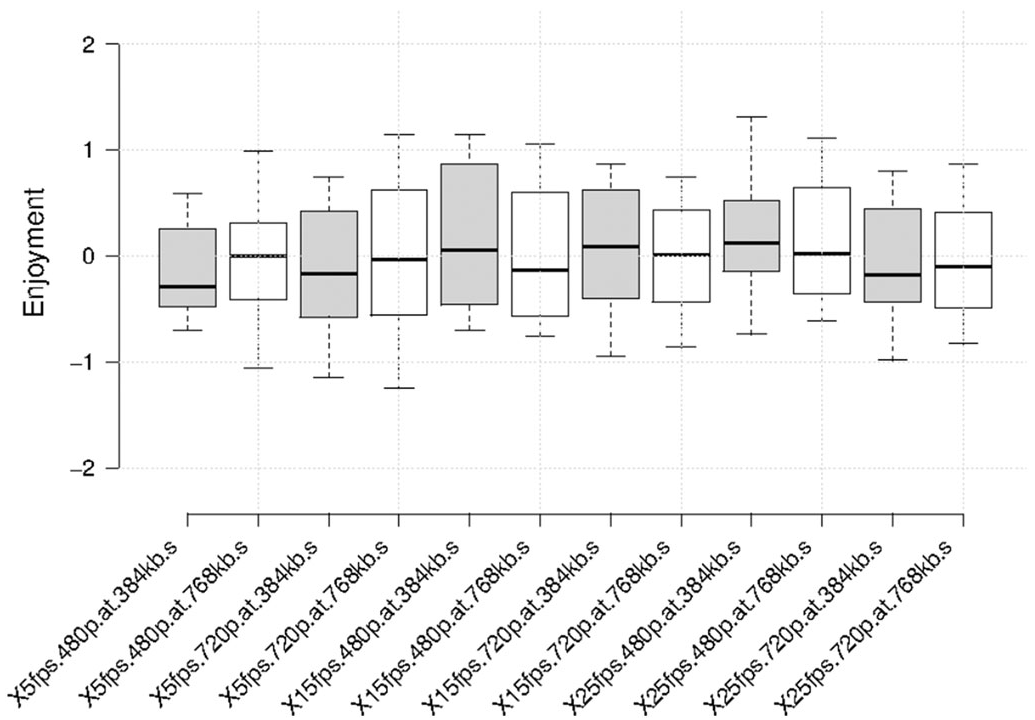
- The "MASK" Effect: In highly emotional scenes (like the emotional climax in Forrest Gump), viewers gave high quality ratings even when the technical specs were at their lowest (5 fps, 384 kbps). The affective engagement literally overpowered the visual artifacts.
Experimental Performance
By moving from a system-only model to a "Human + System" model, the accuracy of predicting perceived quality and enjoyment increased by 3% and 9% respectively.
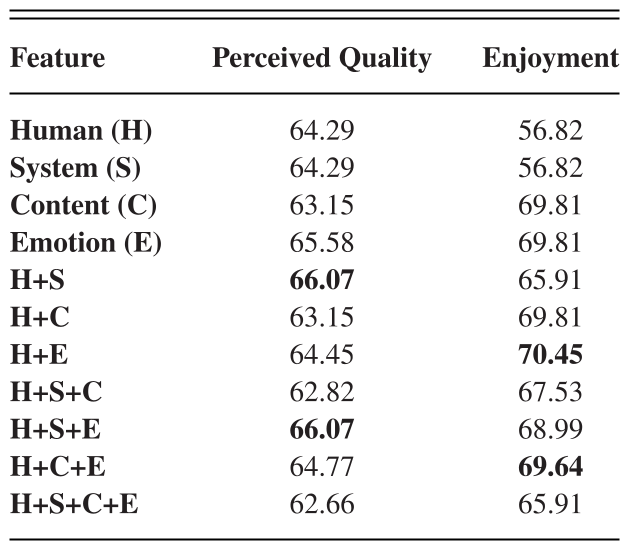
The machine learning framework (using SVM with L1 regularization) demonstrated that while "Emotion" features are great for predicting quality, combining "Human + Emotion" features yields the absolute best performance for predicting Enjoyment.
Critical Analysis & The Future of Personalized Streaming
Takeaway
Quality is a human construct. This research provides a roadmap for Human-Centered QoS (Quality of Service). Imagine a streaming service that knows your personality profile and adjusts its delivery algorithm: if you are high in "Agreeableness," the system might prioritize smoothness over raw resolution, knowing you have a higher tolerance for slight blurriness.
Limitations
- The "Student" Bias: The participants were mostly university students, which may not represent the full spectrum of global digital literacy or age-related perception.
- The Lab Environment: While local institution latency was controlled, hardware differences (dead pixels, ambient light) might have slightly confounded the "human" variance.
Conclusion
This work marks a shift from "Systems Engineering" to "Psychological Engineering" in multimedia. As we move toward more immersive experiences (VR/AR), understanding the viewer's internal properties will be just as important as the bandwidth they possess.