
Deciphering the "Soul" in the Machine: Extracting Dance Personality from Skeletal Data
The Possibility of Personality Extraction Using Skeletal Information in Hip-Hop Dance by Human or Machine
The paper investigates "personality extraction" in Hip-Hop dance by analyzing skeletal data captured via Kinect. It proposes a machine learning framework using Random Forest to distinguish individual dancers and conducts a subjective study to compare human versus machine perception of dance individuality.
TL;DR
Can a machine recognize your "vibe" just by looking at your bones? This research explores whether Hip-Hop dance personality can be extracted using low-cost depth sensors (Kinect). By transforming motion into joint angles and displacement vectors, the authors achieved over 92% accuracy in identifying specific dancers, proving that our unique stylistic "fingerprints" are deeply embedded in our kinematics.
The Motivation: Can We Search for Style?
In the era of YouTube and TikTok, teaching oneself to dance is the norm. However, beginners often face a "matching" problem: they mimic instructors whose physical proportions or stylistic "personalities" don't align with their own, leading to frustration.
The researchers hypothesized that if a machine can identify a dancer's "personality" (their unique way of interpretation) from a simple skeleton, we could eventually build search engines that say: "Based on how you move, this instructor is your perfect stylistic match."
Methodology: Angles vs. Movement
The study utilized a Kinect sensor to record 22 dancers performing the same Hip-Hop choreography to Traila$ong’s “Gravity.” To isolate "personality" from "physique," the authors stripped away video pixels, leaving only 15-point 3D skeletal coordinates.
1. Feature Engineering
The team focused on two specific types of data signatures:
- Angle Features: Capturing the "Form." They calculated the joint angles of elbows, shoulders, and knees.
- Movement Features: Capturing the "Dynamics." They measured the spatial displacement of joints over time.
2. The Classifier
Using a Random Forest algorithm, the system was trained to perform a 12-value classification task.
 Figure 1: The 15-point skeletal structure used to extract 3D coordinates and calculate joint angles.
Human vs. Machine: The "Aha!" Moment
The most fascinating part of the study was the gap between human subjective perception and machine precision.
- Subjective Findings: Experienced dancers were better at recognizing themselves than beginners, but even then, it wasn't easy. Experienced dancers pointed to hand shapes and angles as their signature, while beginners focused on general "movement."
- Machine Findings: The machine didn't care about the hands as much. It found the most "personality" in the knees (for angles) and the chest/upper body (for movement intensity).
Experimental Results
The classification accuracy was startlingly high, as shown in the confusion matrices below:
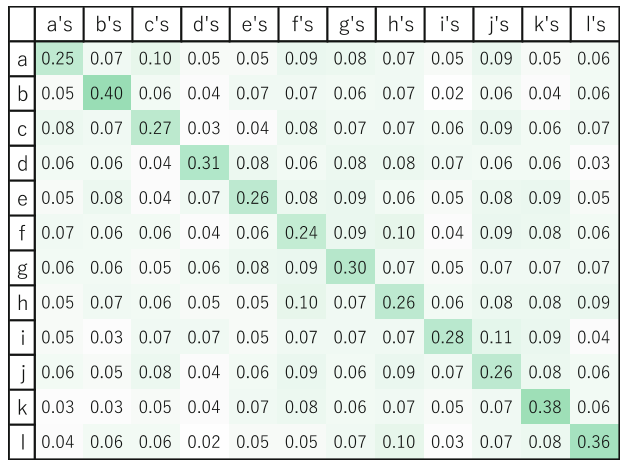 Figure 2: Confusion matrix for Angle Feature classification. High diagonal values indicate the machine successfully identified the individual dancer nearly every time.
| Feature Type | Beginners Accuracy | Experienced Accuracy |
|---|---|---|
| Angle Features | 99.1% | 92.0% |
| Movement Features | 95.4% | 89.5% |
Critical Insight: Why Does This Matter?
The core takeaway is that personality is objective data.
While a dancer might think their "style" is in their hands, the machine proves that the "rhythm" of their chest movement and the specific "bend" of their knees are much more reliable identifiers. This suggests that "personality" in dance is a combination of posture (Form) and energy distribution (Movement).
Limitations and Future Work
The study was limited to a specific 15-second choreography. The real "Holy Grail" will be Cross-Choreography Identification: identifying a dancer's personality in a completely different routine. Furthermore, while Kinect was used here, modern "Pose Estimation" (like OpenPose or Mediapipe) could allow this to work with standard 2D smartphone videos, bringing personalized dance search to the masses.
Conclusion
This research bridges the gap between the artistic "feel" of dance and hard kinematic data. By proving that a machine can identify us by our skeletal "twitches" and "angles," it opens the door to a future where AI acts as a stylistic matchmaker, helping every dancer find their unique voice by connecting them with the right mentors.