
The Digital Mirror: How Your Social Media Posts Reveal Your Personality
7KH ,PSDFW RI 3HUVRQDOLW\ RQ 8VHU*HQHUDWHG &RQWHQW LQ 2QOLQH 6RFLDO 1HWZRUNV
This study investigates the relationship between the "Big Five" personality traits and User-Generated Content (UGC) on social media. Using data from over 15,000 Facebook users, the authors quantify how traits like Extraversion and Neuroticism dictate topic preferences, linguistic patterns, and emotional expression in online posts.
TL;DR
Ever wondered why some people only post about work while others share every emotional high and low? A large-scale study of over 15,000 Facebook users reveals that our User-Generated Content (UGC) is a precise reflection of our "Big Five" personality traits. By analyzing topic preferences, grammar, and sentiment, researchers have decoded the psychological blueprints hidden in our digital footprints.
Background: Beyond Simple "Likes"
In the era of social media, our digital presence is more than just data; it is an extension of our psyche. While previous studies focused on specific behaviors (like "who clicks what"), this research looks at the composition of what we write. It positions itself as a comprehensive link between established psychological theory (The Big Five) and modern behavioral informatics.
Problem & Motivation: The Missing Link in UGC
Despite the abundance of social data, we often lack a deep understanding of why users generate specific types of content. Prior work has shown that personality influences communication, but these studies were often limited by small sample sizes or narrow focus (only looking at word frequency). This study aims to bridge that gap by looking at four distinct dimensions:
- Topic Preferences: What do you talk about?
- Expression Patterns: How do you structure your sentences?
- Sentiment States: What is your emotional tone?
- Cognition Styles: How do you process information?
Methodology: Mapping the Mind to the Feed
The authors utilized the Big Five Personality Theory, which categorizes humans into five dimensions: Agreeableness, Conscientiousness, Extraversion, Neuroticism, and Openness.
To connect these traits to content, they processed Facebook status updates using LIWC (Linguistic Inquiry and Word Count), a gold-standard tool in computational linguistics. This allowed them to turn messy text into structured data points like "percentage of positive emotion words" or "frequency of social pronouns."
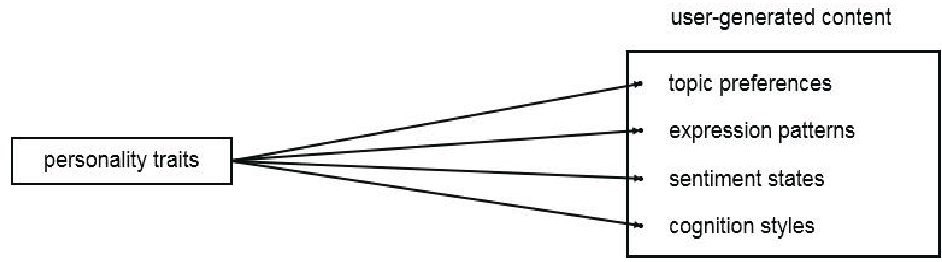
The figure above illustrates the research model, showing the flow from personality traits (independent variables) to UGC features (dependent variables) while controlling for demographics like age and gender.
Key Insights: What the Data Says
The regression analysis yielded fascinating results that align with psychological intuition but provide quantitative proof:
1. The "Extravert's" Social Hub
Extraverts are significantly more likely to talk about Leisure, Family, and Friends. They use more social words and "netspeak" (slang/internet abbreviations), reflecting their outgoing and communicative nature.
2. The "Conscientious" Professional
Users high in Conscientiousness tend to post about Work. Their language is more formal, often avoiding excessive pronouns and focusing on achievement-oriented topics.
3. The "Neurotic" Emotional Loop
Neuroticism was a strong predictor of Negative Emotion words. Interestingly, these users also showed a higher usage of first-person singular pronouns ("I", "Me"), suggesting a more self-focused and internally turbulent state.
4. The "Open" Intellectual
People high in Openness use longer words (> 6 letters) and display complex cognitive processes in their writing. They represent the "thinkers" of the social network.
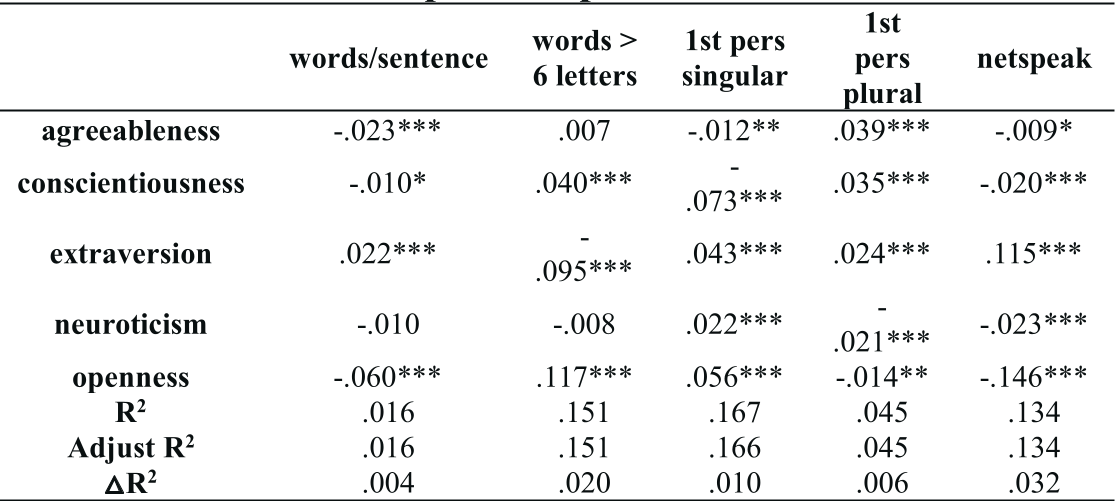
The table above highlights the standardized coefficients, showing the strong relationship between Openness and word complexity, and Extraversion and netspeak.
Deep Insight & Conclusion
This study confirms that our online persona is not a mask, but a consistent manifestation of our underlying traits.
Clinical and Commercial Value
- Personalized Marketing: Brands can move beyond "demographic" targeting to "psychographic" targeting, reaching users based on their intrinsic motivations.
- Mental Health: Significant shifts in linguistic markers (e.g., a sudden spike in neurotic markers) could serve as early warning signs for psychological distress.
Limitations
While the sample size is impressive, the study is limited to Facebook. Future research should investigate if these "personality fingerprints" remain stable across different platforms like TikTok (video-based) or LinkedIn (professionally gated).
Final Takeaway: Your status update is more than a message; it’s a psychological signature. In the digital age, we don't just use tools; our tools reveal who we are.