
When Jaunty Juveniles Meet Serious Suits: The Psychology of Social Media Etiquette at Work
Personality Influences on Etiquette Requirements for Social Media in the Work Context When Jaunty Juveniles Communicate with Serious Suits
This study investigates how personality traits (FFM) and demographics influence etiquette requirements for social media in professional settings. Using a questionnaire-based approach (N=99), the researchers analyze acceptance criteria across email, blog, and chat mediums, identifying Conscientiousness and Age as primary drivers of formal communication demands.
TL;DR
Bringing social media into the office isn't just a technical challenge—it's a psychological minefield. This research reveals that your personality (Conscientiousness) and your age are the biggest predictors of whether you'll find a ":-)" or a "BTW" offensive in a professional message. While chat is treated like "oral" speech, blogs and emails are held to much higher standards of formal correctness.
Background: The Friction of "Private" Tools in "Public" Spaces
Social media was born in the private sphere. When these tools enter the workspace for knowledge management, they bring along informal habits that often collide with established corporate rituals. In German-speaking contexts particularly, where the distinction between formal (Sie) and informal (Du) addressing is sharp, the "etiquette gap" can lead to friction between different generations and personality types.
The Core Insight: Personality as a Filter
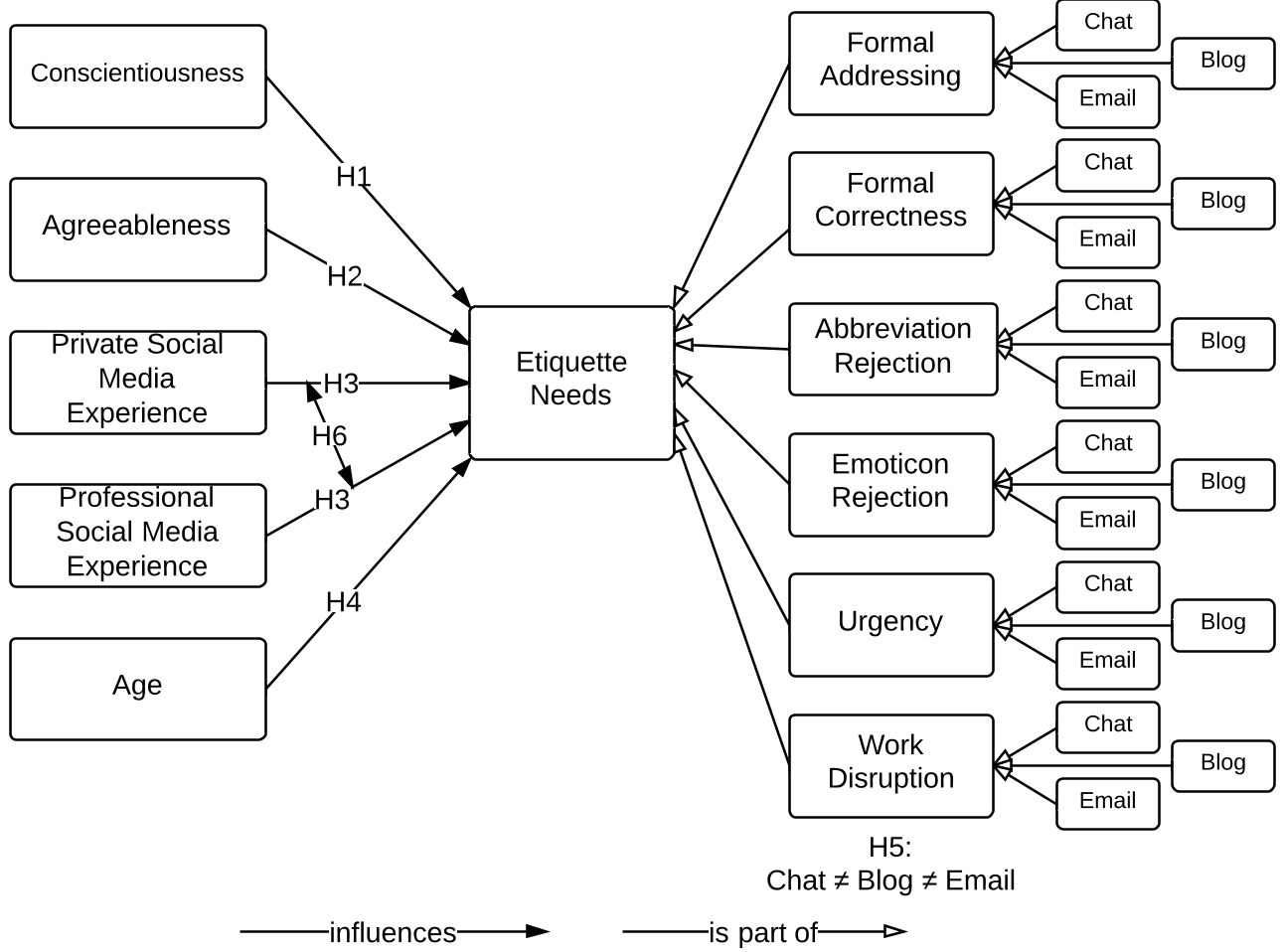
The researchers hypothesized that two "Big Five" traits—Agreeableness and Conscientiousness—would dictate our "desire for decorum." Interestingly, Agreeableness had almost no effect. It is Conscientiousness (the tendency to be organized, dutiful, and disciplined) that acts as the gatekeeper for professional etiquette.
Methodology & Framework
The study analyzed how the following independent variables impacted the perception of three media: Email, Chat, and Blog.
- Independent Variables: Age, Social Media Expertise, Conscientiousness, Agreeableness.
- Etiquette Dimensions: Formal addressing, Correct spelling, Abbreviation/Emoticon rejection, and Work disruption.
Key Findings: The "Medium" Matters
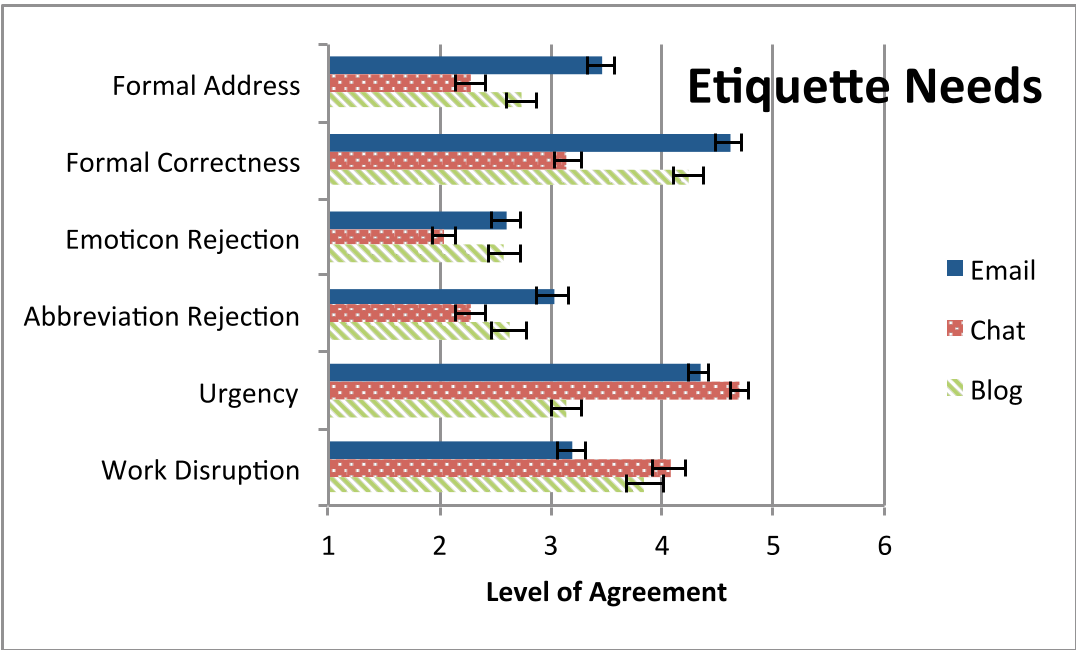
The study found high "Medium Sensitivity." Users don't treat all digital communication the same way:
- Chat is "Oral": It has the lowest requirements for formal addressing and spelling. It is perceived as a synchronous, informal conversation.
- Blogs are "Publications": Surprisingly, blogs require the highest level of formal correctness (spelling/grammar), even more than email in some cases.
- Email is the "Gold Standard": It remains the most formal medium, requiring the highest level of honoifics and full-name addresses.
The Predictive Power of Age and Conscientiousness
Regression analysis showed that:
- Formal Addressing: Age is the strongest predictor. Older users demand to be addressed properly with their full titles.
- Emoticon/Abbreviation Rejection: Driven primarily by Conscientiousness. High-scoring individuals see "lol" or "brb" as a lack of professional rigor.
- Work Disruption: Conscientious people feel significantly more "interrupted" by social media pings, whereas social media "likers" feel no such disruption.
Critical Analysis & Conclusion
This paper serves as a warning for "one-size-fits-all" digital transformations. A "Jaunty Juvenile" (young, high-tech experience) might see emoticons as essential for building rapport, while a "Serious Suit" (older, high conscientiousness) might see them as a sign of incompetence.
Practical Takeaways for Managers:
- Instruction is Key: Young employees should be coached on when to pivot to formal addressing, especially when using internal blogs or commenting on senior leadership posts.
- Media-Specific Rules: Don't force email-level formality on chat; but don't allow chat-level sloppiness on the company blog.
- Culture Matters: This study was conducted in Germany. The results emphasize that etiquette is highly cultural and language-dependent—the "formality gap" may be even wider in high-context cultures.
Limitations & Future Work
The sample was relatively young (mean age 28.8) and predominantly non-technical. Future research should investigate if "Expertise" eventually overrides "Personality"—does a highly conscientious software engineer eventually embrace chat abbreviations out of pure efficiency? Furthermore, the role of Openness to Experience remains an untapped variable that could explain the early adoption of informal digital etiquette.