
Personality Learning Analytics: The Next Frontier in Intelligent Virtual Learning
Personality Learning Analytics System in Intelligent Virtual Learning Environment
This paper proposes a conceptual system architecture for Personality Learning Analytics within an Intelligent Virtual Learning Environment (IVLE). It integrates machine learning (Java/Python) and Big Five personality traits to monitor, predict, and provide feedback on student performance, achieving a specialized framework for data-driven pedagogical intervention.
TL;DR
This research introduces a robust system architecture that bridges the gap between raw data collection and personalized pedagogy. By integrating Personality Analytics into an Intelligent Virtual Learning Environment (IVLE), the authors provide a roadmap for systems that don't just record what happened, but predict what will happen to a student's learning journey based on their behavioral traits.
Problem & Motivation: Beyond the Spreadsheet
Academic analytics has long been criticized for being "data rich but insight poor." While most modern Learning Management Systems (LMS) can track log-ins and grade submissions, they fail to capture the human element. Why does a student struggle? Is it a lack of content clarity, or a mismatch between the delivery method and the student's personality (e.g., an Introvert struggling in a highly collaborative forum)?
The authors argue that the current disconnect between Business Intelligence and Learning Hypotheses prevents educators from intervening effectively. Their motivation was to create a "Socially Aware" and "Context-Aware" system that treats students as individuals rather than data points.
Methodology - Architecture of Intelligence
The system follows a classic yet rigorous Waterfall Model (Selection, Analysis, Design, Coding, Testing, Implementation). At its core, the architecture consists of three distinct layers:
- Data Warehouse: Consolidates user profiles, course content, and interaction logs.
- Analysis Module: A hybrid engine using Java (for LMS integration) and Python-based machine learning libraries for complex data mining.
- Visualization Layer: A dashboard for instructors to provide feedback and a customized interface for students to receive "adaptive" content.
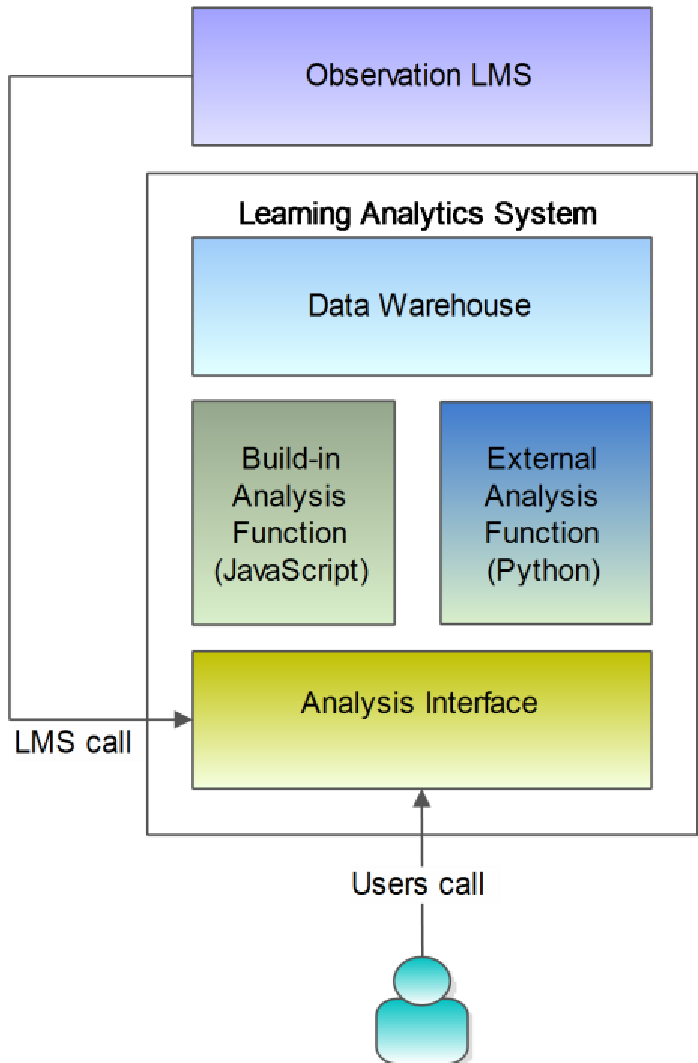 Figure: The Learning Analytics Module showing the integration between LMS and the Personal Analytics engine.
A unique feature is the extraction of personality interaction logs. For learners, it tracks the Big Five (Openness, Extraversion, Agreeableness, Conscientiousness, Neuroticism); for instructors, it tracks interpersonal structures to ensure the "Human-in-the-loop" remains effective.
The 10 Pillars of Intelligent Learning
The paper validates the architecture through 10 essential components. According to the expert panel, the most critical factors for a successful intelligent environment are:
- Adaptability (Mean: 4.73): The ability to push resources based on user preference.
- Socially Aware (Mean: 4.67): Understanding relationships and empathy within the digital space.
- Whole Record (Mean: 4.60): Maintaining a deep, longitudinal history of the learning path.
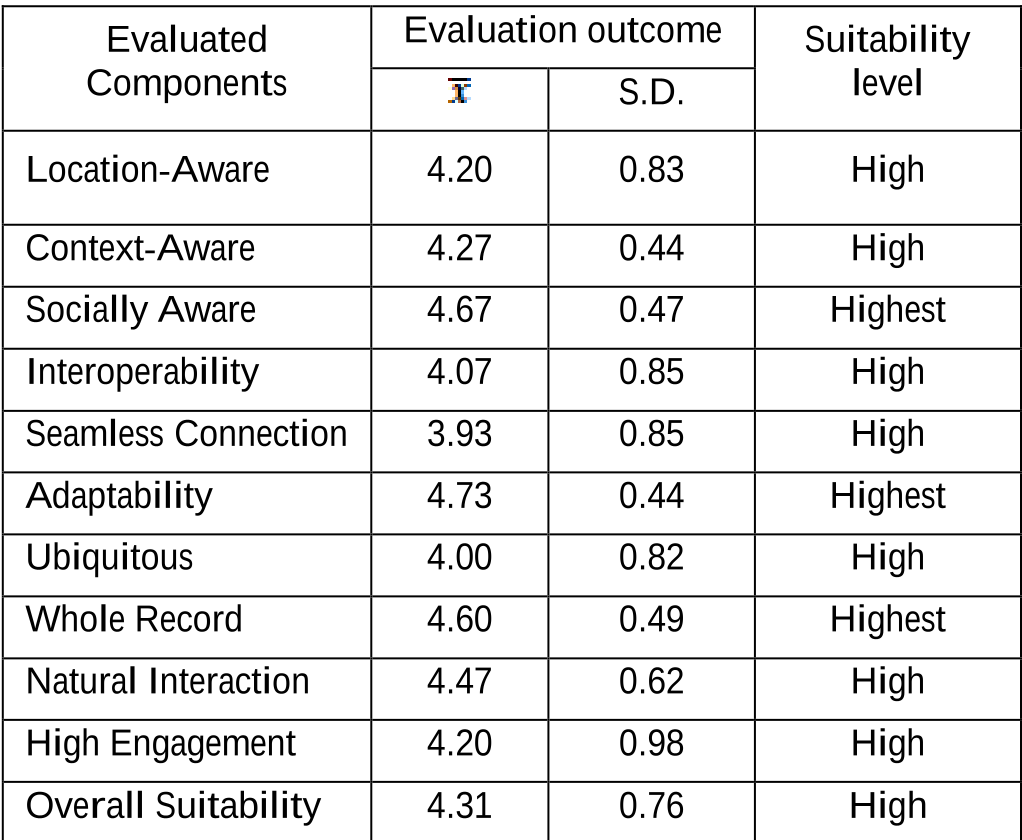 Table: Expert suitability evaluation showing high scores across all architectural components.
Critical Analysis & Conclusion
Takeaway
The shift from "Reactive Analytics" (reporting grades) to "Proactive Analytics" (predicting personality-based obstacles) is the most significant contribution of this work. By defining a clear 10-component framework, the authors provide a tangible checklist for developers of next-generation educational software.
Limitations & Future Work
While the architecture is theoretically sound and expert-validated, the paper lacks a large-scale longitudinal study of actual student outcomes. Future research should investigate how "Neuroticism" scores, for instance, correlate with specific types of digital intervention to prove the clinical efficacy of this personality-aware approach.
The authors suggest this is just the beginning. The next step is applying Text Mining to verify student knowledge creation in real-time, specifically within the context of higher education in Thailand.
Keywords: Learning Analytics, Big Five Personality, Intelligent Virtual Learning Environment, Waterfall Model.