
Personality Modeling: Turning Image 'Likes' into Psychological Insights for Better Recommendations
Personality Modeling Based Image Recommendation
This paper introduces an advanced personality-based image recommendation framework that models the Big Five traits (Openness, Conscientiousness, Extraversion, Agreeableness, Neuroticism) using Flickr "favorites." By transitioning from a direct "Features-to-Personality" (F2P) mapping to a "Features-to-Answers" (F2A+A2P) approach, the authors achieve State-of-the-Art performance in user modeling and recommendation.
TL;DR
Can your Flickr "favorites" reveal your personality? This paper demonstrates that they can. By leveraging high-level semantic features and a novel two-stage modeling approach (F2A+A2P), the researchers significantly improved the accuracy of personality prediction, leading to an image recommendation system that "understands" user tastes far better than traditional low-level feature models.
Context & Motivation: The Noise in the Mirror
In the world of Recommender Systems, "Personality" is the ultimate latent variable. However, predicting it from images is notoriously hard. Prior work suggested that self-assessed personality scores were too noisy to model accurately, favoring "expert" ratings instead.
The authors of this paper challenge that notion. They argue that the "noise" isn't in the users, but in the methodology. Traditional systems tried to jump directly from pixels to traits (e.g., from "Brightness" to "Extraversion"). This paper posits two main improvements:
- Semantic Depth: Moving from low-level features (color, edges) to semantic ones (objects, scenes, facial expressions).
- Structural Realism: Modeling the way psychologists actually measure personality—through questions (BFI-10)—rather than direct scores.
Methodology: The F2A+A2P Pipeline
The core innovation is the Features-to-Answers + Answers-to-Personality (F2A+A2P) approach. Instead of a direct regression (F2P), the system uses a Sparse and Low-rank Transformation (SLoT) to predict how a user would answer specific personality questions based on their liked images.
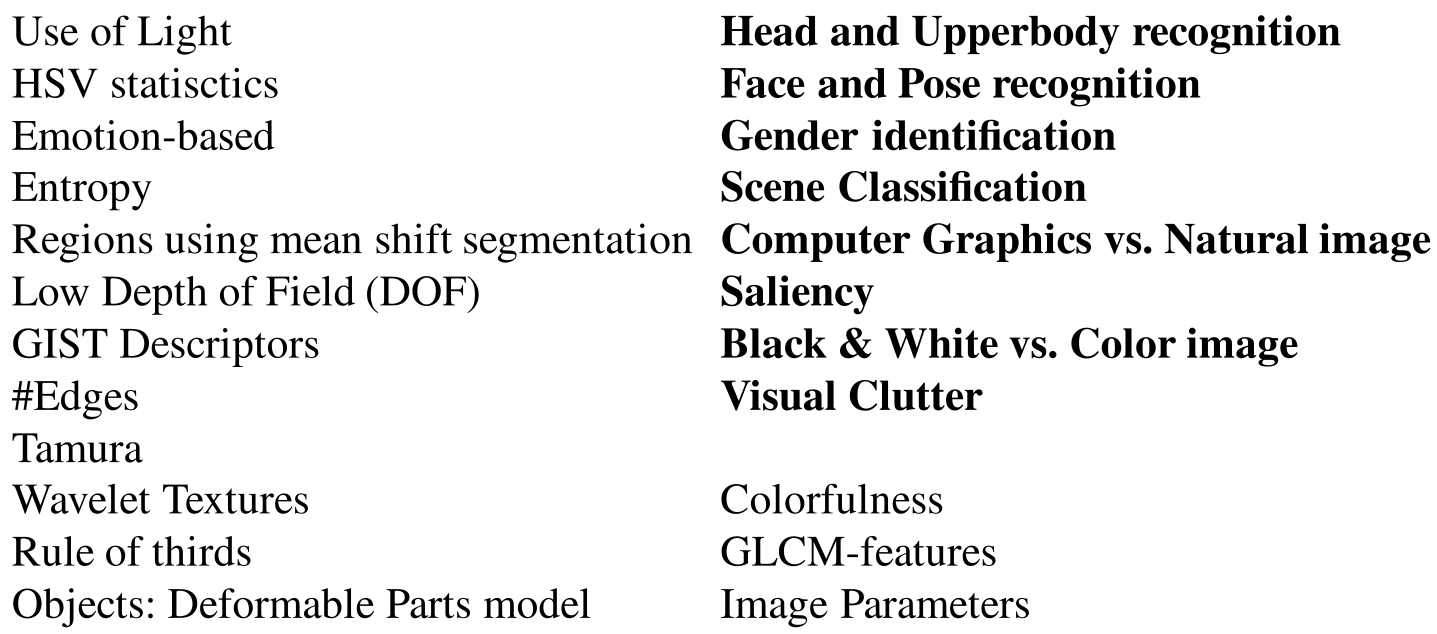
1. High-Level Semantic Features
The authors added features such as:
- Scene Classification: Identifying if the user likes nature or urban environments.
- Object Recognition: Presence of people, faces, or specific genders.
- Visual Clutter: A key indicator for Neuroticism.
2. The SLoT Formulation
The mapping from features () to answers () is solved using an objective function that balances regression error with sparsity (only some features matter for certain answers) and low-rank constraints (answers are correlated):
Experiments & Results: Bridging the Gap
The researchers tested their approach on the PsychoFlickr dataset (300 users, 60,000 images).
Key Performances:
- Accuracy Boost: The F2A+A2P model outperformed baseline LASSO and sparse SVR by massive margins, often reducing error by nearly half.
- Expert Knowledge Generalization: Perhaps most impressively, a model trained on expert assessments generalized remarkably well to self-assessed user data, proving that the methodology captures objective psychological truths rather than just mimicking noise.
Improved Recommendations:
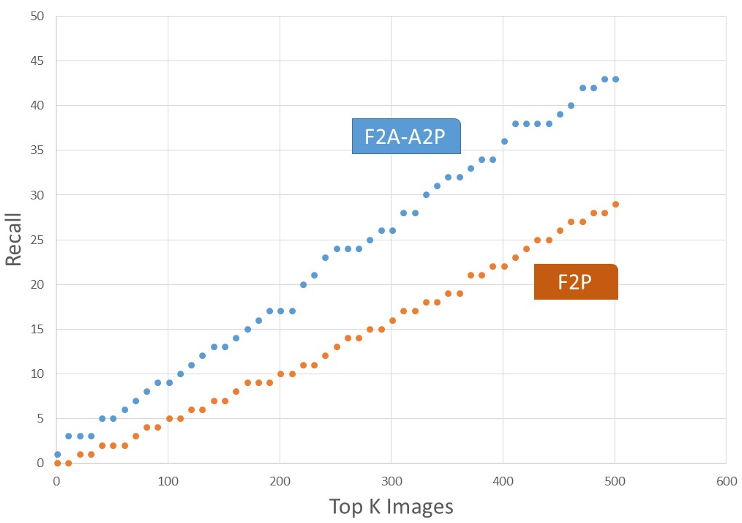
When applied to a recommendation task, the F2A+A2P approach showed a much steeper recall curve (Fig 3). It was able to retrieve images that aligned with a user's personality traits—for example, retrieving scenic, object-less backdrops for users with low Extraversion scores.
Critical Insight & Conclusion
The success of this work lies in its psychological intuition. By recognizing that personality traits are high-level abstractions, the authors chose to model the "intermediate" layer—the BFI-10 answers—which are more linearly related to visual content than the abstract traits themselves.
Takeaway: Effective AI personalization should not ignore the established structures of human psychology. By transforming the problem from a black-box regression into a structured psychological simulation, we can achieve more "natural" and accurate user-content matching.
Limitations: The study uses "Pro" users on Flickr, which may introduce an "Openness" bias toward artistic content. Future work should validate these semantic mappings on more diverse, casual social media datasets.