
The Digital Mirror: Does Your Personality Define Your Facebook Persona?
Personality and motivations associated with Facebook use
This study investigates the relationship between the Five-Factor Model (FFM) of personality and Facebook usage patterns among undergraduate students. Utilizing the NEO-PI-R inventory and a custom Facebook questionnaire, it identifies how traits like Extraversion, Neuroticism, and Openness to Experience influence specific social networking behaviors and motivations.
TL;DR
Contrary to the popular belief that our digital lives are a direct reflection of our "offline" personalities, this study reveals a more complex reality. While Extraversion and Neuroticism do influence how we use Facebook—such as joining more groups or preferring text-based "Walls" over photos—the Big Five personality traits are surprisingly weak predictors of overall engagement. Instead, the raw motivation to communicate and specific CMC (Computer-Mediated Communication) competence play far larger roles in determining our digital footprint.
Why Motivation Trumps Personality
In the early days of social media research, psychologists assumed that the Internet acted as a laboratory for the "Big Five" personality traits (Neuroticism, Extraversion, Openness, Agreeableness, and Conscientiousness). However, this 2009 study from the University of Windsor highlights a critical shift: Facebook isn't just a place to meet strangers; it's a tool to manage existing social capital.
The authors found that while we might expect an "Extravert" to have thousands of friends, the data didn't strictly support this. Instead, the "Motivation" to use the technology was the primary engine driving time spent on the platform.
Breaking Down the Big Five on Facebook
1. Extraversion: The Group Seekers
Extraverts, who crave social stimulation, predictably joined more Facebook Groups ( vs. for Introverts). However, they didn't necessarily spend more time online.
- Insight: Extraverts likely view Facebook as a supplement, not a substitute. They use it to organize real-world activities rather than replacing them.
2. Neuroticism: The Quest for Control
One of the most fascinating findings involves how Neurotic individuals—those more sensitive to threat—interact with specific features.
- Wall vs. Photos: High-Neuroticism users preferred the "Wall," while low-Neuroticism users preferred "Photos."
- The Logic: A Wall post allows for "Information Control." You can edit your text, delete it, and take your time to craft a response. Photos are "leaky"—they reveal emotional states, locations, and social contexts that a high-neuroticism person might find threatening.
3. Openness to Experience: The Curious Paradox
Individuals high in Openness were more "socially active" (using more features), yet they scored lower on CMC Knowledge.
- The Logic: The authors suggest these individuals are "explorers, not technicians." They are eager to try every new button Facebook releases because of their curiosity, but they don't necessarily care to understand the underlying mechanics or "how the system works."
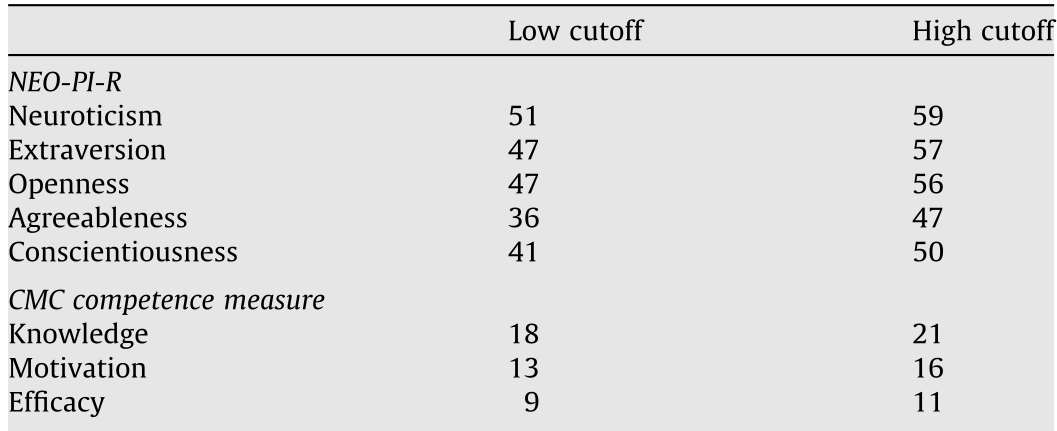
Methodology: The Power of Extreme Groups
To find these signals in the noise, the researchers utilized the NEO-PI-R, a gold-standard personality inventory. Because personality effects are often subtle, they divided the sample into "high," "medium," and "low" thirds, comparing only the extremes.
(Note: Referencing the factor analysis showing how usage splits between 'Attitudes' and 'Online Sociability')
Critical Analysis & Conclusion
The most striking takeaway is the limitation of broad personality models. The authors admit that "personality factors were not as influential as previous literature would suggest."
Why the "Big Five" Might Be Failing
- Imprecise Resolution: Terms like "Agreeableness" might be too broad to predict whether someone clicks "Like" on a photo.
- The Rise of Shyness and Narcissism: Traits not fully captured by the Big Five—like shyness or narcissism—might be the true drivers of SNS behavior.
- The Invisible Interface: For many, Facebook has become "invisible"—a utility as common as the telephone. Once a technology reaches mass adoption, personality traits matter less than habit and social necessity.
Future Outlook: As we move into an era of AI-driven social feeds, the focus of research is shifting from "who you are" (personality) to "what triggers your engagement" (algorithmic motivation). This study was a foundational step in realizing that the digital self is not just a copy of the physical self—it's a curated extension driven by the specific tools available.
Academic Reference: Ross, C., et al. (2009). Personality and motivations associated with Facebook use. Computers in Human Behavior.