
Beyond the Mirror: Why Your Robot Shouldn't Be Your Personality Twin
Abstract-This study was conducted to define the correlation of a person's personality and that of a personal service robot's and to determine the perception people have on a personal service robot's personality: (1) Kind and friendly personalities were preferred in a personal service robot. This can suggest people's perceptions of personal service robots, (2) in human-robot interaction, theories on human-human interaction or human-computer interaction did not apply. There were no preferences towards robots with similar or complimentary personalities to the user, (3) Difference in preference was shown according to the user's personality types, (4) A higher preference towards feeling type robots when given orders was shown. This indicated user's desire for a kind robot
This study investigates human personality preferences for Personal Service Robots (PSRs), uncovering that users overwhelmingly prefer "Kind" and "Friendly" robot personalities (Exterversion-Feeling and Introversion-Feeling) over those reflecting their own traits. Utilizing MBTI-based personality modeling and TTS-driven speech interaction, the research establishes that traditional Human-Computer Interaction (HCI) theories like the "Law of Similarity Attraction" do not directly apply to the emerging field of Human-Robot Interaction (HRI).
TL;DR
A common assumption in technology design is that we like things that reflect ourselves. New research from KAIST challenges this "Similarity Attraction" dogma, proving that when it comes to personal service robots, we don't want a mirror—we want a friend. While we prefer computers that match our personality, we demand that robots remain kind, mild, and friendly, regardless of whether we are introverts or extroverts.
The "Media Equation" Crisis
For decades, the field of Human-Computer Interaction (HCI) has relied on the Law of Similarity Attraction: dominant people like dominant interfaces, and submissive people prefer submissive ones. However, as robots move from industrial cages into our living rooms, the "Media Equation" is breaking.
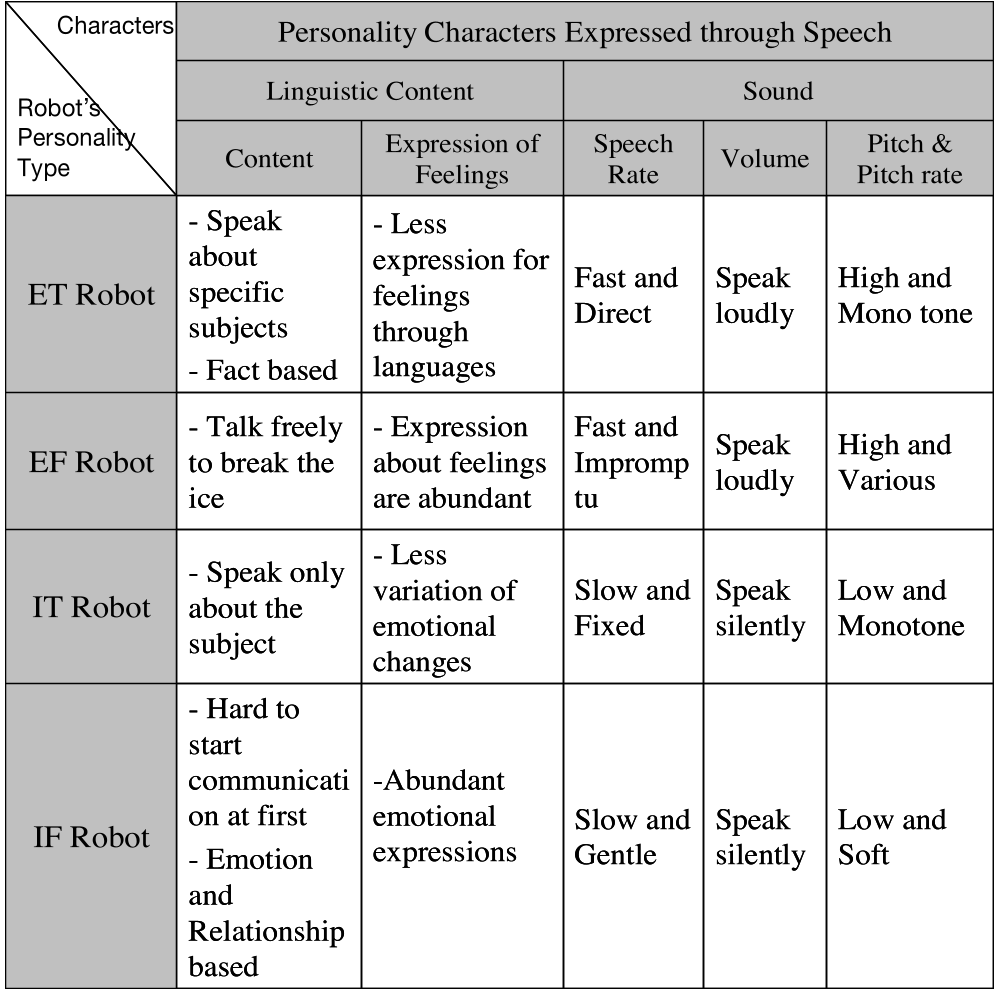
The researchers identified a critical gap: Does a physical robot’s presence change the fundamental social rules of interaction? To find out, they mapped human personalities using the MBTI model and tested them against robots programmed with four distinct archetypes: ET (Extraversion-Thinking), EF (Extraversion-Feeling), IT (Introversion-Thinking), and IF (Introversion-Feeling).
Methodology: Coding Personality into Speech
The team used I-Robi, a family service robot, as the primary testbed. Because physical gestures are technically limited, they focused on Speech as the primary personality indicator.
- The ET Robot: Fast, loud, fact-based, and decisive.
- The IF Robot: Slow, soft-spoken, relationship-oriented, and mild.
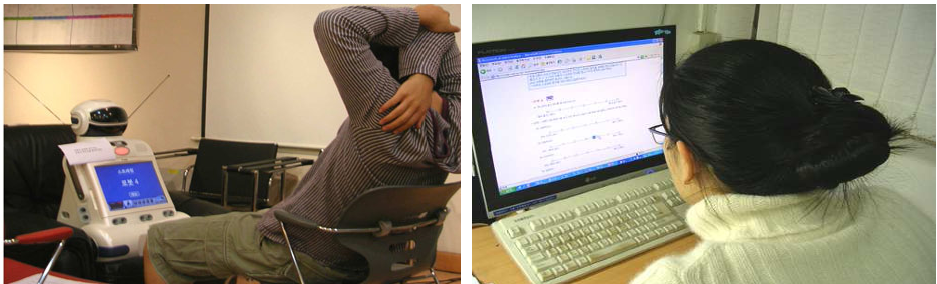
The experiment design was ingenious: participants interacted with both a physical robot and a computer script performing two tasks: a low-involvement task (weather report) and a high-involvement task (ordering the user to do stretching exercises).
The Results: A Psychological Divergence
The findings were startling. In the computer experiment, the old laws held true—people liked the "voice" that matched their own MBTI profile. But once the "voice" was put into a physical robot, the behavior changed:
- Uniform Preference: Most participants, regardless of their own personality, showed a strong preference for EF (Extrovert-Feeling) and IF (Introvert-Feeling) robots.
- The "Order" Effect: When the robot gave orders (stretching exercises), the preference for "Thinking" types (ET/IT) plummeted. Users found aggressive or strict robots unpleasant when they were sharing physical space.
- The F-Factor: Users with "Feeling" (F) traits showed even higher emotional sensitivity toward the robot's kindness compared to "Thinking" (T) users.
Deep Insights: The Robot is a "Helper," Not a "Tool"
The study concludes that users perceive personal service robots through a unique social lens. While a computer is seen as a tool (where efficiency and similarity matter), a robot is seen as a social entity.
Key Design Takeaways:
- Don't Mirror, Just Be Kind: Developers shouldn't spend excessive resources on "personality matching." A baseline of kindness and mildness (F-traits) is the safest and most effective design path.
- Function-Driven Personality: A robot's personality should be fluid. It might need to be more "IF" (mild) when reminding a user to take pills, but perhaps more "EF" (energetic) when acting as a social companion.
- The Physicality Premium: Physical presence creates a sense of vulnerability in users. An "aggressive" computer is a nuisance; an "aggressive" robot is a threat.
Critical Analysis & Conclusion
This research is a vital correction to the "one-size-fits-all" approach to personality in AI. However, it has limitations: the study used a relatively young demographic (KAIST students) and a specific robot form factor (I-Robi). Future work should explore if these preferences hold for humanoid robots or elderly users.
Ultimately, the value of this work lies in its reminder that Human-Robot Interaction is its own discipline. We cannot simply copy-paste theories from the screen to the real world. For a robot to be home-ready, it doesn't need to be our twin—it just needs to be a gentleman.