
P-ALICE: Decoding Microblog Personalities with Smarter Sampling
Personality Prediction for Microblog Users with Active Learning Method
The paper introduces a personality prediction framework for Sina Weibo users using a Pool-based Active Learning in approximate linear regression (P-ALICE) approach. By strategically selecting the most "informative" unlabeled users for professional personality testing, the authors build a Big-Five trait regression model that achieves superior accuracy with significantly fewer labeled samples.
TL;DR
Predicting a user's "Big Five" personality traits from their social media footprint usually requires thousands of labeled surveys—a logistical nightmare. This paper introduces an Active Learning framework that doesn't just learn from data but chooses which users to learn from. Using the P-ALICE regression algorithm, the researchers achieved state-of-the-art prediction accuracy on Sina Weibo by labeling only 100 strategic users, proving that in psychological AI, quality of data beats quantity.
The Bottleneck: Why Personality Labels are Expensive
In the world of Computational Psychology, data is asymmetric. We have billions of "behaviors" (likes, post counts, timing), but very few "labels" (actual personality scores). To get a label, a user must sit down and answer a 20-100 item psychological inventory.
Previous studies relied on Passive Learning, where models are trained on whatever data is available. The authors identified two major flaws in this:
- High Cost: Randomly asking users to take tests is inefficient.
- Covariate Shift: The distribution of users who willingly take tests might differ significantly from the general population, leading to biased models.
Methodology: The P-ALICE Framework
The core innovation is the transition from random sampling to Active Inquiry. The system extracts 47 behavioral features (e.g., post frequency, sentiment of descriptions, and posting time slots) and applies Singular Value Decomposition (SVD) to reduce noise and dimensionality.
The Active Selection Engine
Instead of standard regression, the authors use P-ALICE (Pool-based Active Learning in approximate linear regression).
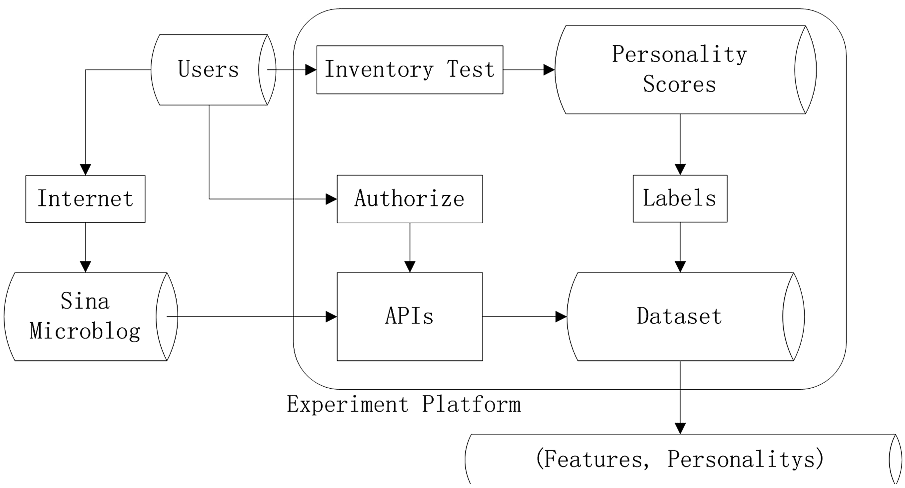
The mathematical "intuition" behind P-ALICE:
- Weighted Least-Squares: It applies a weight function to handle the difference between the training and test distributions.
- Bias Re-sampling: It uses a parameter to actively choose users from a pool that are expected to minimize the Generalization Error. It essentially asks: "Which user, if labeled, would most reduce my uncertainty about the rest of the crowd?"
Experimental Results: Doing More with Less
The researchers compared P-ALICE against three baselines: Linear Regression (LR), Local Linear Kernel Regression (LLKR), and OLS.
1. Performance Gains
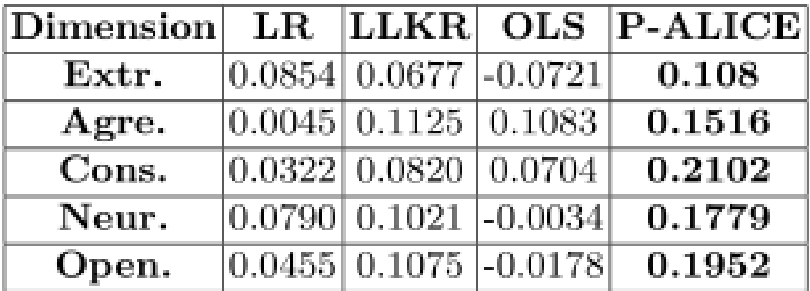
P-ALICE consistently yielded lower Mean Absolute Error (MAE) and Root Mean Squared Error (RMSE) across all Five traits: Extraversion, Agreeableness, Conscientiousness, Neuroticism, and Openness.
2. High Correlation with Small Samples
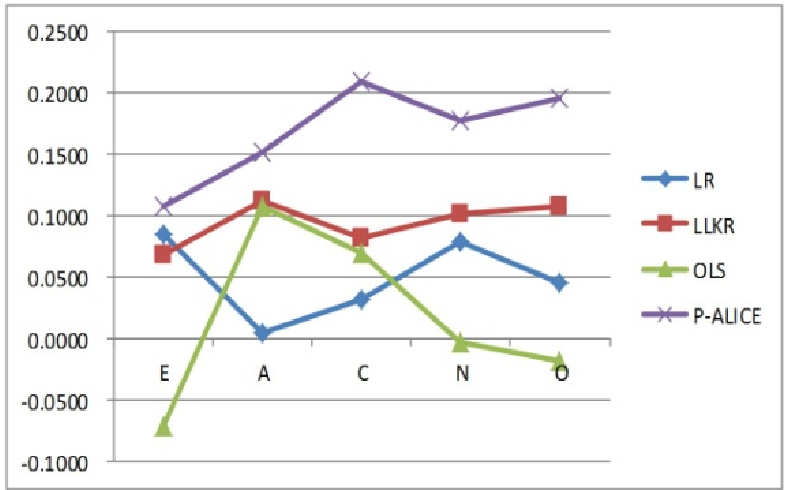
As seen in the chart below, P-ALICE (the blue line) maintains much higher Correlation Coefficients (CORR). For Conscientiousness (Cons.), it reached a correlation of 0.21, which is remarkably high given the training size was only 100 users.
Critical Insights & Takeaways
- Basis Function Matters: The authors found that Gaussian Kernel functions are superior for multi-trait prediction because they can model non-linear relationships without the constraints of polynomial orders.
- Tuning the 'Active' Intensity: The parameter (set to 0.6) acts as a throttle for how aggressively the model focuses on "outlier" vs. "representative" samples.
- Efficiency: The ability to build a functional psychological profile using only 100 participants opens doors for low-budget psychological research and real-time social media monitoring for public health.
Conclusion
This paper serves as a bridge between Active Learning theory and Psychological application. By treating "label acquisition" as a strategic resource management problem, the authors have provided a blueprint for future AI systems that need to understand human nature without being "data-hungry."
Future Directions: Integrating NLP (Natural Language Processing) on the actual content of the microblogs (rather than just metadata) could further tighten the correlation between digital behavior and the human psyche.