
Decoding Human Persona: How Capsule Networks Revolutionize Conversational Personality Recognition
Personality Recognition in Conversations using Capsule Neural Networks
This paper introduces a novel framework for automatic personality recognition in conversations using Capsule Neural Networks. By modeling word co-variance as capsules and employing dynamic routing-by-agreement, the method achieves SOTA performance on the Big Five personality traits, notably outperforming traditional lexicon-based and n-gram approaches.
TL;DR
Researchers have developed a new way to "read" personalities from daily conversations. By using Capsule Neural Networks, the system identifies the Big Five personality traits more accurately than previous methods. Instead of just counting keywords, the model understands the relationship between sets of words, achieving a significant 10-20% boost in F1 scores over traditional benchmarks.
Personality: The Digital Signature in Our Speech
Every word we speak carries a hidden fingerprint of who we are—our values, social habits, and emotional stability. While psychology has long used the Big Five Model (Openness, Conscientiousness, Extraversion, Agreeableness, Neuroticism), traditional AI struggled to capture these traits automatically.
Past approaches relied on:
- N-grams: Simple word sequences that miss context.
- LIWC: Fixed dictionaries that require manual expert curation.
- Self-Reports: Biased and retrospective data.
The authors of this paper argue that personality isn't just about what words you use, but the hierarchical patterns of how those words co-vary.
Methodology: The Power of Capsules
The core innovation lies in treating semantic features as Capsules. Unlike standard neurons, a capsule stores information as a vector. Its length represents the probability a trait exists, while its orientation represents the specific attributes of that trait.
The Two-Tiered Architecture
- Utterance Level (Capsule Component):
- PrimaryCaps: Uses a Bi-LSTM with Multi-head Self-Attention to extract different semantic aspects of a sentence.
- PersonalityCaps: Uses Dynamic Routing-by-Agreement to decide which semantic "parts" belong to which personality "whole."
- User Level (Statistical Classifier): This layer aggregates all individual utterance predictions for a single user to provide a final personality assessment.
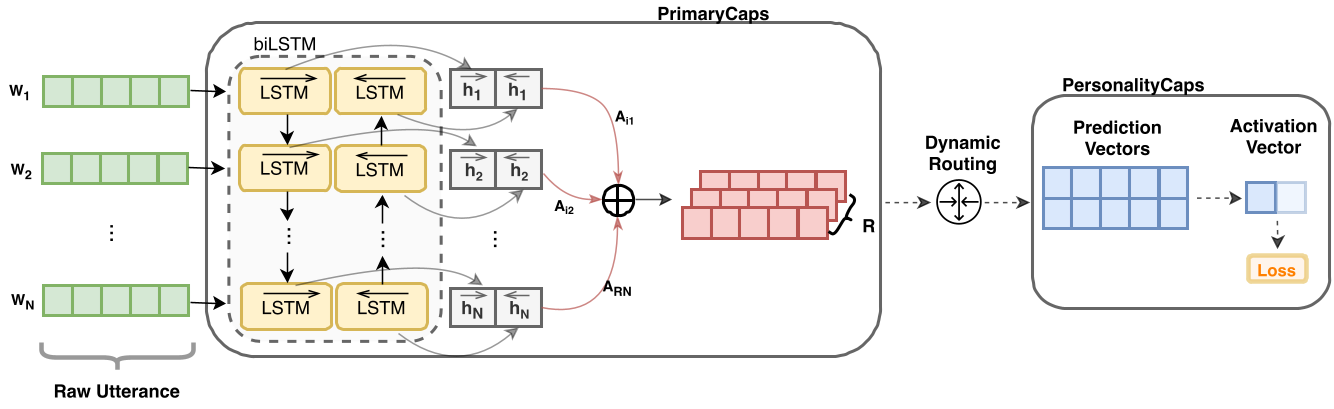 Figure 1: The Capsule-based architecture showing the flow from raw text to PersonalityCaps.
Experimental Battleground
The model was tested on a unique dataset of 15,269 utterances from 96 subjects wearing EAR (Electronically Activated Recorders).
The results were definitive: The CapsStat variant (using a Decision Tree on capsule norms) significantly outperformed the competition.
| Model | Recall | Precision | F1 Score |
|---|---|---|---|
| N-grams | 42.31% | 46.89% | 44.21% |
| LIWC (Expert Lexicon) | 60.15% | 51.61% | 54.43% |
| CapsStat (Proposed) | 61.55% | 68.33% | 64.68% |
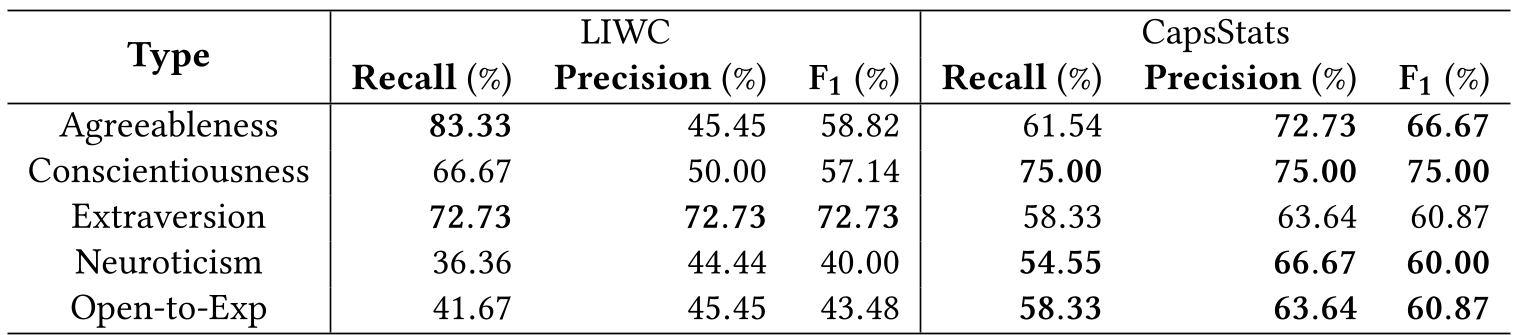 Figure 2: Breakdown of performance across the Big Five dimensions.
Visualizing the "Logic" of Personality
One of the most striking parts of this research is the interpretability. By looking at the self-attention weights, we can see the model "focusing" on specific linguistic cues:
- Agreeableness: Focuses on words of compliance and social harmony.
- Conscientiousness: Highlights words related to planning and future-oriented organization.
- Openness: Attends to descriptive, imaginative metaphors (e.g., calling a car a "party wagon").
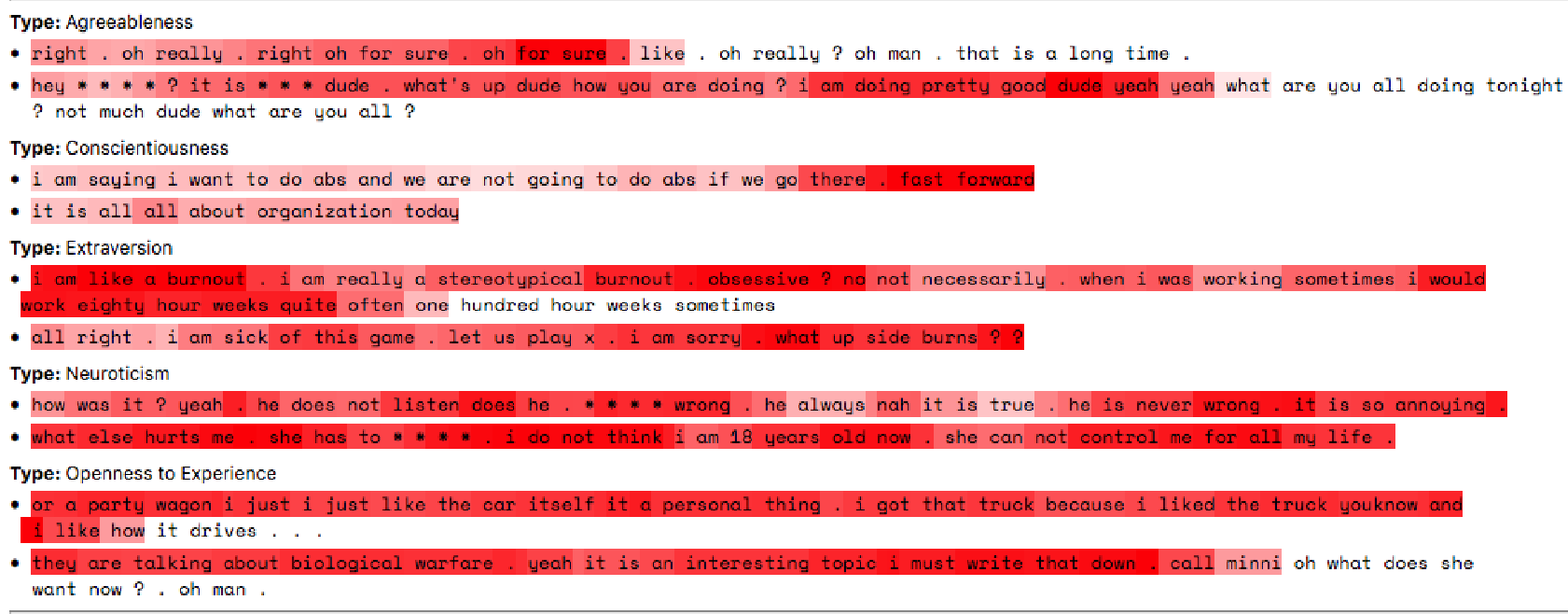 Figure 3: Attention weights showing how the model prioritizes different words for different traits.
Critical Insight & Future Outlook
The success of this model suggests that Capsule Networks are uniquely suited for "soft" NLP tasks like psychology, where relationships between concepts are more important than simple keyword matches.
Limitations: The model handles personality as discrete categories (e.g., Extrovert vs. Non-extrovert). In reality, personality is a spectrum. The authors identify moving toward regression-based continuous scales and integrating contextual embeddings (like BERT) as the next logical steps for the field.
This work paves the way for conversational agents that aren't just polite, but truly empathetic—adjusting their tone and strategy based on the perceived personality of the user.