
CNN-Based Personality Recognition: Moving Beyond Handcrafted Features
Personality Recognition Using Convolutional Neural Networks
The paper introduces a Convolutional Neural Network (CNN) architecture for Personality Recognition based on the Big Five model. Utilizing pre-trained GloVe word embeddings as input, the model achieves performance comparable to SOTA results (RMSE 0.1625) without requiring handcrafted linguistic resources.
TL;DR
This paper presents a shift from manually engineered linguistic features to deep learning for identifying personality. By using a Convolutional Neural Network (CNN) paired with GloVe embeddings, the authors developed a system that matches state-of-the-art accuracy on the PAN-AP-2015 benchmark without any domain-specific tuning.
Background & Motivation
Personality Recognition (PR) is the "holy grail" of Author Profiling. For years, the field was dominated by SVMs and Decision Trees fed with carefully curated lists of function words, emoticons, and punctuation markers.
The authors identify a major flaw in this approach: Resource Dependency. Handcrafted features that work for Facebook might fail on Twitter; features for English might not exist for Spanish. To break this cycle, the researchers proposed a model that views text as a structural signal—an image of word vectors—and uses convolutions to "discover" the latent patterns of personality.
Methodology: Text as an Image
The core intuition is that a tweet can be represented as a matrix , where is the number of words and is the embedding dimension (25 or 50).
The Architecture
- Input Layer: Words are converted to vectors using pre-trained GloVe Twitter embeddings.
- Convolutional Layer: Instead of a single filter, the model uses a parallel strategy with kernels of heights 3, 5, and 7. This allows the network to "read" the text in 3-word, 5-word, and 7-word chunks simultaneously.
- Concatenation & Pooling: Features from all filters are joined and passed through a Max-Pooling layer to extract the most salient signals regardless of their position in the tweet.
- Regression Output: Unlike typical classification, this model ends with a linear activation layer to predict five continuous values (the Five Factor Model: Openness, Conscientiousness, Extroversion, Agreeableness, and Stability).
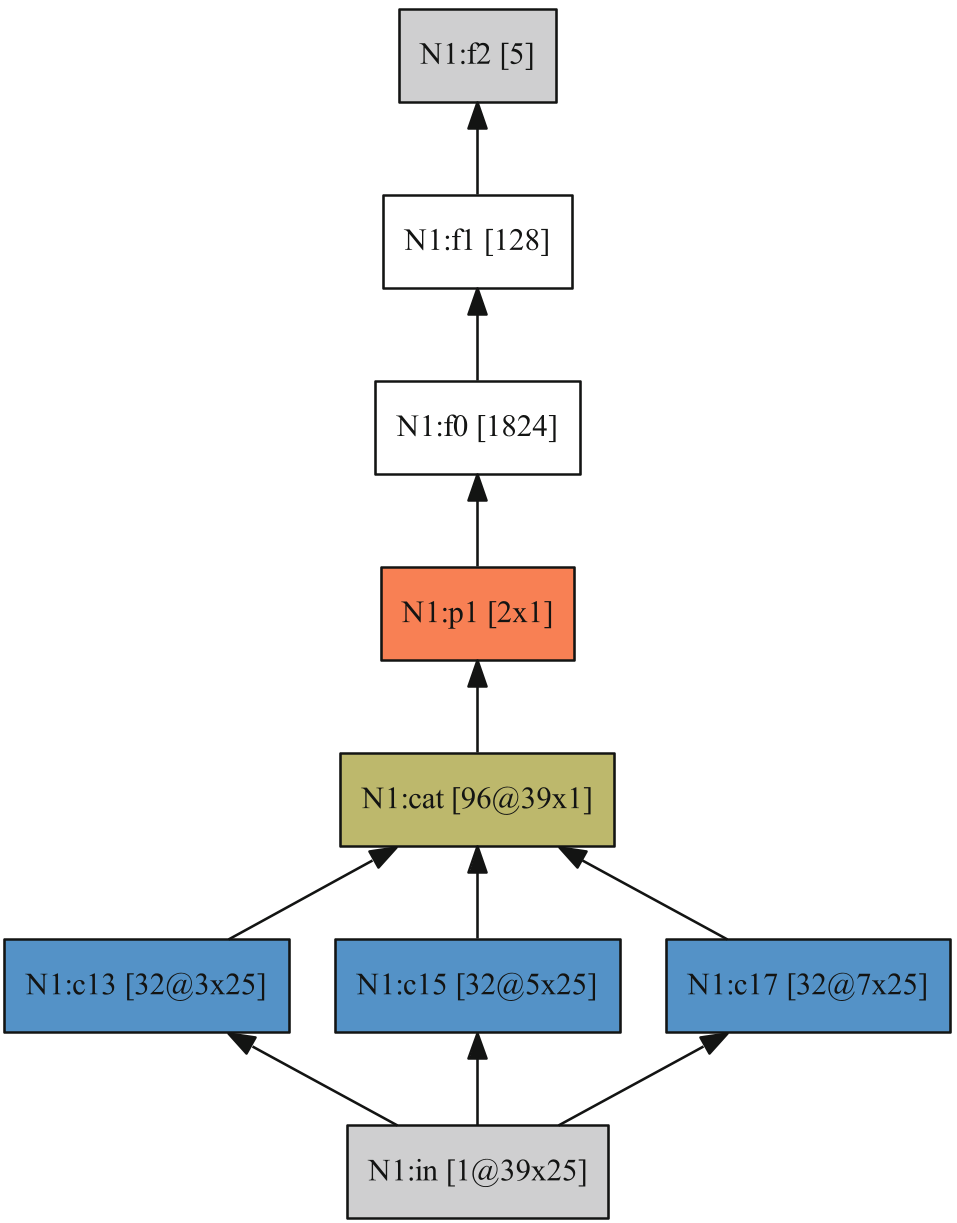 Figure 1: The proposed CNN architecture featuring parallel convolutional filters and a regression output.
Experimental Heartbeat
The model was tested on the PAN-AP-2015 corpus, containing over 14,000 tweets. Since the goal was to predict an author's personality rather than a tweet's personality, the authors averaged the predictions of all tweets belonging to a single user.
Performance vs. The Field
The CNN achieved an RMSE of 0.1625. While the top system at PAN 2015 reached 0.1442, the authors conducted a dependent t-test revealing a p-value of 0.47. In academic terms, this means the CNN's performance is statistically equivalent to the SOTA, achieved with significantly less human labor.
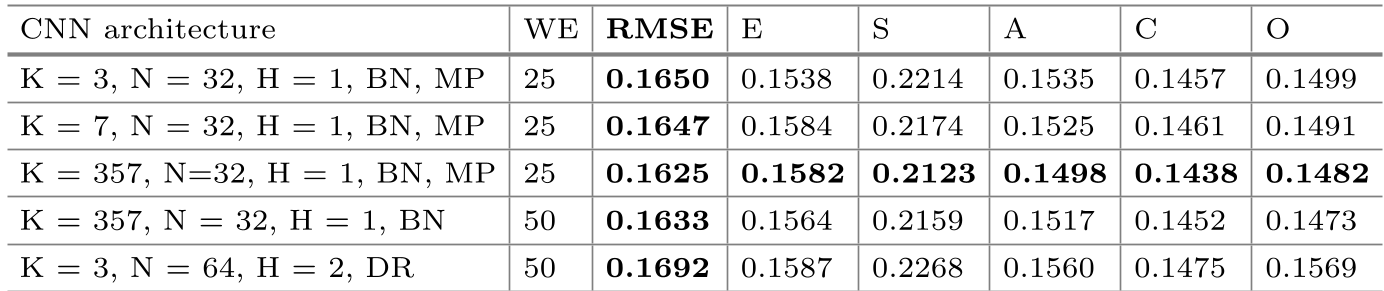 Table 1: Performance of various CNN configurations. The "K=357" model indicates the use of concatenated kernels.
Critical Analysis & Insights
- Physical Intuition: The success of the multi-kernel approach (3, 5, and 7) suggests that personality manifests in short stylistic bursts and specific phrasing patterns that are effectively captured by convolution.
- Stability is Hard: Across all models, "Stability" (Neuroticism) consistently showed the highest error. This implies that emotional stability might be more nuanced or harder to detect in short-form text like Twitter compared to traits like "Extroversion."
- Limitations: The model currently treats each tweet as an independent snapshot. It does not yet account for the temporal progression or the relationship between tweets of the same user during the training phase.
Conclusion
This work serves as a proof-of-concept for the "end-to-end" era of personality recognition. By demonstrating that raw word vectors and CNNs can rival human-designed features, it paves the way for universal, multilingual author profiling systems. Future research will likely see these shallow CNNs replaced by deeper architectures or Transformers to capture even longer-range contextual dependencies.