
Voice-Based Personality Recognition: Decoding Extraversion in Call Centers
A Development of Personality Recognition Model from Conversation Voice in Call Center Context
This paper introduces a personality recognition model tailored for call center environments, leveraging the Maudsley Personality Inventory (MPI) scales. By utilizing Artificial Neural Networks (ANN) and openSMILE-extracted acoustic features from simulated Thai conversation audio, the study achieves targeted classification of Extraversion/Introversion traits.
TL;DR
This research presents a machine learning approach to identify customer personality traits—specifically Extraversion and Introversion—directly from speech during call center interactions. Using the Maudsley Personality Inventory (MPI) and Artificial Neural Networks, the authors achieved an identification accuracy of up to 75%, providing a roadmap for highly personalized customer service.
Contextualizing Personality in Customer Service
In the high-pressure environment of a call center, understanding a customer’s disposition is the key to satisfaction. While most AI applications in this space focus on Sentiment Analysis (detecting anger or joy), this paper argues that Personality Recognition provides a more stable and actionable "customer insight."
The authors pivot away from the common "Big 5" model to the MPI (Maudsley Personality Inventory). Why? Because the MPI’s binary scales (Extraversion-Introversion and Neuroticism-Stability) are simpler for business logic: matching an introverted customer with a calm, methodical agent, or an extroverted customer with a high-energy representative.
Methodology: From Waveform to Psychological Profile
The study utilized a Simulated Speech Corpus where 92 Thai volunteers roleplayed a mobile plan inquiry. The technical pipeline involves three rigorous stages:
- Diarization & Pre-processing: Separating the customer's voice from the agent and removing silence (stripping the audio from ~3.7 minutes down to ~1.7 minutes of pure speech).
- Acoustic Feature Extraction: Using openSMILE with the INTERSPEECH 2012 configuration, the team extracted 6,125 features, encompassing energy levels, spectral descriptors, and voicing (F0).
- Cross-Validation: Due to the relatively small sample size, the study employed Leave-One-Out Cross-Validation (LOOCV) to ensure robust performance across Logistic Regression, LinearSVC, Random Forest, and ANNs.
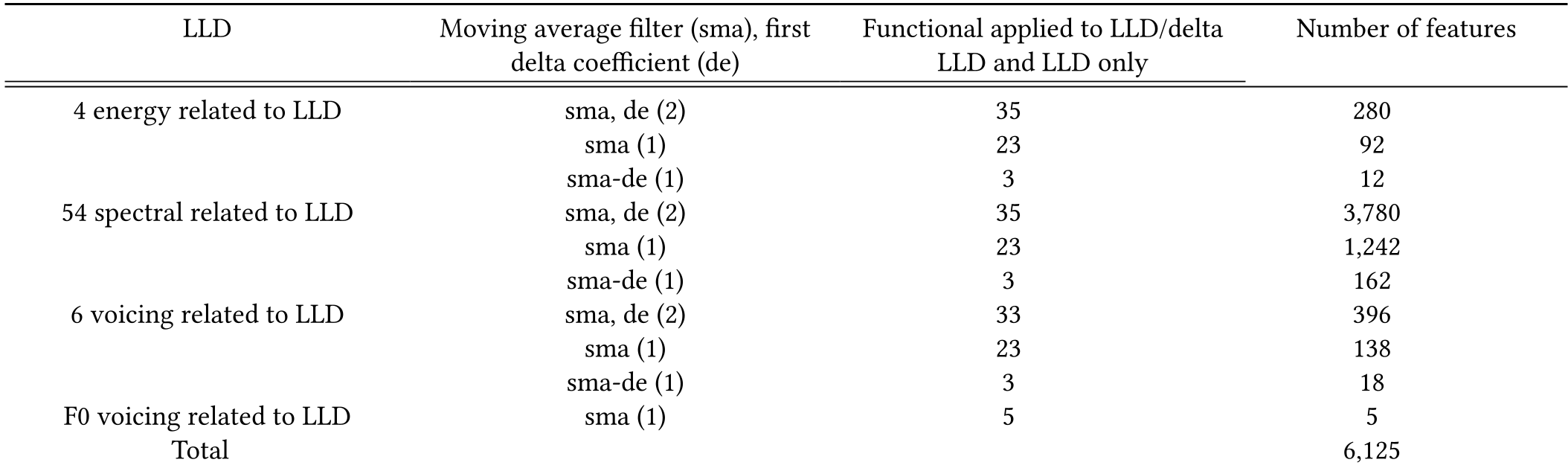 The model utilized a massive array of spectral and energy features to capture subtle vocal nuances.
The Results: The "Voice" of Extraversion
The results reveal a fascinating divide in how personality manifests in voice:
- Extraversion (E-scale): The Artificial Neural Network (ANN) excelled here, reaching a predictive value of 0.75 for extraversion and 0.71 for introversion.
- Neuroticism (N-scale): All models struggled, hovering near-random performance.
 Performance of various ML techniques on the MPI E-scale.
This aligns with psychological theory: Extraversion is inherently "expressive" and external-facing, characterized by distinct volume, pitch, and tempo variations. Neuroticism, conversely, is an internal emotional state that may not consistently leak into the acoustic properties of a professional inquiry call.
Critical Insight & Industry Value
The "Takeaway" for the industry is clear: non-intrusive profiling works for Extraversion. Businesses can use these models to:
- Dynamic Scripting: Adjusting the sales pitch length based on the customer's introversion level.
- Agent Routing: Routing high-extraversion callers to top-performing "people-persons" to boost upsell rates.
- Ad Personalization: Feeding the recognized trait into a CRM for tailored email marketing post-call.
Limitations and The Road Ahead
While promising, the study was conducted in a simulated environment. Real-world call center audio is fraught with background noise and varying VOIP quality. Future work must bridge this "reality gap" and explore if adding demographic data like age or occupation can finally unlock the elusive Neuroticism scale.
Ultimately, this work proves that our voices Carry more than just words; they carry the blueprint of our personality, ready to be decoded by the next generation of AI call centers.