
Beyond Labels: Improving Personality Recognition with Label Distribution Learning
Personality Recognition on Social Media With Label Distribution Learning
This paper introduces Label Distribution Learning (LDL) for Big Five personality recognition on social media (Sina Weibo). By extracting 113 profile and content features, the authors demonstrate that LDL algorithms, particularly LD-SVR, significantly outperform traditional classification and regression baselines in predicting continuous personality scores.
TL;DR
Researchers have successfully applied Label Distribution Learning (LDL) to the Big Five personality traits on Sina Weibo. By treating personality as a continuous distribution rather than discrete categories, their LD-SVR model achieved state-of-the-art accuracy (MAE 4.26) and significantly better computational efficiency than traditional regression baselines.
Problem & Motivation: The "Binary" Trap in Psychology
Most automated personality recognition (PR) systems suffer from a reductionist bias. They typically use binary classification to label users as "High" or "Low" in traits like Neuroticism or Openness. This approach is flawed for two reasons:
- Loss of Nuance: Human personality is a spectrum. A score of 30.1 vs 29.9 on a 50-point scale shouldn't result in two completely different categories.
- Trait Correlation: The Big Five traits are not independent. For instance, Neuroticism and Conscientiousness are often negatively correlated. Treating them as isolated variables loses valuable predictive information.
The authors argue that Label Distribution Learning (LDL) is the "natural" fit for this problem, as it models the relative intensity of all traits simultaneously.
Methodology: Mapping Digital Traces to Distributions
The authors collected data from 994 Sina Weibo users, extracting 113 features divided into three categories:
- Profile Static: Gender, location, nickname length.
- Profile Dynamic: Follower/Following counts, status updates.
- Content-based: Psychological and linguistic features extracted via TextMind (e.g., frequency of "I" vs. "We", emotional words).
The LDL Pipeline
- Label Distribution Generation: Raw BFI scores are normalized so that the sum of the five traits equals 1. This transforms a set of scores into a probability-like distribution.
- Model Training: Unlike standard regression (which trains 5 separate models), LDL models like LD-SVR (Label Distribution Support Vector Regression) and SA-IIS (Improved Iterative Scaling) learn the mapping from features to the entire distribution at once.
 Table: Statistical distribution of Big Five scores in the Sina Weibo dataset.
Experiments & Results: Efficiency Meets Accuracy
The study compared LDL approaches against 9 conventional algorithms (including Random Forest, Gaussian Processes, and SVR).
Predictive Power (MAE)
The LD-SVR method consistently outperformed all others. It achieved an average MAE of 4.262, whereas the best conventional baseline (Random Forest) lagged behind at 4.438. The "Standard" SVR performed much worse than the LDL-specific version, proving that the joint modeling of distributions is the key differentiator.
Computational Efficiency
Efficiency is where the LDL paradigm shines. Because LDL models the traits jointly:
- LD-SVR: 0.28s runtime.
- Random Forest: 5.00s (required to build 5 independent models).
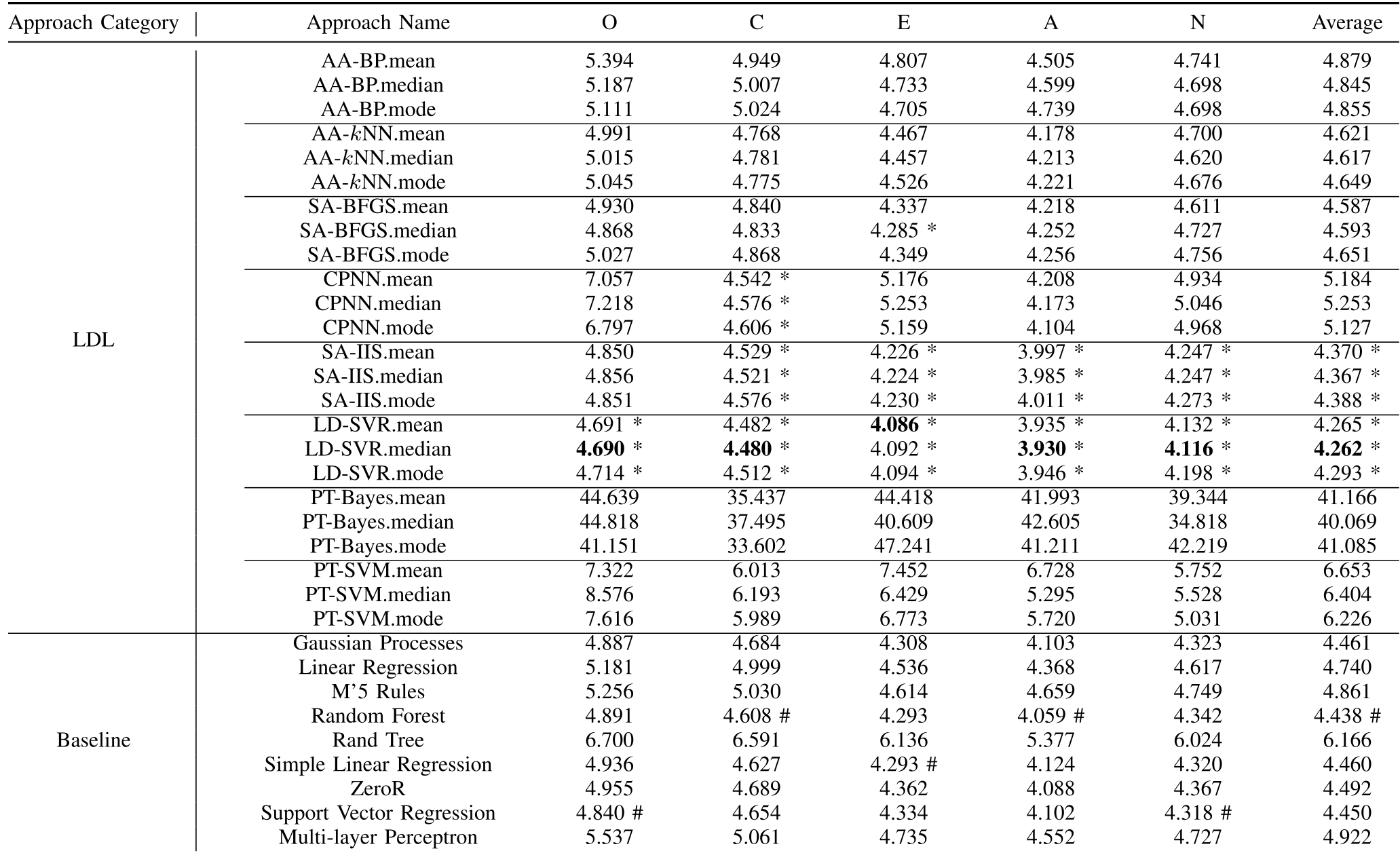 Table: Comparison of MAE across Big Five Traits. LDL methods like LD-SVR and SA-IIS show lower error rates across almost all categories.
Critical Analysis & Conclusion
Takeaway
The core contribution of this work is the validation of LDL as a superior mathematical framework for PR. By enforcing a distribution constraint, the model inherently respects the relationships between traits, mirroring the internal consistency of human psychology.
Limitations & Future Work
- The Weight of Features: While the study focused on algorithms, it relied on "lightweight" feature extraction. Integrating Deep Learning (CNNs/LSTMs) for automated feature discovery from raw text could further reduce MAE.
- Normalization Constraints: The assumption that the Big Five "fully describes" a personality (summing to 1) is a mathematical necessity for LDL, but a psychological simplification. Future work might explore ways to handle "open" distributions where external factors are considered.
This research marks a significant step toward more empathetic and accurate social media mining, moving us closer to AI that understands the spectrum of human character.