
Personality Sensing: Deciphering the Biological Signature of the Self
Personality Sensing: Detection of Personality Traits Using Physiological Responses to Image and Video Stimuli
The paper introduces a generic framework for objective personality detection using non-invasive, commercial-grade physiological sensors. By capturing eye-tracking (ETG) and galvanic skin response (GSR) data while subjects view affective image and video stimuli, the system achieves a state-of-the-art mean accuracy of 89.9% across 16 traits from the Dark Triad, BIS/BAS, and HEXACO models.
TL;DR
Researchers have developed a framework that "reads" your personality through your eyes and skin. By watching 25 minutes of specifically curated videos and images, a machine learning system can predict your traits—ranging from honesty to narcissism—with nearly 90% accuracy. This moves personality assessment from subjective "faking-prone" surveys to objective biological data.
Background: Escape from the Questionnaire
For decades, determining if someone is an extrovert or a "Machiavellian" meant handing them a 500-question booklet. The problems are obvious: people lie, they get tired, and they lack self-awareness. The authors of this study argue that our autonomic nervous system—the part of the brain that controls pupil dilation and sweating—doesn't lie. It reacts to emotional stimuli based on our deep-seated personality structures.
Methodology: The Framework of Objective Detection
The researchers proposed a four-stage framework:
- Stimuli: 50 images (IAPS) and 7 movie clips (e.g., from Seven or Life is Beautiful) designed to evoke fear, anger, amusement, and sadness.
- Sensing: Using SMI eye-tracking glasses and a Procomp Infiniti GSR sensor.
- Processing: Extracting features like Blink Rate, Saccade Amplitude, and Hjorth parameters (complexity/purity of the signal).
- Machine Learning: Using Correlation-based Feature Selection (CFS) to prune redundant data, followed by Naive Bayes classification.
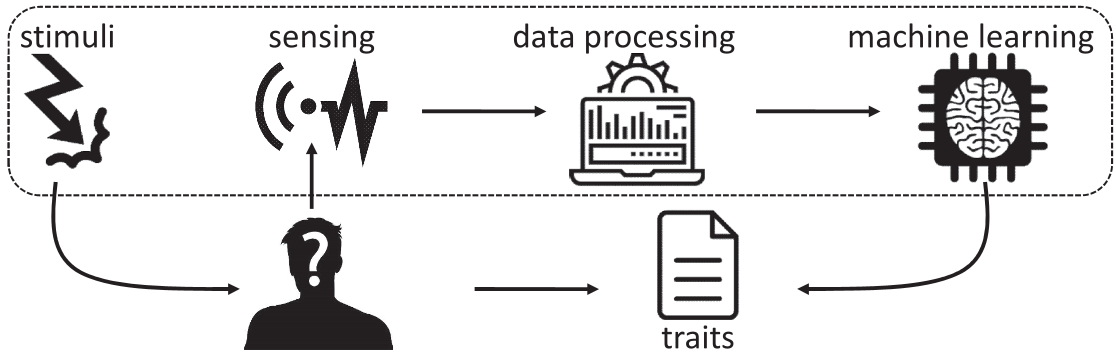 Figure 1: The proposed Personality Sensing Framework, bridging external stimuli and machine learning predictions.
Key Insights: Why Your Pupils and Sweat Matter
The study investigated three major personality models: Dark Triad (darker traits), BIS/BAS (motivation/anxiety), and HEXACO (standard traits + Honesty).
- The "Dark" Eye: Saccade Rate (how fast your eyes move between points) was a dominant predictor for Psychopathy.
- The "Anxious" Pupil: Pupil size was found to be highly predictive of BIS (Behavioural Inhibition System), which relates to fear and anxiety.
- The "Complexity" of Sweat: A novel finding was that Hjorth parameters in GSR signals—measuring the statistical "complexity" of skin conductance—were primary indicators for Narcissism and Conscientiousness.
Experimental Results: Breaking the SOTA
The study compared seven different classifiers. Naive Bayes (NB) emerged as the winner. When combining ETG and GSR signals, the system surpassed previous works by a wide margin.
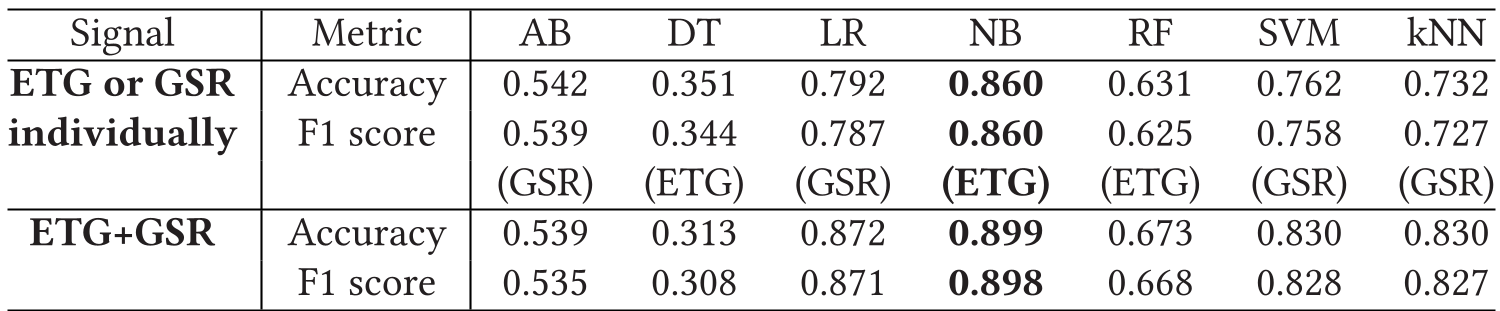 Table: Comparison of ML algorithms. Naive Bayes consistently delivers high accuracy across different sensor modalities.
While previous methods required nearly 90 minutes of data, this framework achieved superior results in under 25 minutes. Most notably, the "Honesty" trait in the HEXACO model—notoriously hard to measure because dishonest people lie on surveys—was predicted with high accuracy, fulfilling the promise of an "objective" lens.
Critical Analysis & Future Outlook
Takeaway: This work represents a shift toward "User-Aware Computing." Imagine a UI that adapts its tone because it knows you score high on Neuroticism, or a job screening tool that isn't fooled by rehearsed interview answers.
Limitations:
- Sample Size: With only 21 subjects, the model needs validation on a larger, more diverse population.
- Extreme Traits: The subjects were mostly students and staff; the model might perform differently for clinical populations or those at the extreme ends of the spectrum.
The future of interaction isn't just about what we click—it's about how our bodies react to what we see. As wearable technology becomes more ubiquitous, your "biological signature" might soon become your most accurate resume.